
Which planets are retrograde right now?
Eight planets, one board: live status from the speed of each, with the station instants and the arc every retrograde retraces.
4 — of the eight planets that retrograde, 4 are retrograde at 2026-09-28 10:53 UTC.
| Planet | Status | Position | Speed (°/day) | This or next retrograde | Stations direct |
|---|---|---|---|---|---|
| Mercury | direct | 27.2° Libra | +1.375 | retrograde from 24 Oct 2026, 07:08 UTC · in 26 days | direct 13 Nov 2026, 15:56 UTC |
| Venus | direct | 8.0° Scorpio | +0.180 | retrograde from 3 Oct 2026, 07:14 UTC · in 5 days | direct 14 Nov 2026, 00:28 UTC |
| Mars | direct | 0.1° Leo | +0.588 | retrograde from 10 Jan 2027, 12:58 UTC · in 104 days | direct 1 Apr 2027, 14:16 UTC |
| Jupiter | direct | 19.1° Leo | +0.183 | retrograde from 13 Dec 2026, 01:30 UTC · in 76 days | direct 13 Apr 2027, 02:34 UTC |
| Saturn | retrograde | 11.7° Aries | -0.078 | since 26 Jul 2026, 18:00 UTC | direct 10 Dec 2026, 22:47 UTC · 73 days |
| Uranus | retrograde | 5.5° Gemini | -0.015 | since 10 Sep 2026, 21:00 UTC | direct 8 Feb 2027, 12:00 UTC · 133 days |
| Neptune | retrograde | 2.9° Aries | -0.028 | since 7 Jul 2026, 12:00 UTC | direct 13 Dec 2026, 00:00 UTC · 76 days |
| Pluto | retrograde | 3.1° Aquarius | -0.008 | since 6 May 2026, 18:00 UTC | direct 16 Oct 2026, 00:00 UTC · 18 days |
Snapshot at 2026-09-28 10:53 UTC. With JavaScript on, the status column is recomputed at load from each planet's current speed (POST /api/objects); the station instants come from the committed table.
Four of the eight planets that retrograde are retrograde as of 2026-09-28 10:53 UTC: Saturn, Uranus, Neptune and Pluto. All of them are outer planets, which spend four to five months of every year retrograde; Mercury, Venus and Mars are direct. The next station is Venus, turning retrograde 3 Oct 2026, 07:14 UTC at 8.4° Scorpio. Status is the sign of each planet's daily motion now; every station instant comes from a 12-hourly Skyfield/JPL DE440 lattice — tropical zodiac, geocentric, UTC.
See what these retrogrades activate in your chart
Computed 2026-09-28 10:53 UTC · Skyfield 1.55 + JPL DE440 via POST /api/objects and POST /api/scan · tropical zodiac, geocentric, times in UTC. The static figures are recomputed on every deploy; the live block refreshes when the page loads. Times are shown in UTC.
What turns next
A station is the instant a planet's apparent motion passes through zero. Each planet's next one, whichever kind it is — the pair of instants around a retrograde is in the table below it.
| Planet | Next turn | When (UTC) | At |
|---|---|---|---|
| Venus | stations retrograde | 8.4° Scorpio | |
| Pluto | stations direct | 3.0° Aquarius | |
| Mercury | stations retrograde | 20.9° Scorpio | |
| Saturn | stations direct | 7.9° Aries | |
| Neptune | stations direct | 1.6° Aries | |
| Jupiter | stations retrograde | 27.0° Leo | |
| Mars | stations retrograde | 10.4° Virgo | |
| Uranus | stations direct | 1.6° Gemini |
Each planet’s current or next retrograde
The pre-shadow begins when the planet first reaches the degree it later turns direct at; the post-shadow ends when it returns to the degree it turned retrograde at. Both are read off the same lattice as the stations.
| Planet | Stations retrograde | Stations direct | Days | Arc | Pre-shadow from | Post-shadow to |
|---|---|---|---|---|---|---|
| Mercury | 20 | 15.9° | ||||
| Venus | 42 | 15.6° | ||||
| Mars | 81 | 19.5° | ||||
| Jupiter | 121 | 10° | ||||
| Saturn | 137 | 6.8° | ||||
| Uranus | 151 | 4° | ||||
| Neptune | 159 | 2.8° | ||||
| Pluto | 162 | 2.4° |
What this means for everyone
What the board measures
A planet is retrograde when its geocentric longitude is decreasing — when the number in the position column is getting smaller from one day to the next. That is the whole test, and it is the same one the transit terminal applies: the sign of the daily motion. The eight bodies here are the ones that ever pass it; the Sun and Moon never move backwards against the zodiac. The board reads all eight at once, and for each one dates the station on either side of now from a single twelve-hourly lattice, so the instant a planet turns is the same instant on every page of this site.
Two kinds of retrograde
The count on this page is mostly a fact about the outer planets. Jupiter, Saturn, Uranus, Neptune and Pluto each retrograde once a year for four to five months — Uranus for 151 days, Neptune for 159, Pluto for 162 — because the retrograde is Earth overtaking them on the inside, and Earth does that every year. So each of them is retrograde around 44% of the time, and two or three of the five are retrograde on most days of any year. That is background, not an event.
The inner three are the other kind. Mercury retrogrades 3 times in 2026 for about three weeks each, retracing 15.9° this time; Venus does it once every nineteen months for around six weeks (42 days from 3 Oct 2026); Mars once every twenty-six months for two and a half (81 days from 10 Jan 2027). These are the retrogrades that read as periods, because they are rare enough to have a before and an after. When the board shows one of them retrograde, that is the row worth reading first.
Collective weather
Every station happens at the same instant for everyone, and the arc a planet retraces is the same band of the zodiac in every chart. The tradition reads a retrograde as a review window for that planet's business — Mercury's messages and arrangements, Venus's valuations, Mars's momentum — and that is a description of a season's texture, shared by everyone living through it. It is not a hazard and this page does not treat it as one.
What the sky-only reading leaves out
Whether a particular retrograde touches you is a question about degrees. The arc is a specific band — 5.0° Scorpio to 20.9° Scorpio for Mercury's next cycle — and a natal planet inside it is crossed three times over the whole cycle, which is a dated personal transit. A natal planet outside it gets the ordinary passing contacts and nothing more. The rows below hand each planet to the place that checks: the transit hubs for the slow planets, the calculator for Mercury, and the app for the full chart.
Why two sites disagree about the dates
A station is one instant in UTC; printed as a date in a publisher's own time zone it can land a day either side. Shadow periods differ more, because sites define them differently — some by the degrees retraced, as here, some by an orb around them. What does not differ is the zodiac: a station is a station in the tropical and the sidereal frame alike, since the longitude stops decreasing at the same moment whatever the zero point. Only the sign named for it changes.
What the instrument claims
It computes eight stations from real positions, dates each to the minute, and measures the arcs and shadows. It does not say what any retrograde brings, and it does not rank this year against another. Where each one sits in your chart is the question the handoff answers.
For your chart specifically
The eight arcs below are the same for every chart; whether one contains a natal point of yours is what makes a retrograde a transit rather than weather. Each row hands off to the page that checks.
How this appears in Cosmic KPI
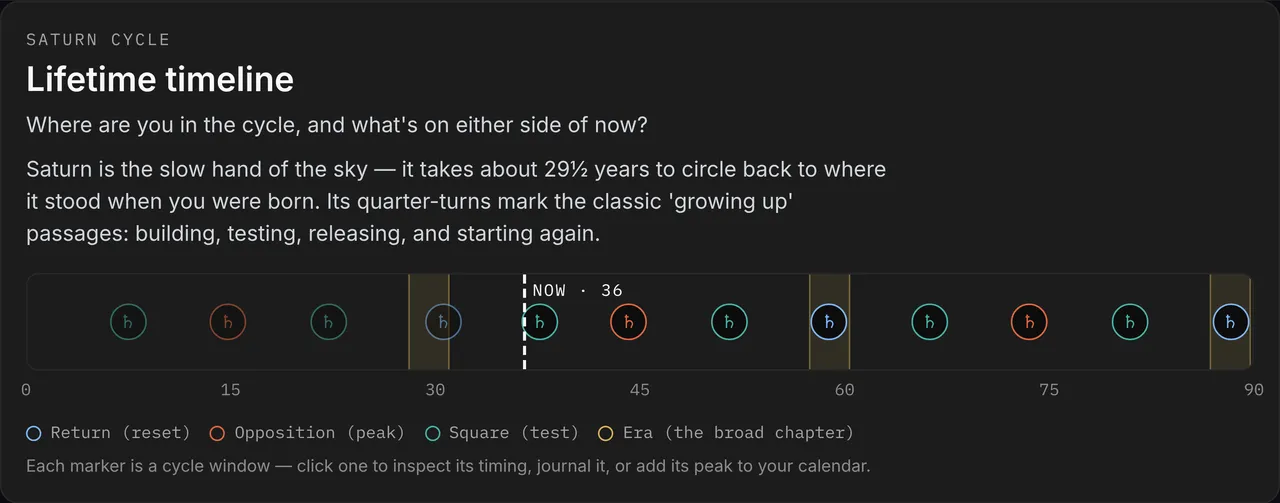
The Retrograde Windows pack in Life Cycles draws every retrograde for every planet across your timeline with its shadow periods shaded, and the terminal flags which of your natal points sit inside each current arc.
See what these retrogrades activate in your chart
Common questions
- Which planets are retrograde right now?
- As of 2026-09-28 10:53 UTC: Saturn, Uranus, Neptune and Pluto. The status column on this page is recomputed from each planet's current speed when the page loads.
- Is it unusual for several planets to be retrograde at once?
- No. The five outer planets are each retrograde for four to five months a year — Pluto 162 days, Neptune 159 — so two or three of them are retrograde on most days. A count of three or four is ordinary; what changes the texture of a period is Mercury, Venus or Mars joining them.
- When is the next planet to go retrograde?
- Venus, stationing retrograde 3 Oct 2026, 07:14 UTC at 8.4° Scorpio. The next station of any kind for each planet is in the table above.
- When is the next Mercury retrograde?
- Mercury stations retrograde 24 Oct 2026, 07:08 UTC at 20.9° Scorpio and direct again 13 Nov 2026, 15:56 UTC at 5.0° Scorpio; its pre-retrograde shadow opens 4 Oct 2026.
- Are retrograde dates different in the sidereal zodiac?
- No. A station is the moment a longitude stops decreasing, and that moment is the same whichever zero point the zodiac is measured from — so the dates on this page hold for both. What changes between the two frames is the sign a station is named in, since sidereal longitudes sit roughly 24° earlier.
- Does a retrograde affect me?
- Only if the arc it retraces contains one of your natal degrees; then the planet crosses that point three times over the cycle, which is a dated personal transit. The hubs date those crossings by natal sign, the Mercury calculator checks from a birth date, and the app computes the full chart.
The words on this page
Every term this layer uses has a definition in the research library — what it means, and what it means for a chart.
Related
Which of these retrogrades cross your chart?
Cosmic KPI computes every retrograde pass against your natal points — the three crossings, dated, with visible math. No account needed to start.
See what these retrogrades activate in your chart →