
Every sign change in 2027
52 ingresses and just one by an outer planet: the year the inner planets do the moving, with every retrograde re-entry marked.
52 sign changes by the Sun and the planets in 2027, with the Moon excluded, and only one by an outer planet: Jupiter into Virgo 26 Jul 2027, 04:49 UTC. 4 are retrograde re-entries — Mercury backing into Aquarius on 18 Feb 2027, Mars backing into Leo on 21 Feb 2027, Mercury backing into Gemini on 26 Jun 2027, Mercury backing into Libra on 16 Oct 2027 — which is why Mercury alone accounts for 18 rows. Mars is retrograde from 10 Jan 2027, 12:58 UTC to 1 Apr 2027, 14:16 UTC. Instants are refined to the minute from Skyfield/JPL DE440 positions; tropical zodiac, geocentric, UTC.
See your own transits, in your chart and your calendar
101 days — to the next: Venus enters Sagittarius, 7 Jan 2027, 08:53 UTC; 0 of 52 listed events have passed as of 2026-09-28 10:53 UTC. The Moon is full at 96.2% illumination now.
With JavaScript on, this line is recomputed at load — the next event counted from the current instant, with the Moon's phase now (POST /api/objects). Without it, the figures are correct as of the snapshot.
Computed 2026-09-28 10:53 UTC · Skyfield 1.55 + JPL DE440 via POST /api/scan (daily) and POST /api/scan/windows · tropical zodiac, geocentric, times in UTC. The static figures are recomputed on every deploy; the live block refreshes when the page loads. Times are shown in UTC.
Every ingress of 2027
Each row is a boundary crossing solved on a fifteen-minute window and interpolated to the degree; the daily lattice only supplies the candidate. Re-entries — a planet crossing back over a boundary while retrograde — carry a badge, and the single outer-planet row is highlighted.
| When (UTC) | Planet | Enters | Note |
|---|---|---|---|
| Venus | Sagittarius | ||
| Mercury | Aquarius | ||
| Sun | Aquarius | ||
| Mercury | Pisces | ||
| Venus | Capricorn | ||
| Mercury | Aquarius | retrograde, backing in | |
| Sun | Pisces | ||
| Mars | Leo | retrograde, backing in | |
| Venus | Aquarius | ||
| Mercury | Pisces | ||
| Sun | Aries | ||
| Venus | Pisces | ||
| Mercury | Aries | ||
| Venus | Aries | ||
| Sun | Taurus | ||
| Mercury | Taurus | ||
| Mercury | Gemini | ||
| Mars | Virgo | ||
| Venus | Taurus | ||
| Sun | Gemini | ||
| Mercury | Cancer | ||
| Venus | Gemini | ||
| Sun | Cancer | ||
| Mercury | Gemini | retrograde, backing in | |
| Venus | Cancer | ||
| Mercury | Cancer | ||
| Mars | Libra | ||
| Sun | Leo | ||
| Jupiter | Virgo | outer planet | |
| Venus | Leo | ||
| Mercury | Leo | ||
| Mercury | Virgo | ||
| Venus | Virgo | ||
| Sun | Virgo | ||
| Mars | Scorpio | ||
| Mercury | Libra | ||
| Venus | Libra | ||
| Sun | Libra | ||
| Mercury | Scorpio | ||
| Venus | Scorpio | ||
| Mars | Sagittarius | ||
| Mercury | Libra | retrograde, backing in | |
| Sun | Scorpio | ||
| Venus | Sagittarius | ||
| Mercury | Scorpio | ||
| Sun | Sagittarius | ||
| Venus | Capricorn | ||
| Mars | Capricorn | ||
| Mercury | Sagittarius | ||
| Mercury | Capricorn | ||
| Venus | Aquarius | ||
| Sun | Capricorn |
Retrograde stations in 2027
The retrogrades that begin in the year. Each Mercury retrograde that straddles a sign boundary produces a re-entry, which is where the year's extra Mercury rows come from.
| Planet | Stations retrograde | Stations direct | Days | Arc |
|---|---|---|---|---|
| Mars | 81 | 19.5° | ||
| Mercury | 22 | 15.1° | ||
| Pluto | 163 | 2.4° | ||
| Mercury | 24 | 8.9° | ||
| Neptune | 159 | 2.8° | ||
| Saturn | 136 | 6.9° | ||
| Uranus | 151 | 4° | ||
| Mercury | 21 | 15.6° |
What this means for everyone
A quiet year for the slow planets
2027 has a single outer-planet ingress: Jupiter into Virgo at 26 Jul 2027, 04:49 UTC. Saturn, Uranus, Neptune and Pluto each stay in the sign they entered earlier — Saturn in Aries, Uranus in Gemini, Neptune in Aries, Pluto in Aquarius — so the long themes the tradition reads from slow-planet signs do not turn over this year; they settle. Where 2026 was a year of thresholds, 2027 is the year after them, and the calendar shows it: one highlighted row where the previous year had four.
Why 52 is more than 2026's count
The bigger number is not a bigger year. It comes from Mercury, which changes sign 18 times because 3 of its retrogrades cross a boundary going backwards: it backs into Aquarius on 18 Feb 2027, Gemini on 26 Jun 2027, Libra on 16 Oct 2027, and every re-entry is counted. Venus adds 15 and Mars 6. Take the re-entries out and the inner planets are doing what they do every year; the count is a fact about where the stations happened to fall, which is a real fact, but a small one.
The year's long retrograde
The event of 2027 for the fast planets is Mars: retrograde from 10 Jan 2027, 12:58 UTC at 10.4° Virgo to 1 Apr 2027, 14:16 UTC at 20.9° Leo, 81 days retracing 19.5°, and backing across the Leo boundary on 21 Feb 2027 on the way. Mars retrogrades only every twenty-six months, so a year that holds a whole one has a different rhythm from one that does not: a band of 20° across two signs that Mars crosses three times over about half a year. That band is the same band in every chart; whether it contains one of your natal points is the personal question.
Counting rules, stated
This page counts the Sun and the nine planets, excludes the Moon (which changes sign every two to three days), and counts a retrograde re-entry as its own row. A table that excludes re-entries gives 48; one that adds the Moon gives a number in the hundreds. Both are consistent with this one once the rule is known, which is why the rule is printed.
The same boundary, a different house
Each ingress is one instant for everyone and one sign for everyone. What the sky-only calendar cannot supply is the house that sign occupies in a given chart, or the natal points that sit in it — and those decide whether Jupiter's arrival in Virgo is the background of the year or a dated contact. The hub for Jupiter dates its contacts by natal sign; the app dates them to the degree.
What the instrument claims
52 boundary crossings and 8 retrograde stations, each an instant. It does not say what any of them brings, and it does not treat the higher count as a busier year.
For your chart specifically
One outer planet changes sign this year and it opens a new run of contacts for every chart. The Mars retrograde retraces the same band for everyone; whether a natal point of yours sits in it is the question.
How this appears in Cosmic KPI
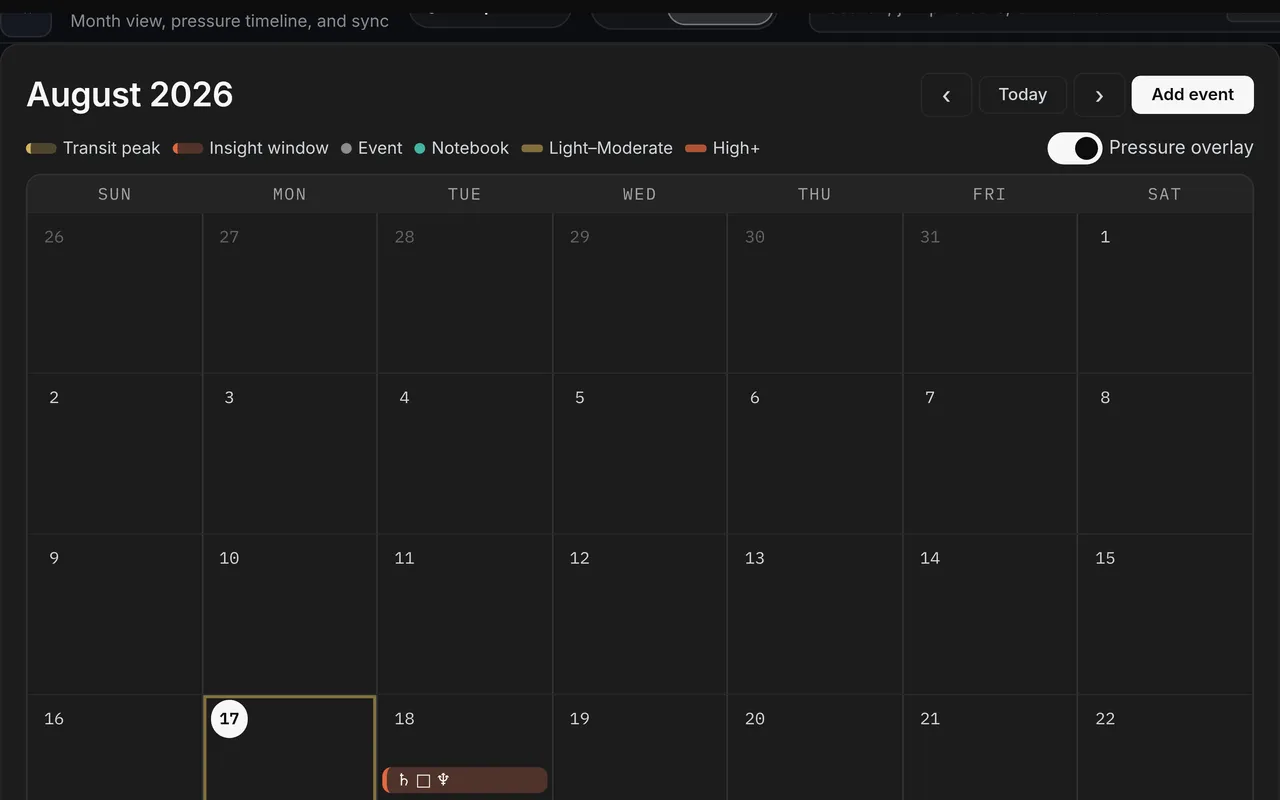
Life Cycles draws every slow planet's sign as a band across your timeline and shades each retrograde with its shadow periods; the calendar marks the ingresses on their days.
See your own transits, in your chart and your calendar
Common questions
- How many sign changes are there in 2027?
- 52, counting the Sun and the nine planets, excluding the Moon, and counting the 4 retrograde re-entries: Venus 15, Mercury 18, Sun 12, Mars 6, Jupiter 1.
- When does Jupiter enter Virgo in 2027?
- 26 Jul 2027, 04:49 UTC. It is the only outer-planet ingress of the year; Saturn, Uranus, Neptune and Pluto stay in their signs.
- When is Mars retrograde in 2027?
- 10 Jan 2027, 12:58 UTC to 1 Apr 2027, 14:16 UTC, from 10.4° Virgo back to 20.9° Leo — crossing back into Leo on 21 Feb 2027. 81 days, 19.5° retraced.
- Why does Mercury change sign 18 times in 2027?
- Its three retrogrades each straddle a sign boundary, so Mercury crosses some boundaries three times — forward, back, forward again — and each crossing is a row. The backward crossings are into Aquarius on 18 Feb 2027 and into Gemini on 26 Jun 2027 and into Libra on 16 Oct 2027.
- When are the equinoxes and solstices of 2027?
- March equinox (Sun into Aries) 20 Mar 2027, 20:24 UTC; June solstice (Sun into Cancer) 21 Jun 2027, 14:10 UTC; September equinox (Sun into Libra) 23 Sep 2027, 06:01 UTC; December solstice (Sun into Capricorn) 22 Dec 2027, 02:42 UTC. The Sun's ingresses are the seasons by definition in the tropical zodiac.
- Does the sidereal zodiac give different ingress dates?
- Yes, by weeks — sidereal longitudes are about 24° behind tropical ones, so every sign boundary is crossed later. The instants here are tropical, which is the frame in which the Sun's ingress into Aries is the equinox; a sidereal table is consistent with itself but not with these dates.
The words on this page
Every term this layer uses has a definition in the research library — what it means, and what it means for a chart.
Related
See what every 2027 sign change does to your chart
Cosmic KPI computes each of these events as a transit to your own natal points — the house, the exact aspects, the time in your zone. No account needed to start.
See your own transits, in your chart and your calendar →