
Your planetary transits, measured, dated, and on your calendar.
Cosmic KPI computes every transit to your birth chart from real ephemeris positions, scores each day’s pressure 0–100, and puts the timing on a calendar you can subscribe to in Google, Apple, or Outlook.
Sixteen working surfaces
One chart in, fifteen working surfaces out — and one that needs no chart at all. Everything below runs on the same canonical scan of your sky.
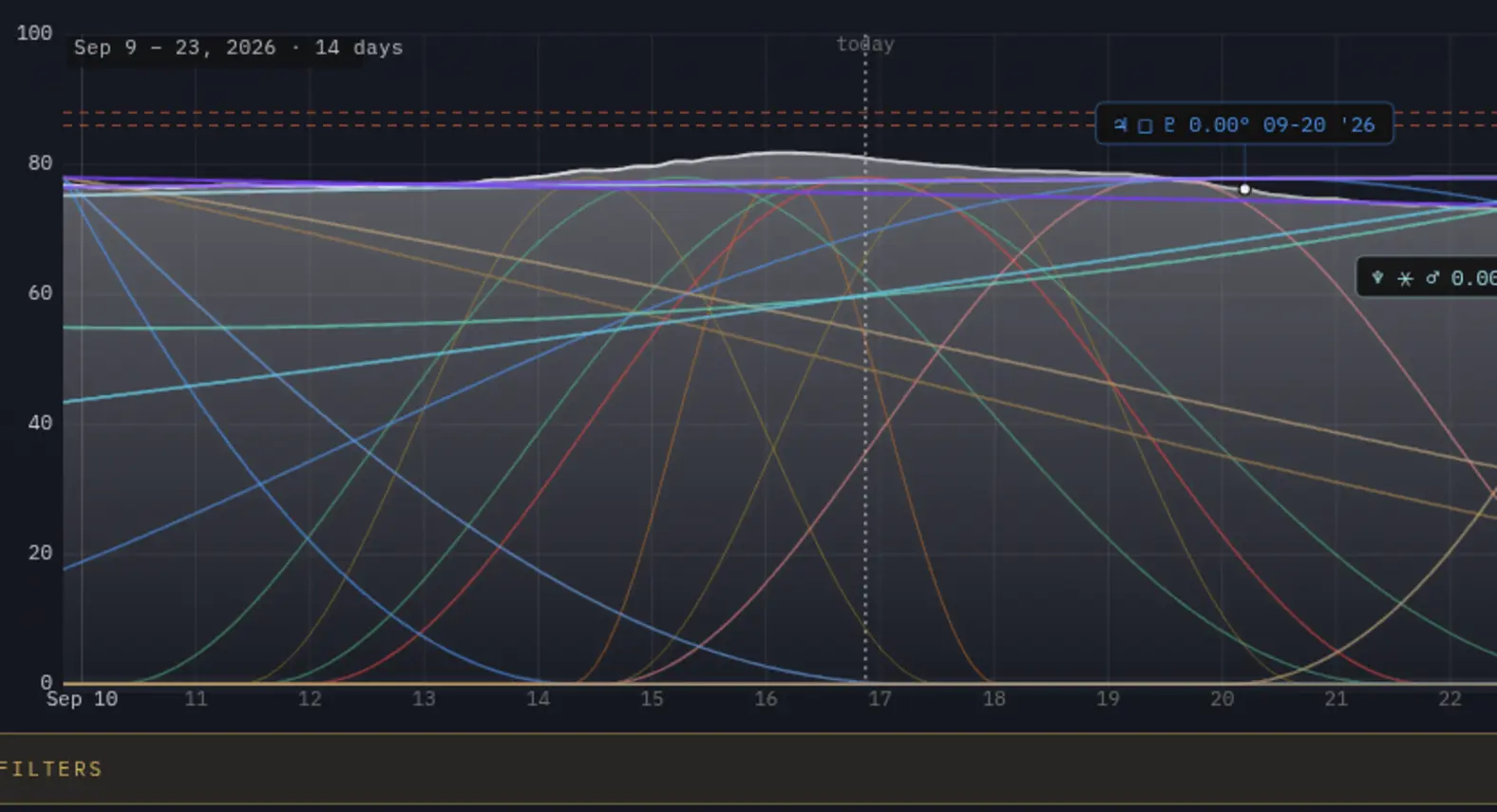
See pressure, not vibes
The 0–100 timeline shows when transits stack up and when they clear — every exact pass labeled and dated.
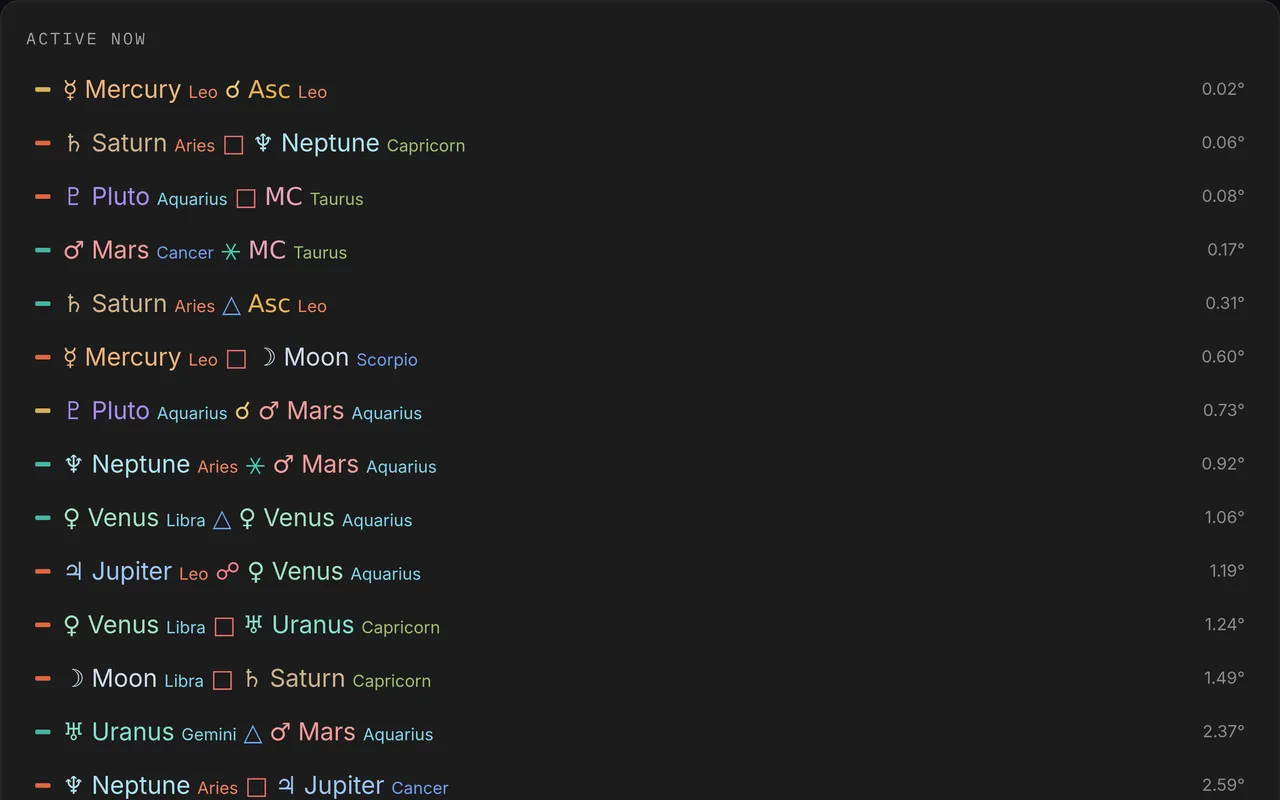
Know what’s active right now
The live transit terminal lists today’s exact aspects, orbs, and peaks.
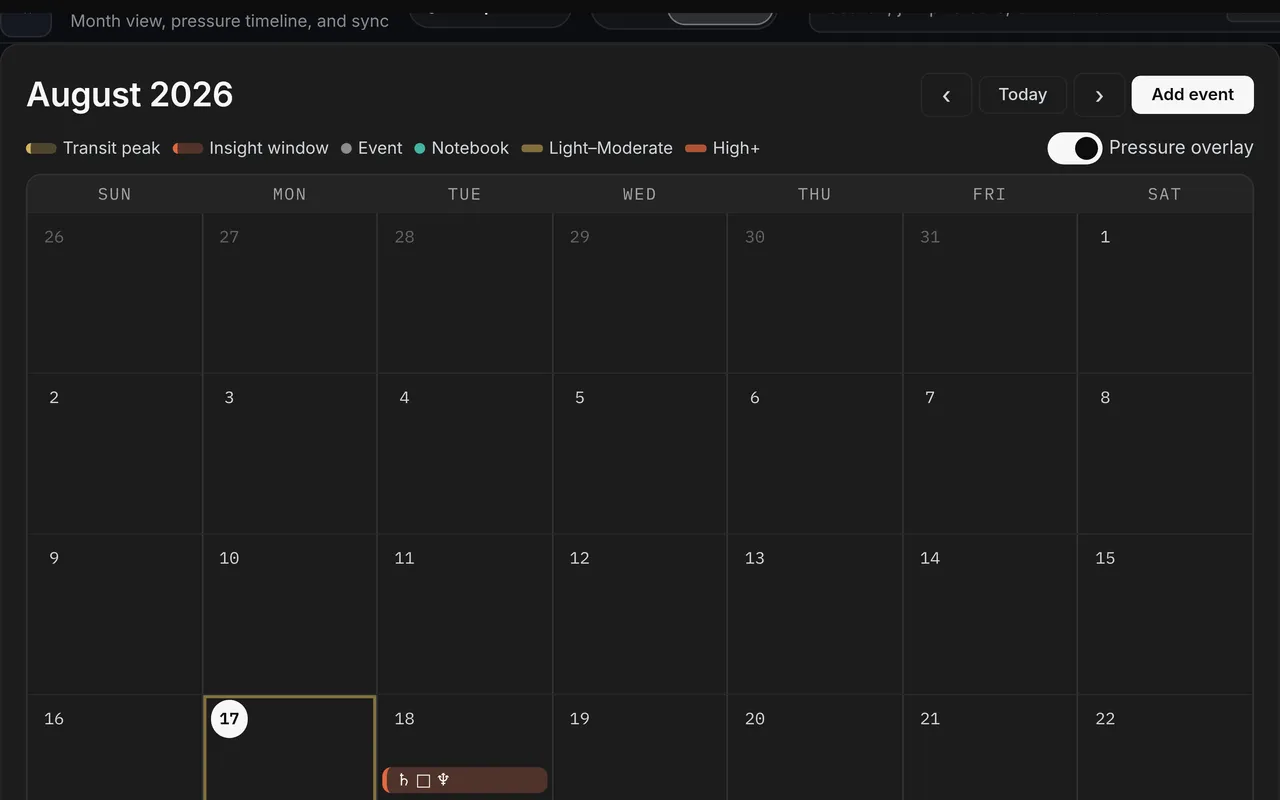
Plan around your sky
A month calendar of your timing windows, with day-by-day detail.
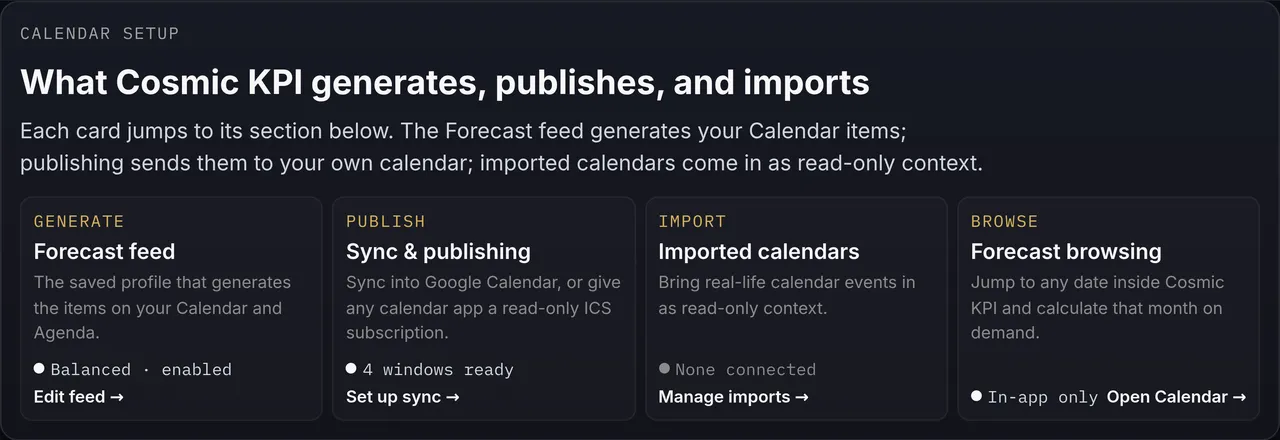
Your transits, in your calendar app
ProSubscribe once in Google, Apple, or Outlook — it stays current on its own.
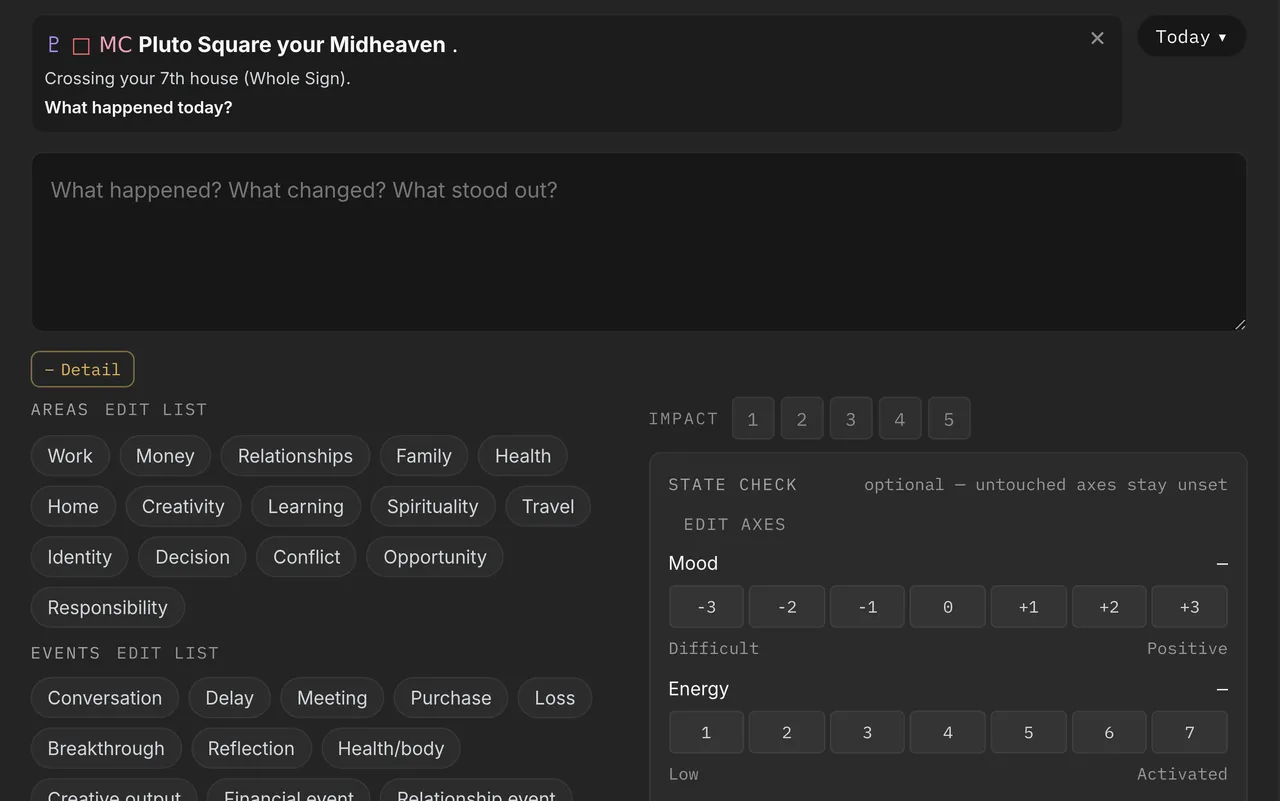
Test it against your life
The notebook logs your days and shows co-occurrence with transits over time.
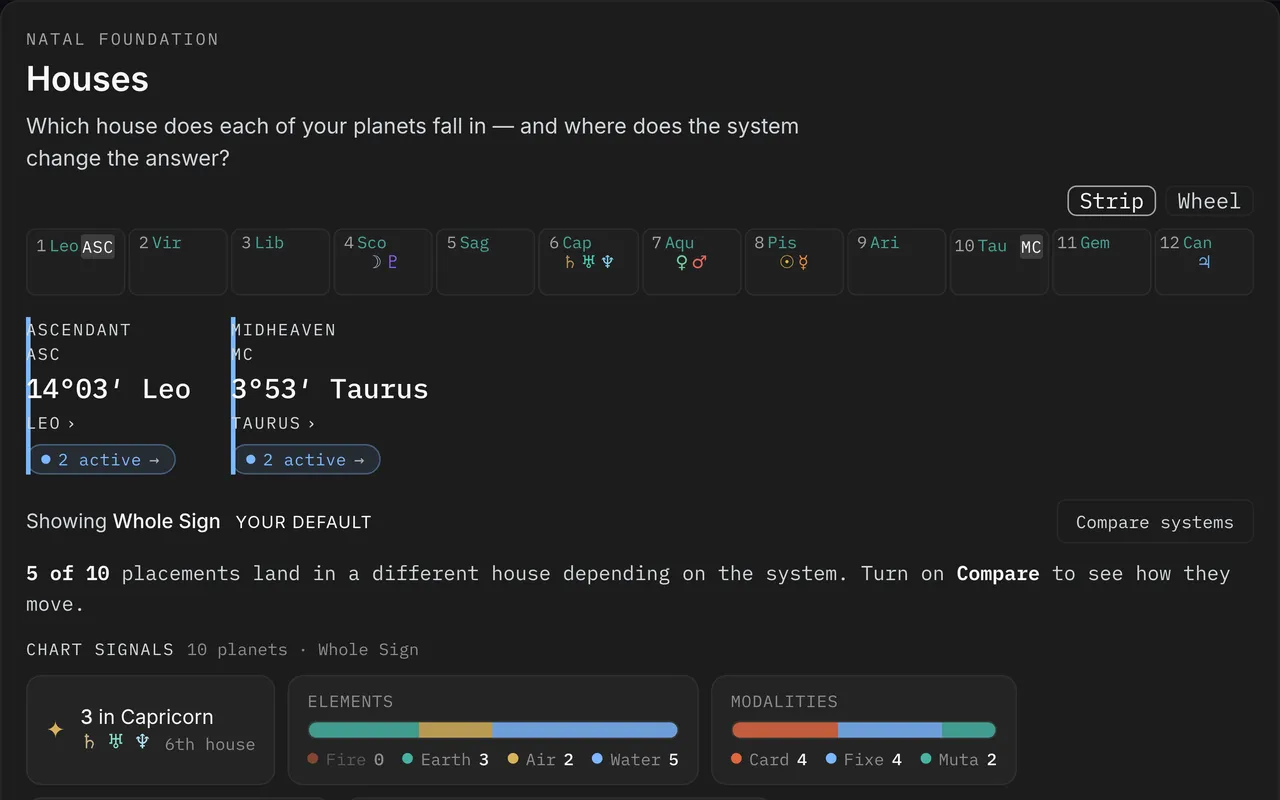
Read your own chart deeply
Natal placements, houses, and aspects with the math visible.
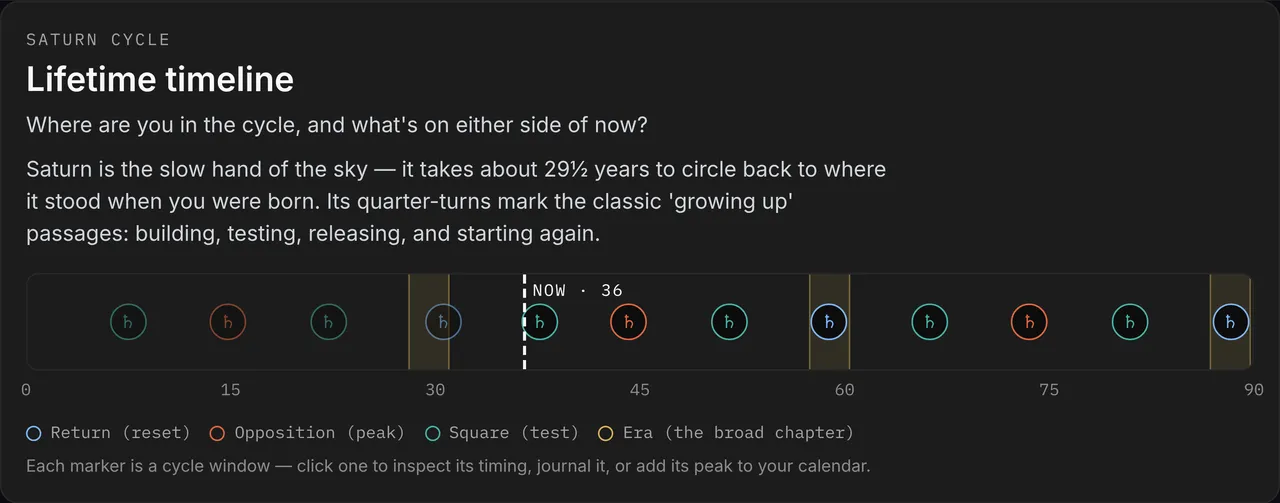
Track the long arcs
Saturn return, Jupiter cycle, nodal cycle, retrogrades — dated, not vague.
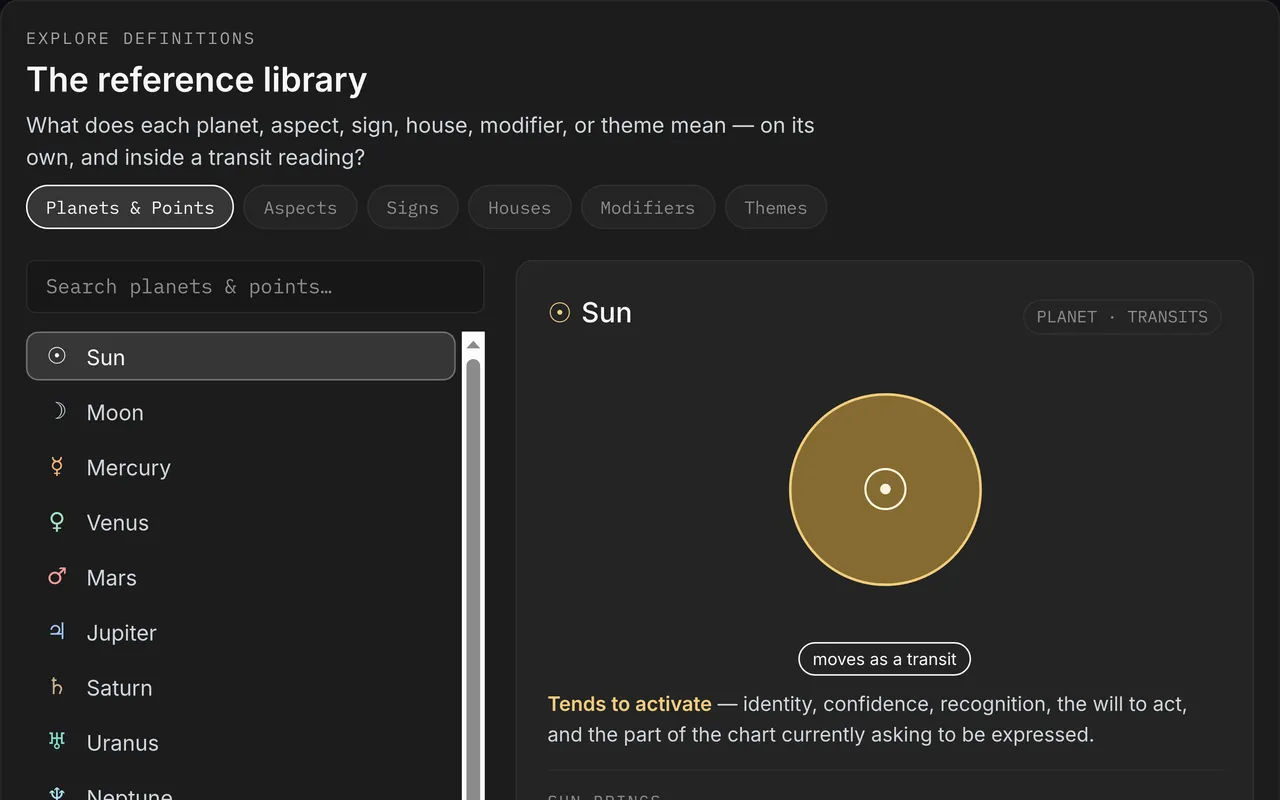
Look it up properly
A 170-page research library that explains each transit and cites its basis.
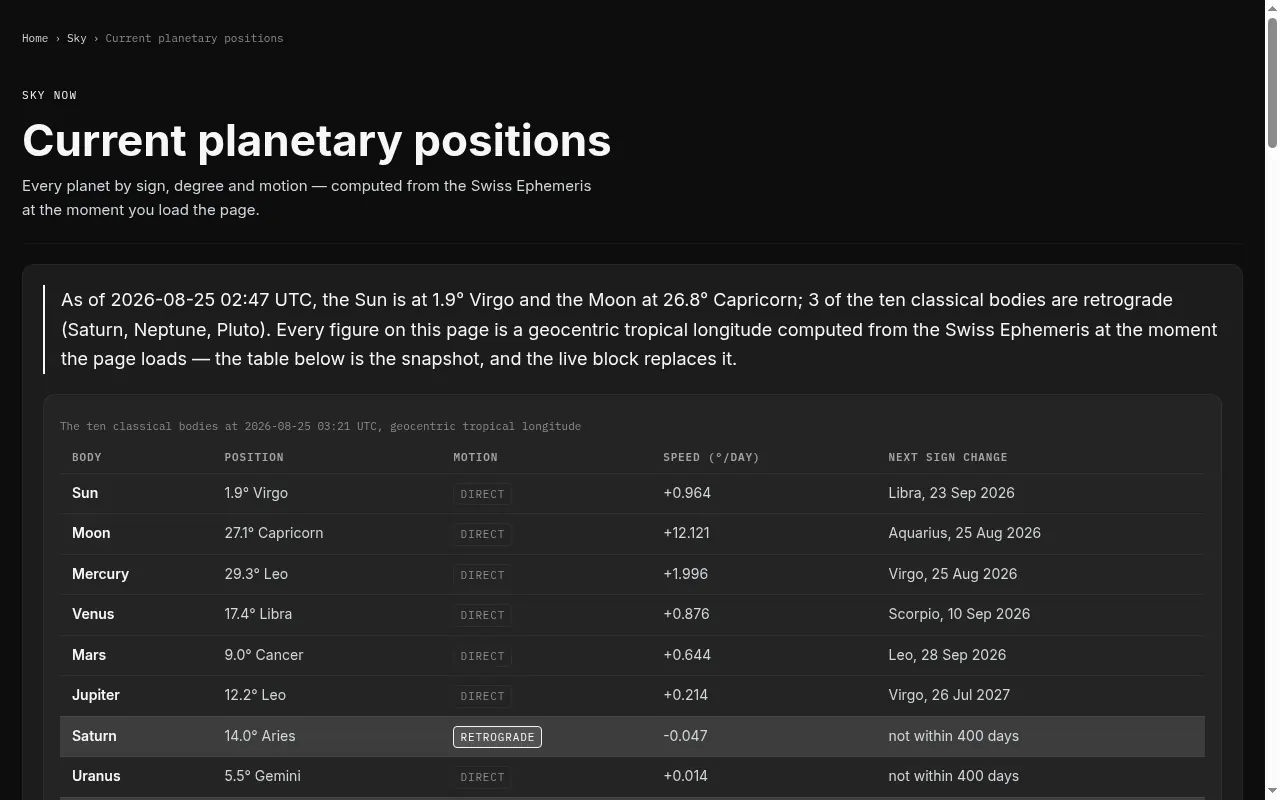
See what the sky is doing right now
Live positions, retrograde status, the Moon, and every coming lunation and sign change — no chart needed.
And when you go deeper
-
Synastry
Pair two charts: the interaspect grid, the composite, and — the part grids don’t show — when transits activate the relationship.
-
People & Ancestry
Family charts on one tree, with cross-chart resonance and the timing patterns that repeat across generations.
-
Echoes
Which past years most resemble now — recurring sky patterns, found in your own chart’s history.
-
Period Briefing
ProAny timeframe summed up — its themes, biggest forces, and moments to hold — exportable as a PDF.
-
Reflection
ProWhen each contact in your chart comes back, beside what you wrote the last time it did.
-
Daily check-in
Rate yesterday on your own dimensions, in under a minute — the series that makes the forecast testable.
-
Evidence
Your saved timing-window feedback and signal history, reviewable in one place.
Read about each surface: Ancestry · Synastry · Notebook · Calendar · Timeline · Transit Terminal · Your Sky · Period Briefing · Natal
How it works
Three steps from birth data to a working timing instrument.
- 1
Enter birth data.
Date, time, place. No account needed to see your sky.
- 2
The engine computes your Key Planetary Indicators.
A Key Planetary Indicator is one measured relationship between a moving planet and a fixed point in your birth chart — computed from real ephemeris positions, dated, and scored so you can see when it applies, peaks, and fades.
The full model, explained → - 3
See them as instruments.
A pressure timeline, a forecast calendar, and a feed your calendar app subscribes to.
Intensity has a shape you can plan with
The pressure timeline turns all of your active transits into one calibrated 0–100 curve over time, so intensity has a shape you can plan with.
When several slow transits tighten at once, the curve climbs; when they release, it clears. Every exact pass sits on the curve as a dated, labeled event, and per-planet filters let you solo the storyline you care about. The score is never a black box: tap any point to open the exact contributors, each with its orb, weight, and dates.
Click any transit and investigate it
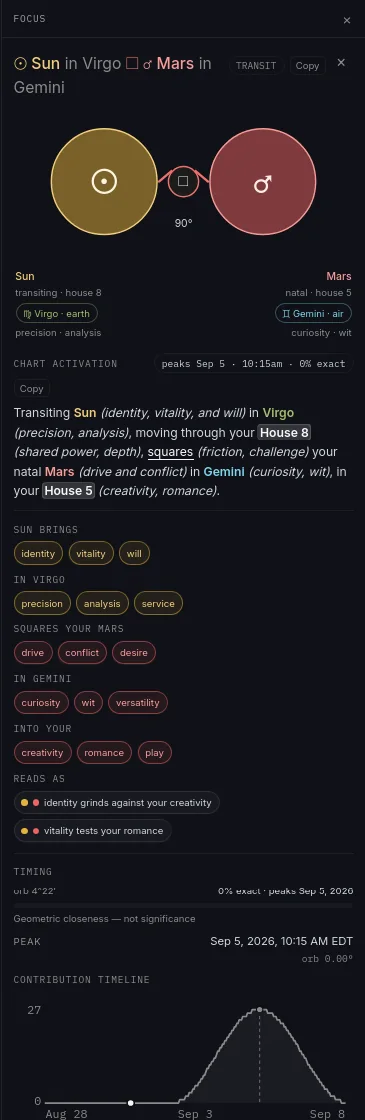
Every transit on the timeline, the terminal, and the calendar can be clicked open and investigated — one panel with the full case for that contact.
The Focus panel reads the aspect in plain language — what each planet brings, what it presses on in your chart, and the houses it runs through. Below that: the activation window with its peak timed to the minute, the contact’s own contribution curve, where it lands in your chart, and a what-if row that re-reads the pair as any other aspect. From the same panel you can add the window to your calendar, take a note under it, open the research page behind it, or mark whether the window resonated — evidence for your own record.
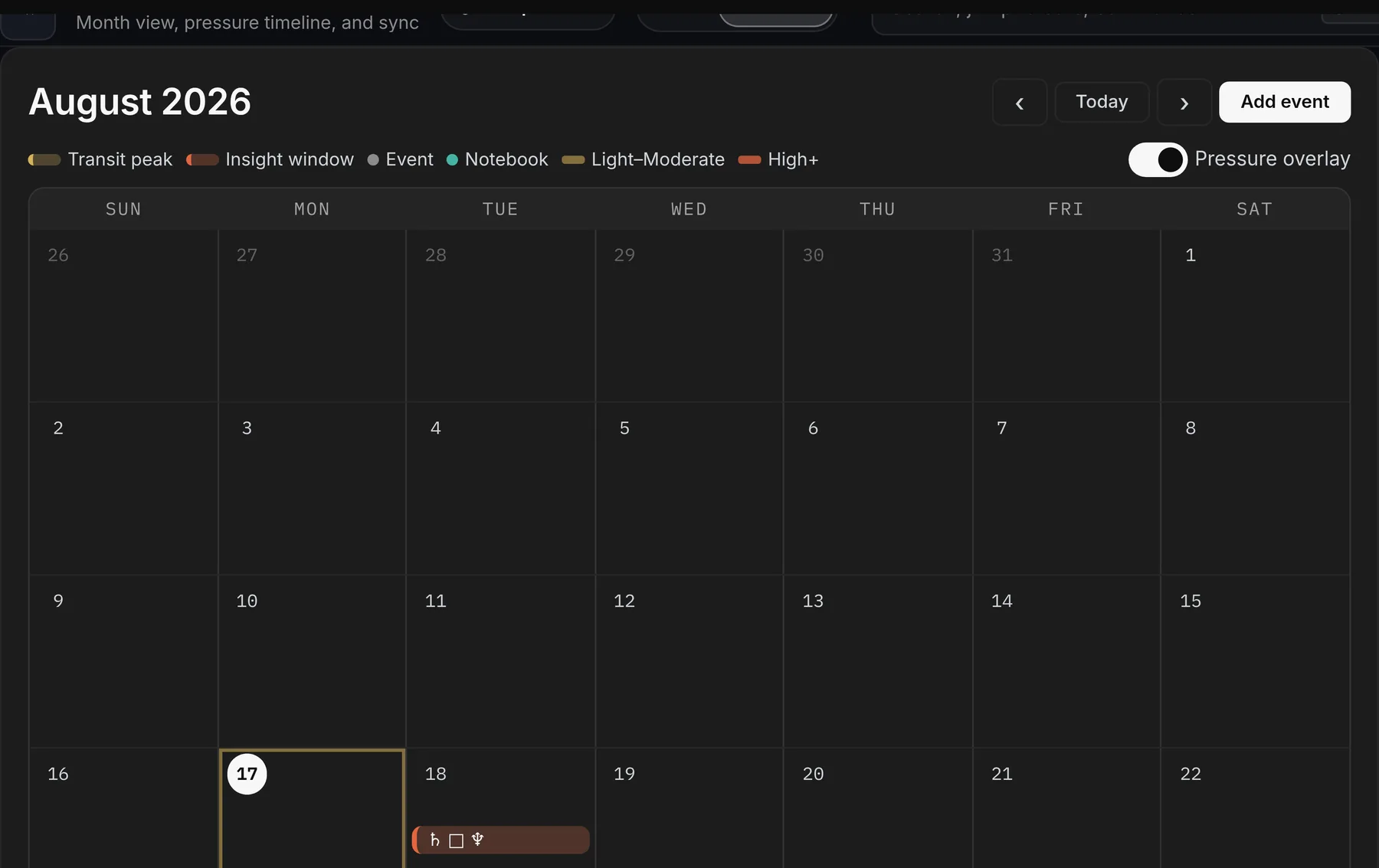
Your windows arrive where you already plan
Calendar Sync publishes your transit timing as a private calendar feed. Subscribe once in Google, Apple, or Outlook and your windows arrive where you already plan your life.
Each event is a timing window with a plain-language title: when it opens, when it’s exact, when it lets go. The feed updates itself nightly as your windows evolve, stays timezone-correct, and supports direct Google push — nothing to export or re-import, ever.
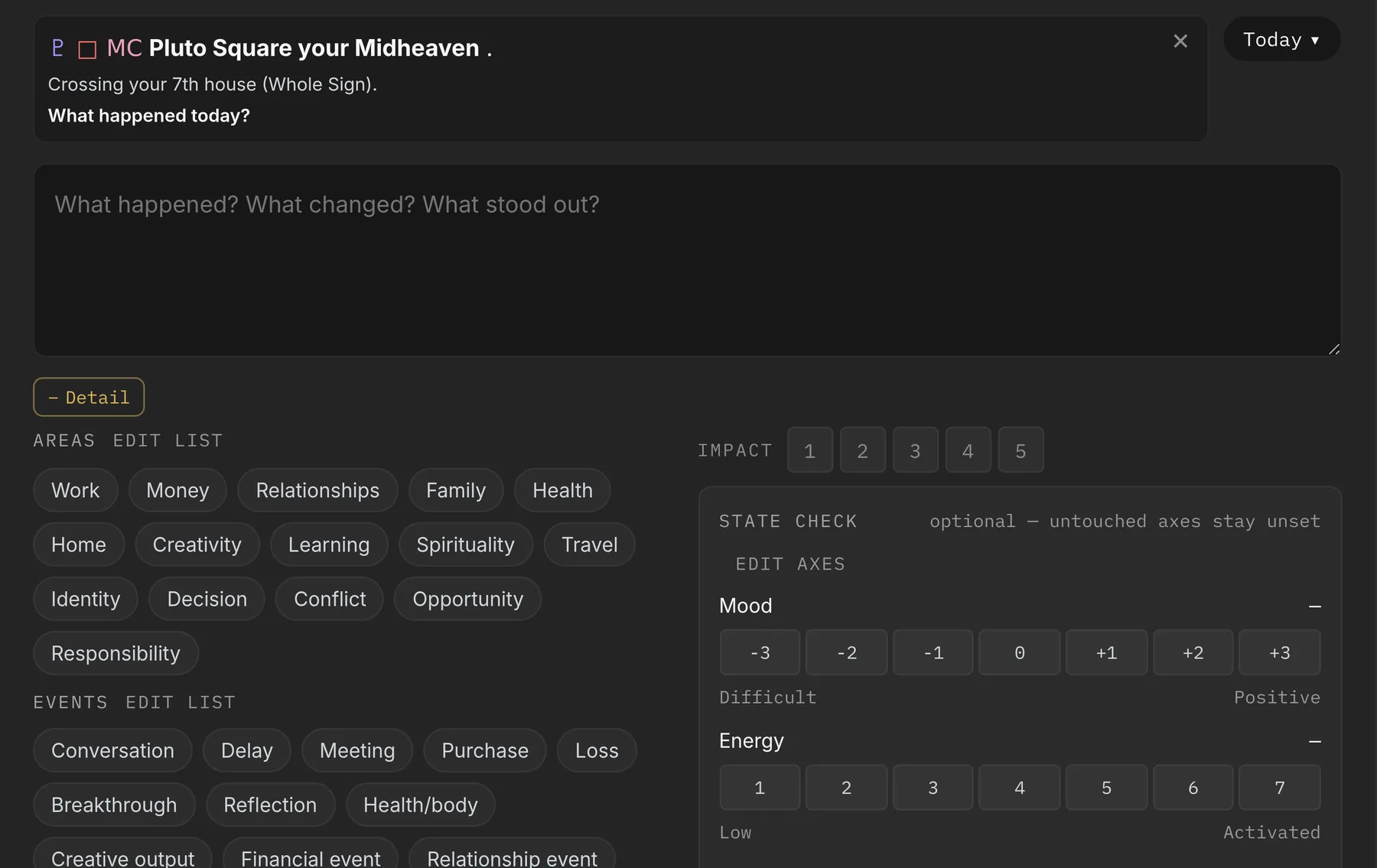
Where the instrument meets your life
The notebook is where the instrument meets your life: log a day in a sentence, and over time see which entries co-occur with which transits.
Every entry is saved with a snapshot of the sky it was written under. The evidence view maps entries against transits over months, and recurrence brings the past forward: the last time Saturn was here, here’s what you wrote. The product measures co-occurrence; you judge the meaning.
The sky itself, in your calendar app, with no account
Four calendar subscriptions carrying the collective sky — new and full moons, eclipses, sign ingresses, retrograde stations and the retrograde periods between them — each computed with Skyfield from JPL DE440 and dated to the minute. No account, no email, no birth details.
These are the one part of Cosmic KPI that asks nothing of you, and they can be, because every event in them is true at the same instant for everyone: a new moon at 12:01 UTC is that new moon in Lima and in Sydney. So each one ships as a UTC instant with no time zone attached and your calendar app places it in yours — the minute stands, rather than a date someone rounded it to. Each event is keyed by its own cycle rather than by its timestamp, which is the part most feeds get wrong: recomputing the sky on a newer ephemeris moves a time in place instead of deleting the event and creating a stranger beside it, so a reminder you set survives the refresh.
The whole sky
Moons, eclipses, sign ingresses and retrograde stations in one calendar — the one to take if you would rather not decide.
Moons and eclipses
Every new and full moon, with the eclipses among them on their own instant. No planets, no sign changes.
Sign changes and stations
Every ingress, and the minute each planet turns retrograde and the minute it turns direct again.
Retrograde periods as bands
The same retrogrades drawn as one banner from station to station, with the shadow dates around each.
The snapshot behind all four is recomputed weekly and the calendars are regenerated with it; your app picks the change up on its own schedule. What any of these events lands on in your own chart is the part that needs a chart — every entry carries the link to it.
Choose a calendar and subscribe →An instrument, not an oracle
Cosmic KPI is an instrument, not an oracle: it computes, dates, and displays — interpretation stays yours.
- Positions come from Skyfield and NASA JPL’s DE440 ephemeris, computed server-side for your exact birth moment and for every hour of the scan window.
- One canonical scan configuration — a 3° envelope, sampled hourly — so every surface reads the same records.
- Scores are calibrated to your own chart’s range, and every number opens to show its basis: the transits, the orbs, the weights.
- The same analysis math runs in the browser and on the server, and the two are compared in CI — divergence fails the build.
Free and Pro
Free is a working instrument, not a teaser. Pro adds the publish loop — your timing delivered to your own calendar — plus the full horizon.
Free
- Your chart computed and saved
- Pressure timeline
- Live transit terminal
- Calendar and day detail
- Notebook and daily check-in
- Synastry overview and family charts
- Life cycles
- Full research library
Pro
- Calendar feed — subscribe in Google, Apple, or Outlook
- Direct Google Calendar push
- Full timeline horizon and the long-range frame
- Period Briefing and day-inspector PDF reports
- Synastry timing and relationship reports
- Reflection — notebook patterns and transit snapshots
- Full Echoes analysis
- Chart library
No card. Nothing is charged today — these are the prices you’ll see when checkout opens.
Start freeCommon questions
What is a planetary transit calendar?
A calendar of the periods when moving planets form exact angles to the positions in your birth chart. Cosmic KPI computes those windows from real ephemeris data and publishes them as a subscribable feed, so they appear in Google, Apple, or Outlook alongside your normal events.
What is a Key Planetary Indicator?
A Key Planetary Indicator is one measured relationship between a moving planet and a fixed point in your birth chart — computed from real ephemeris positions, dated, and scored so you can see when it applies, peaks, and fades.
How accurate are the calculations?
Positions come from Skyfield, the MIT-licensed astronomy library, computing on the DE440 planetary ephemeris published by NASA’s Navigation and Ancillary Information Facility at the Jet Propulsion Laboratory. Scans sample hourly, and every score can be opened to show the exact transits and weights behind it.
Do I need my exact birth time?
No — you can mark the time unknown and still get every planet-to-planet transit. An exact time adds the house-based signals, and the app labels which indicators depend on it.
What’s included in Pro?
The calendar feed (an ICS subscription plus direct Google push), the full timeline horizon including the long-range frame, Period Briefing and day-inspector PDF reports, synastry timing, notebook pattern analytics, and the chart library. Free keeps the working core: your chart, the timeline, the terminal, the notebook, and the research library.
Can I compare two charts?
Yes — Synastry pairs any two charts with the interaspect grid and the composite, and the timing layer shows when transits activate the relationship itself. People & Ancestry goes wider: family charts on one tree, with the resonance and repeating timing patterns across them.
How does calendar sync work?
Pro generates a private feed URL; you subscribe to it once in your calendar app. The feed updates itself nightly as your windows evolve — nothing to export or re-import.
How is this different from a horoscope app?
Everything here is computed from your own chart, not your sun sign, and every signal shows its astronomical basis — the transit, the orb, the dates. The app measures and dates; what it means for you stays your call.
A precision instrument for planetary timing.
Enter your birth data. See your sky in a minute. Free.
Start free