Current planetary positions
Every planet by sign, degree and motion — computed with Skyfield from JPL DE440 at the moment you load the page.
As of 2026-09-28 10:53 UTC, the Sun is at 5.3° Libra and the Moon at 27.7° Aries; 4 of the ten classical bodies are retrograde (Saturn, Uranus, Neptune, Pluto). Every figure on this page is a geocentric tropical longitude computed with Skyfield from JPL DE440 at the moment the page loads — the table below is the snapshot, and the live block replaces it.
See these positions against your chart
| Body | Position | Motion | Speed (°/day) | Next sign change |
|---|---|---|---|---|
| Sun | 5.3° Libra | direct | +0.981 | Scorpio, 23 Oct 2026 |
| Moon | 27.7° Aries | direct | +14.003 | Taurus, 28 Sep 2026 |
| Mercury | 27.2° Libra | direct | +1.375 | Scorpio, 30 Sep 2026 |
| Venus | 8.0° Scorpio | direct | +0.180 | Libra, 25 Oct 2026 (backing in, retrograde) |
| Mars | 0.1° Leo | direct | +0.588 | Virgo, 25 Nov 2026 |
| Jupiter | 19.1° Leo | direct | +0.183 | Virgo, 26 Jul 2027 |
| Saturn | 11.7° Aries | retrograde | -0.078 | not within 400 days |
| Uranus | 5.5° Gemini | retrograde | -0.015 | not within 400 days |
| Neptune | 2.9° Aries | retrograde | -0.028 | not within 400 days |
| Pluto | 3.1° Aquarius | retrograde | -0.008 | not within 400 days |
| Point | Position | Motion |
|---|---|---|
| Chiron | 29.5° Aries | retrograde |
| North Node (mean) | 27.8° Aquarius | retrograde |
| South Node (mean) | 27.8° Leo | derived |
| Black Moon Lilith (mean) | 1.5° Capricorn | direct |
| Ceres | 15.3° Cancer | direct |
| Pallas | 16.1° Aries | retrograde |
| Juno | 26.1° Capricorn | direct |
| Vesta | 23.6° Aries | retrograde |
Snapshot at 2026-09-28 10:53 UTC. With JavaScript on, this block is recomputed for the current instant from POST /api/objects (one request, about 2 KB).
Computed 2026-09-28 10:53 UTC · Skyfield 1.55 + JPL DE440 via POST /api/objects and POST /api/scan · tropical zodiac, geocentric, times in UTC. The static figures are recomputed on every deploy; the live block refreshes when the page loads. Times are shown in UTC.
What turns next
The Sun and Moon never retrograde. For the other eight, the next station — the moment the planet appears to stop and reverse, or to resume — with the time of day.
| Planet | Now | Next turn | When (UTC) |
|---|---|---|---|
| Mercury | direct | stations retrograde | |
| Venus | direct | stations retrograde | |
| Mars | direct | stations retrograde | |
| Jupiter | direct | stations retrograde | |
| Saturn | retrograde | stations direct | |
| Uranus | retrograde | stations direct | |
| Neptune | retrograde | stations direct | |
| Pluto | retrograde | stations direct |
Tightest aspects in the sky right now
TIGHTEST PAIR · NEPTUNE SEXTILE PLUTO
no exact crossing in the forward list
Geometric closeness — not significance
| Pair | Aspect | Orb | Phase |
|---|---|---|---|
| Neptune – Pluto | sextile | 0.21° | separating |
| Sun – Uranus | trine | 0.23° | applying |
| Moon – Mercury | opposition | 0.55° | separating |
Snapshot at 2026-09-28 10:53 UTC. With JavaScript on, the pair and the rows are recomputed at load from the same POST /api/objects response.
Planet-to-planet only: no birth chart is involved. The full grid with every pair in orb, applying and separating, is on the aspects page.
What this means for everyone
What this page measures
A planetary position is a single number: the ecliptic longitude of a body as seen from Earth, measured from 0° Aries along the tropical zodiac. Everything else on the page is derived from it — the sign is the 30° segment it falls in, the degree is the remainder, the motion flag is the sign of its daily change. The ephemeris behind the numbers is the DE440 planetary ephemeris published by NASA’s Navigation and Ancillary Information Facility at the Jet Propulsion Laboratory, read with the MIT-licensed Skyfield library, and the positions are computed at the instant you load the page rather than copied from a monthly table. A position is not an interpretation. It is the measurement every interpretation starts from.
The sky is the same for everyone
Nothing on this page depends on a birth chart, and nothing on it is personal. When Saturn is at 11.7° Aries it is at 11.7° Aries for every person on Earth; the collective weather of a period is set by where the slow planets are and which angles they hold to each other. That is the layer this page shows. It colours the themes of a season — a Saturn–Neptune conjunction at the start of Aries, three outer planets changing sign in one year — without saying anything about how a particular person meets them.
How it lands for you is a different question, and it has a different answer for every chart. A transit is a relationship between a moving planet and a fixed point in a birth chart, and the fixed point is the part this page cannot supply. Saturn in the middle of a cardinal sign is a long, wide plateau for someone with a planet there and background for someone whose chart it does not touch. The handoff below is where the sky-only reading becomes a chart-specific one.
Reading the motion column
Speed is the most underused column in an ephemeris. Mercury at +1.4°/day is slowing toward a station; Saturn at -0.08°/day is retrograde and spends months re-treading a few degrees. A planet near zero speed is at or near a station, and a station is where a transit lingers — the slower a planet moves across a degree, the longer any contact to that degree stays in orb. The “what turns next” table gives each station as an instant, and the transit hubs give the arc each retrograde retraces.
What the figures cannot tell you
These are geocentric tropical longitudes with no latitude, no declination and no house. A house requires a birth time and place; declination is a second coordinate this page deliberately leaves out to stay readable. The instrument measures and dates; the reading is yours.
For your chart specifically
The sky above is the same for every chart. Where it lands is not. Each slow planet below is in the middle of a multi-year transit to some part of every birth chart — the hubs date those contacts by natal sign, and the app dates them to your exact degrees.
How this appears in Cosmic KPI
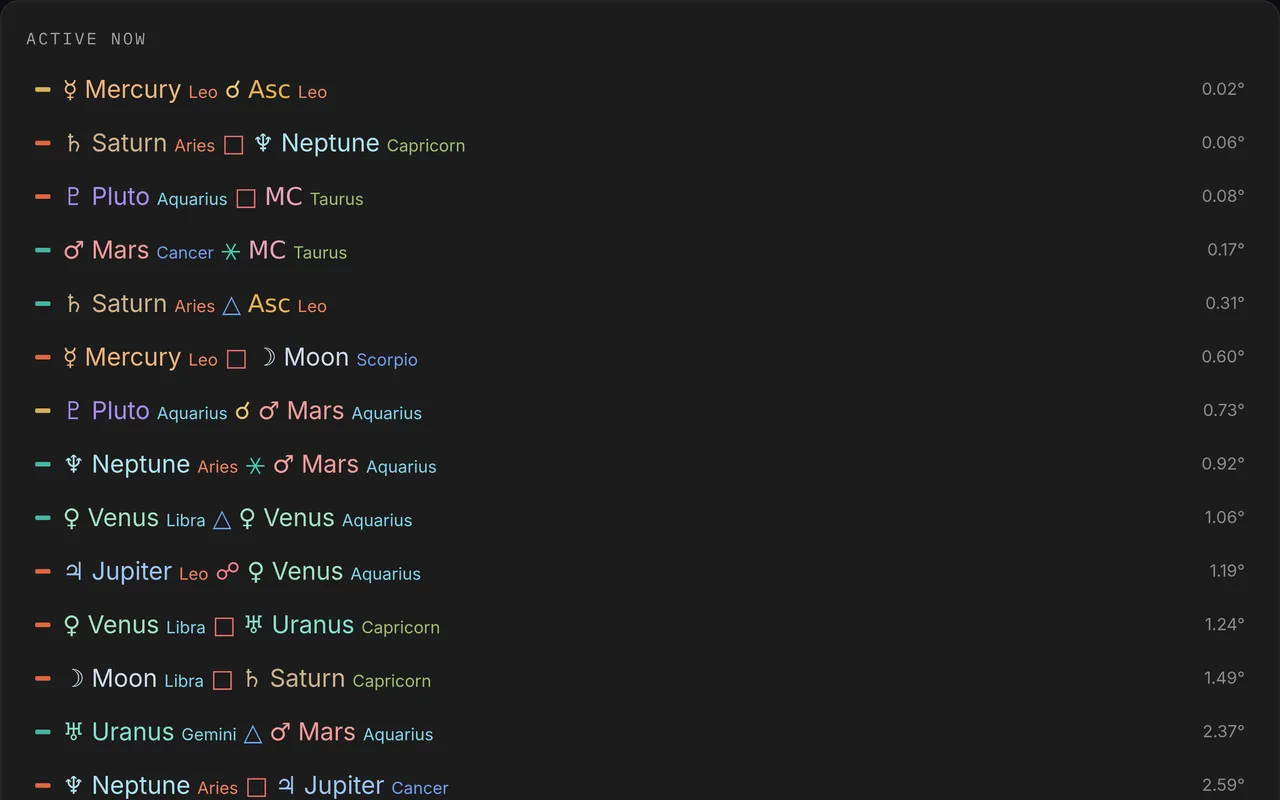
The transit terminal shows the same positions against your own chart — every contact currently in orb, its exact orb reading, applying or separating — and the sky map draws the live wheel with your natal chart inside it.
See these positions against your chart
Common questions
- Which planets are retrograde right now?
- As of 2026-09-28 10:53 UTC: Saturn, Uranus, Neptune, Pluto. The live block on this page recomputes the answer when you load it; the station instants for every planet are in the table above.
- What sign is the Moon in today?
- Aries, at 27.7° Aries as of 2026-09-28 10:53 UTC. The Moon moves about 12–13° a day, so its sign changes every two to three days.
- Are these positions tropical or sidereal?
- Tropical: longitudes are measured from the March equinox point (0° Aries), which is the convention in Western astrology. A sidereal table will show every body roughly 24° earlier, which is why two sites can disagree about which sign a planet is in.
- How accurate are the positions?
- They come from Skyfield with NASA JPL’s DE440 ephemeris, which is accurate to well under an arcsecond for the planets. The page rounds to a tenth of a degree for readability; the underlying value is not rounded.
- How do I see what these planets are doing to my chart?
- Enter your birth details and the app computes every contact the current sky makes to your natal points, dated and scored. No account is needed to see it.
The words on this page
Every term this layer uses has a definition in the research library — what it means, and what it means for a chart.
Related
See what this sky is doing to your chart
Cosmic KPI computes every contact the current sky makes to your natal points — exact dates, visible math, your own chart. No account needed to start.
See these positions against your chart →