Full Moon, January 2027
22 Jan 2027, 12:17 UTC · Moon 2.2° Leo opposite Sun 2.2° Aquarius · 6 full moons running at 2°
The Full Moon of January 2027 is exact 22 Jan 2027, 12:17 UTC, the Moon at 2.2° Leo opposite the Sun at 2.2° Aquarius, not an eclipse — 53 hours after the Sun entered Aquarius. It is the fourth of 6 consecutive full moons at about 2° of their sign (2.7° Taurus on 26 Oct 2026, 2.3° Gemini on 24 Nov 2026, 2.2° Cancer on 24 Dec 2026, 2.2° Leo on 22 Jan 2027, 2.0° Virgo on 20 Feb 2027, 1.5° Libra on 22 Mar 2027). Mars is retrograde throughout, since 10 Jan 2027. In New York that reads 22 Jan, 07:17 EST; London reads 22 Jan, 12:17 GMT; Sydney reads 22 Jan, 23:17 AEDT.
See what this lunation lands on in your chart
116 days — to exact, counted from 2026-09-28 10:53 UTC; the Moon is full at 96.2% illumination now.
With JavaScript on, this line becomes a live countdown with the Moon's current phase and illumination (POST /api/objects). Without it, the figure is correct as of the snapshot.
Computed 2026-09-28 10:53 UTC · Skyfield 1.55 + JPL DE440 via POST /api/scan (Sun + Moon, hourly) and POST /api/eclipses · tropical zodiac, geocentric, times in UTC. The static figures are recomputed on every deploy; the live block refreshes when the page loads. Times are shown in UTC.
The cycle around it
| Phase | Exact (UTC) | Moon at | Sun at | Note |
|---|---|---|---|---|
| Full Moon | 2.2° Cancer | 2.2° Capricorn | ||
| Last Quarter | 9.0° Libra | 9.0° Capricorn | ||
| New Moon | 17.3° Capricorn | 17.3° Capricorn | ||
| First Quarter | 25.4° Aries | 25.4° Capricorn | ||
| Full Moon | 2.2° Leo | 2.2° Aquarius | this page | |
| Last Quarter | 9.2° Scorpio | 9.2° Aquarius | ||
| New Moon | 17.6° Aquarius | 17.6° Aquarius | annular solar eclipse | |
| First Quarter | 25.3° Taurus | 25.3° Aquarius |
Sun into Aquarius, 20 Jan 2027, 07:29 UTC — 2 days before this full moon.
What this means for everyone
The plateau in the drift
Each full moon falls roughly 29° after the last, a little short of a whole sign, so across a year the full-moon degree slides slowly backwards through the signs. Twice a year the slide passes through the start of the signs, and for a few months in a row the full moons land at nearly the same early degree of successive signs. That is where this one sits: 26 Oct 2026 at 2.7° Taurus, 24 Nov 2026 at 2.3° Gemini, 24 Dec 2026 at 2.2° Cancer, 22 Jan 2027 at 2.2° Leo, 20 Feb 2027 at 2.0° Virgo, 22 Mar 2027 at 1.5° Libra — 6 in a row within a degree of 2°, one sign further on each month. The fact is arithmetic, and it is checkable against the table on the year page; it is also the reason anyone with a natal point in the first degrees of a sign gets a run of exact full-moon contacts this winter rather than one.
2.2° Leo, 53 hours into Aquarius season
The Sun entered Aquarius at 20 Jan 2027, 07:29 UTC, so the opposition falls in the first degrees of the Leo–Aquarius axis — fixed fire against fixed air, which the tradition reads as the self shown against the group joined, the performer against the audience. The Wolf Moon in the traditional naming. A full moon early in a fixed sign is the axis at its most settled, and the reading belongs to the fortnight for everyone alike.
Under a Mars retrograde
Mars has been retrograde since 10 Jan 2027, 12:58 UTC, when it stationed at 10.4° Virgo, and stays so until 1 Apr 2027; this is the first full moon inside the retrograde. Mercury enters its pre-retrograde shadow 25 Jan 2027, days after the full moon, ahead of its station on 9 Feb 2027. At the instant Mars, Jupiter and Uranus are retrograde. A culmination during the slow planet's review is the collective texture of the fortnight — momentum re-examined rather than pushed — and a month page can carry that only because the station table sits beside the lunation table.
What a chart adds
A natal planet or angle near 2.2° of Taurus, Leo, Scorpio or Aquarius takes an exact hard aspect from this full moon — and, this winter, from its neighbours. A natal point in Mars's arc (20.9° Leo–10.4° Virgo) is in a slower transit that outlasts the lunation. Where in the chart the Moon lights up is the birth time's and place's to say, so the handoff asks for them.
What the instrument claims
An instant and two degrees, a run counted from the table, a station table read for context. Not a verdict on the fortnight.
For your chart specifically
The Moon is at 2.2° Leo, the 4th of 6 full moons at that degree. Which house it lights, and whether the early degrees of the fixed signs carry a natal point of yours, is the chart's question.
How this appears in Cosmic KPI
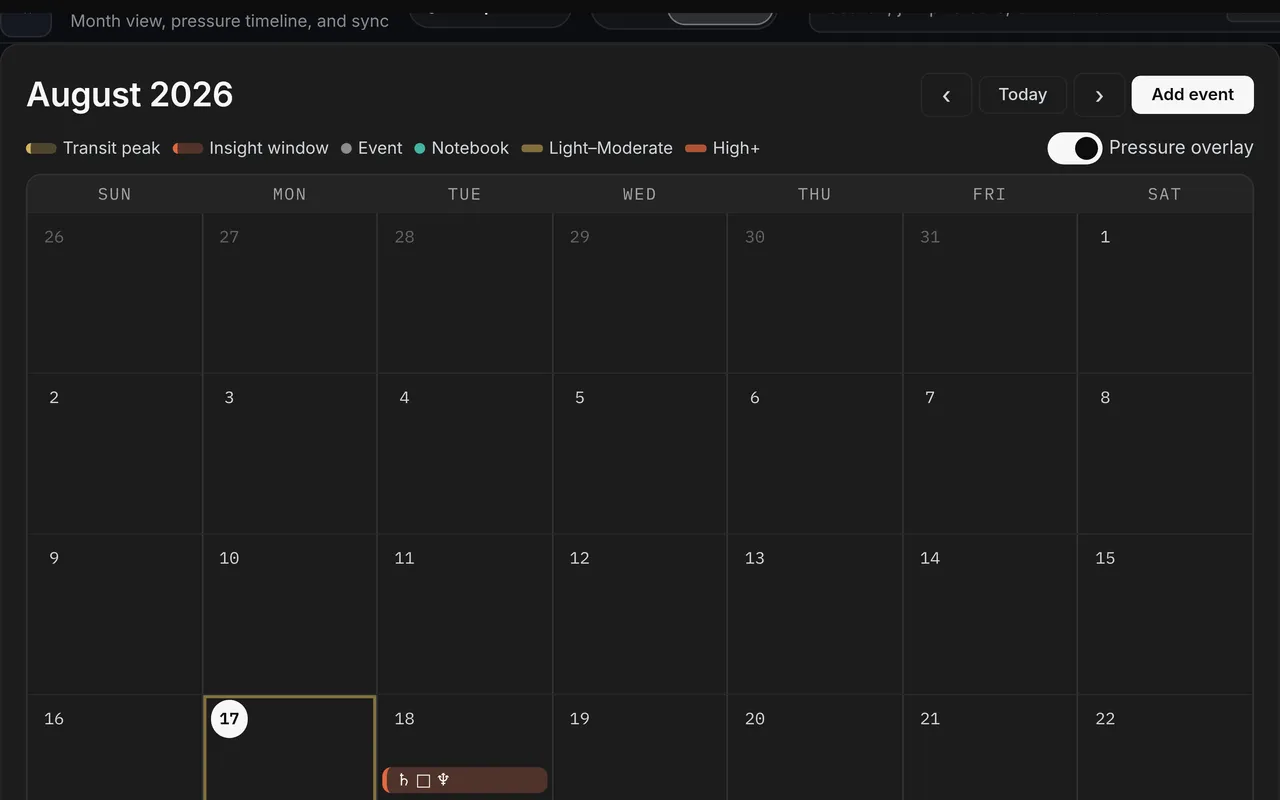
The calendar shows the run of full moons as dated markers with their degrees; the day view lists each one's exact aspects to your points with the orb and the time in your zone.
See what this lunation lands on in your chart
Common questions
- When is the full moon in January 2027?
- 22 Jan 2027, 12:17 UTC. In New York that reads 22 Jan, 07:17 EST; London reads 22 Jan, 12:17 GMT; Sydney reads 22 Jan, 23:17 AEDT.
- What sign is the January 2027 full moon in?
- Leo, at 2.2° Leo, opposite the Sun at 2.2° Aquarius. It is the Wolf Moon by the traditional naming. Tropical zodiac; a sidereal table places it in Cancer.
- Is the January 2027 full moon an eclipse?
- Not this one — 19.5° from the nodes; the eclipse season opens 6 Feb 2027 with an annular solar eclipse at 17.6° Aquarius.
- Why do several full moons in a row fall at the same degree?
- Because each full moon comes about 29° after the previous one — just under a sign — so for a few months the full-moon degree barely moves within its sign while the sign advances. This run: 2.7° Taurus, 2.3° Gemini, 2.2° Cancer, 2.2° Leo, 2.0° Virgo, 1.5° Libra.
- When are the new moons on either side?
- 7 Jan 2027, 20:24 UTC at 17.3° Capricorn came before; 6 Feb 2027, 15:56 UTC at 17.6° Aquarius, an annular solar eclipse, follows. The next full moon is 20 Feb 2027, 23:23 UTC at 2.0° Virgo.
- What house does this full moon fall in for me?
- That answer lives in the birth chart, not on this page — with a birth time and place the app finds the house and dates the full moon's contacts.
The words on this page
Every term this layer uses has a definition in the research library — what it means, and what it means for a chart.
Related
See where this Full Moon lands in your chart
Cosmic KPI computes every contact this lunation makes to your natal points — the house, the exact aspects, the time in your zone. No account needed to start.
See what this lunation lands on in your chart →