New Moon, August 2026
12 Aug 2026, 17:36 UTC · Sun and Moon at 20.0° Leo · total solar eclipse
The New Moon of August 2026 is exact 12 Aug 2026, 17:36 UTC, with the Sun and Moon conjunct at 20.0° Leo, and it is a total solar eclipse — the eclipse reaches its maximum 17:45 UTC, 9 minutes after the conjunction in longitude. The Sun–Moon conjunction lies 10.3° from the lunar nodes, inside the solar-eclipse limit. The instant is the same everywhere: in New York 12 Aug, 13:36 EDT, in London 12 Aug, 18:36 BST, in Sydney 13 Aug, 03:36 AEST.
See what this lunation lands on in your chart
47 days ago — it was exact on 12 Aug 2026, counted from 2026-09-28 10:53 UTC; the Moon is full at 96.2% illumination now.
With JavaScript on, this line becomes a live countdown with the Moon's current phase and illumination (POST /api/objects). Without it, the figure is correct as of the snapshot.
Computed 2026-09-28 10:53 UTC · Skyfield 1.55 + JPL DE440 via POST /api/scan (Sun + Moon, hourly) and POST /api/eclipses · tropical zodiac, geocentric, times in UTC. The static figures are recomputed on every deploy; the live block refreshes when the page loads. Times are shown in UTC.
The cycle around it
| Phase | Exact (UTC) | Moon at | Sun at | Note |
|---|---|---|---|---|
| New Moon | 21.9° Cancer | 21.9° Cancer | ||
| First Quarter | 28.7° Libra | 28.7° Cancer | ||
| Full Moon | 6.5° Aquarius | 6.5° Leo | ||
| Last Quarter | 13.6° Taurus | 13.6° Leo | ||
| New Moon | 20.0° Leo | 20.0° Leo | total solar eclipse | |
| First Quarter | 27.1° Scorpio | 27.1° Leo | ||
| Full Moon | 4.9° Pisces | 4.9° Virgo | partial lunar eclipse | |
| Last Quarter | 11.8° Gemini | 11.8° Virgo |
Sun into Virgo, 23 Aug 2026, 02:18 UTC — 10 days after this new moon.
What this means for everyone
A solar eclipse, measured
A new moon is the instant the Moon's longitude equals the Sun's. It becomes a solar eclipse when that conjunction falls close enough to a lunar node — the crossing of the Moon's orbit with the ecliptic — for the Moon's disc to cover the Sun's, and this one falls 10.3° from the node, which makes it total. Two times are printed because there are two events: the conjunction in longitude at 17:36 UTC, and the eclipse maximum at 17:45 UTC, 9 minutes later, when the Moon's disc is most central on the Sun's. They differ because the Moon has latitude as well as longitude. This page prints both and labels which is which.
Twenty degrees of Leo, for everyone
The Sun and Moon meet at 20.0° Leo, in the third decan of a fixed sign. The tradition reads a new moon as the seed of a month and a solar eclipse as a seed with a longer season — a degree that stays sensitive for half a year, until the next eclipse season — and reads the sign as the register the month is written in. All of that is collective. 20.0° Leo is 20.0° Leo in every chart, and the month it opens is the same month for everyone.
The same degree, a different house
What a chart adds is placement. A natal planet or angle within a degree or two of 20° of Taurus, Leo, Scorpio or Aquarius receives an exact hard contact from this eclipse — the fixed cross — and an eclipse on a natal point is the kind of dated event a journal is for. Everywhere else in the zodiac it is the month's background. The house it falls in needs a birth time and place, which is why the handoff asks for full birth details and not a date alone.
The season's second eclipse
Eclipses come in pairs a fortnight apart. This one is the solar half of the season; the lunar half is the Full Moon of 28 Aug 2026, 04:18 UTC at 4.9° Pisces, a partial lunar eclipse, on the mutable axis rather than the fixed one. Two degrees, two axes, 15 days apart — a chart with points on either is the chart this season is loudest in.
The day before
The rest of the sky is not still. Mars into Cancer, 11 Aug 2026, 08:30 UTC — 33 hours before the eclipse, with Saturn, Neptune, Pluto retrograde at the instant. None of that changes the eclipse; it is the context the month page can carry that a table of eclipse dates cannot.
What the instrument does not compute
The path of totality — where on Earth the eclipse is total, partial or invisible — is a question of geography and the Moon's shadow, and this page does not compute it. It computes the instant, the degree, the node distance and the eclipse type from Skyfield and JPL DE440, and it says where the degree lands for a chart. For the map, use an astronomical source.
For your chart specifically
The eclipse is at 20.0° Leo. Its exact contacts to a chart are a matter of degrees on the fixed cross; the house it seeds needs a birth time.
How this appears in Cosmic KPI
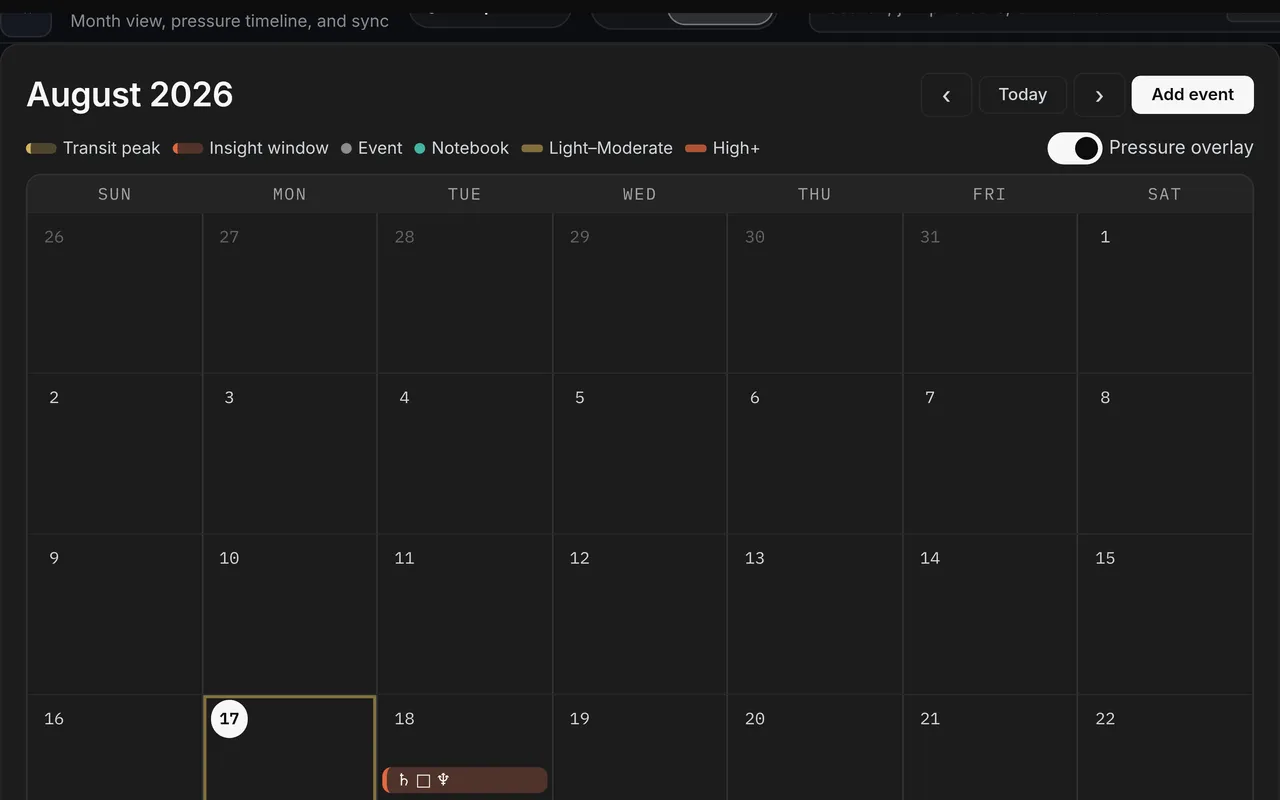
The Eclipse Pack in Life Cycles lists every eclipse with its degree and flags the ones within a few degrees of your natal planets or angles; the calendar marks this one on its day.
See what this lunation lands on in your chart
Common questions
- When is the new moon in August 2026?
- 12 Aug 2026, 17:36 UTC — in New York 12 Aug, 13:36 EDT, in London 12 Aug, 18:36 BST, in Sydney 13 Aug, 03:36 AEST. One instant everywhere; only the clock reading changes.
- What sign is the August 2026 new moon in?
- Leo, at 20.0° Leo — the Sun and Moon conjunct at the same degree. Tropical zodiac; a sidereal table names it about 24° earlier, in Cancer.
- Is the August 2026 new moon a solar eclipse?
- Yes, a total solar eclipse, with maximum eclipse at 12 Aug 2026, 17:45 UTC — 9 minutes after the exact conjunction. Where it is visible as total is not something this page computes.
- When is the lunar eclipse that goes with it?
- 28 Aug 2026, 04:18 UTC, a partial lunar eclipse with the Moon at 4.9° Pisces — the other half of this eclipse season, 15 days later.
- When is the next new moon after this one?
- 11 Sep 2026, 03:27 UTC at 18.4° Virgo, an ordinary new moon. The full moon before this eclipse was 29 Jul 2026, 14:35 UTC at 6.5° Aquarius.
- What does this eclipse mean for my chart?
- It depends on where 20° of the fixed signs falls for you and which house Leo occupies — both need your birth details. The app places the eclipse in your chart and lists its exact contacts to your natal points.
The words on this page
Every term this layer uses has a definition in the research library — what it means, and what it means for a chart.
Related
See where this New Moon lands in your chart
Cosmic KPI computes every contact this lunation makes to your natal points — the house, the exact aspects, the time in your zone. No account needed to start.
See what this lunation lands on in your chart →