
New and full moons of 2026
13 full moons, 12 new moons, 4 eclipses — every one an instant in UTC with the Moon's degree, computed rather than copied.
2026 has 13 full moons and 12 new moons — 50 phase instants with the quarters — and 4 of the lunations are eclipses: 17 Feb 2026 (annular solar eclipse, 28.8° Aquarius), 3 Mar 2026 (total lunar eclipse, 12.8° Virgo), 12 Aug 2026 (total solar eclipse, 20.0° Leo), 28 Aug 2026 (partial lunar eclipse, 4.9° Pisces). May carries two full moons, 1 May 2026 and 31 May 2026, so the second is a blue moon by the calendar-month definition. The year's new moons start at 28.7° Capricorn on 18 Jan 2026 and end at 16.9° Sagittarius on 9 Dec 2026, each about a degree earlier in its sign than the last. Every instant is a Sun–Moon elongation root on an hourly Skyfield/JPL DE440 lattice — tropical zodiac, geocentric, UTC.
Put these on your calendar with your own pressure overlay
5 days — to the next: Last Quarter at 10.3° Cancer, 3 Oct 2026, 13:25 UTC; 37 of 50 listed events have passed as of 2026-09-28 10:53 UTC. The Moon is full at 96.2% illumination now.
With JavaScript on, this line is recomputed at load — the next event counted from the current instant, with the Moon's phase now (POST /api/objects). Without it, the figures are correct as of the snapshot.
Computed 2026-09-28 10:53 UTC · Skyfield 1.55 + JPL DE440 via POST /api/scan (Sun + Moon, hourly) and POST /api/eclipses · tropical zodiac, geocentric, times in UTC. The static figures are recomputed on every deploy; the live block refreshes when the page loads. Times are shown in UTC.
Every phase of the Moon in 2026
New and full moons are highlighted and, where a month page exists, linked. The quarters are the same roots at 90° and 270° of elongation; the eclipse flags come from a separate eclipse search, and a flagged lunation keeps its own instant.
| Phase | Exact (UTC) | Moon at | Sun at | Note |
|---|---|---|---|---|
| Full Moon | 13.0° Cancer | 13.0° Capricorn | ||
| Last Quarter | 20.4° Libra | 20.4° Capricorn | ||
| New Moon | 28.7° Capricorn | 28.7° Capricorn | ||
| First Quarter | 6.2° Taurus | 6.2° Aquarius | ||
| Full Moon | 13.0° Leo | 13.0° Aquarius | ||
| Last Quarter | 20.7° Scorpio | 20.7° Aquarius | ||
| New Moon | 28.8° Aquarius | 28.8° Aquarius | annular solar eclipse | |
| First Quarter | 5.9° Gemini | 5.9° Pisces | ||
| Full Moon | 12.8° Virgo | 12.8° Pisces | total lunar eclipse | |
| Last Quarter | 20.8° Sagittarius | 20.8° Pisces | ||
| New Moon | 28.4° Pisces | 28.4° Pisces | ||
| First Quarter | 5.1° Cancer | 5.1° Aries | ||
| Full Moon | 12.3° Libra | 12.3° Aries | ||
| Last Quarter | 20.3° Capricorn | 20.3° Aries | ||
| New Moon | 27.4° Aries | 27.4° Aries | ||
| First Quarter | 3.9° Leo | 3.9° Taurus | ||
| Full Moon | 11.3° Scorpio | 11.3° Taurus | ||
| Last Quarter | 19.2° Aquarius | 19.2° Taurus | ||
| New Moon | 25.9° Taurus | 25.9° Taurus | ||
| First Quarter | 2.3° Virgo | 2.3° Gemini | ||
| Full Moon | 9.9° Sagittarius | 9.9° Gemini | ||
| Last Quarter | 17.6° Pisces | 17.6° Gemini | ||
| New Moon | 24.0° Gemini | 24.0° Gemini | ||
| First Quarter | 0.5° Libra | 0.5° Cancer | ||
| Full Moon | 8.2° Capricorn | 8.2° Cancer | ||
| Last Quarter | 15.6° Aries | 15.6° Cancer | ||
| New Moon | 21.9° Cancer | 21.9° Cancer | ||
| First Quarter | 28.7° Libra | 28.7° Cancer | ||
| Full Moon | 6.5° Aquarius | 6.5° Leo | ||
| Last Quarter | 13.6° Taurus | 13.6° Leo | ||
| New Moon | 20.0° Leo | 20.0° Leo | total solar eclipse the new moon page → | |
| First Quarter | 27.1° Scorpio | 27.1° Leo | ||
| Full Moon | 4.9° Pisces | 4.9° Virgo | partial lunar eclipse the full moon page → | |
| Last Quarter | 11.8° Gemini | 11.8° Virgo | ||
| New Moon | 18.4° Virgo | 18.4° Virgo | the new moon page → | |
| First Quarter | 25.9° Sagittarius | 25.9° Virgo | ||
| Full Moon | 3.6° Aries | 3.6° Libra | the full moon page → | |
| Last Quarter | 10.3° Cancer | 10.3° Libra | ||
| New Moon | 17.3° Libra | 17.3° Libra | the new moon page → | |
| First Quarter | 25.3° Capricorn | 25.3° Libra | ||
| Full Moon | 2.7° Taurus | 2.7° Scorpio | the full moon page → | |
| Last Quarter | 9.4° Leo | 9.4° Scorpio | ||
| New Moon | 16.8° Scorpio | 16.8° Scorpio | the new moon page → | |
| First Quarter | 25.1° Aquarius | 25.1° Scorpio | ||
| Full Moon | 2.3° Gemini | 2.3° Sagittarius | the full moon page → | |
| Last Quarter | 9.0° Virgo | 9.0° Sagittarius | ||
| New Moon | 16.9° Sagittarius | 16.9° Sagittarius | the new moon page → | |
| First Quarter | 25.2° Pisces | 25.2° Sagittarius | ||
| Full Moon | 2.2° Cancer | 2.2° Capricorn | the full moon page → | |
| Last Quarter | 9.0° Libra | 9.0° Capricorn |
What this means for everyone
What this calendar is
A lunation is an instant, not a day: the moment the Moon's longitude minus the Sun's passes exactly 0° or 180°. This page finds those moments for a whole year on an hourly lattice of Skyfield/JPL DE440 positions and interpolates each root to the minute, which is why it prints 50 times rather than 50 dates. A published table that gives days only is not wrong, but a lunation at 02:11 UTC is the evening before in the Americas, and a table that does not say which day it means cannot be checked.
The shape of 2026
Lunations come every 29.5 days and months are longer, so some years carry an extra one. 2026 has 13 full moons to 12 new moons: May opens with a full moon on 1 May 2026 at 11.3° Scorpio and closes with another on 31 May 2026 at 9.9° Sagittarius. The year also opens and closes in the same sign — the first full moon is at 13.0° Cancer and the last at 2.2° Cancer — because the lunation degree retreats through the zodiac: each new moon falls roughly 29° after the previous one, which is a degree or so short of a full sign, so over twelve months the new-moon degree slides from 28.7° of its sign to 16.9°. That drift is the year's signature, and it is the same in every chart.
Two eclipse seasons
Eclipses happen when a lunation falls near the lunar nodes, and the nodes move slowly enough that eclipses arrive in seasons about every six months. February–March brings an annular solar eclipse at 28.8° Aquarius on 17 Feb 2026 and a total lunar eclipse at 12.8° Virgo on 3 Mar 2026; August brings a total solar eclipse at 20.0° Leo on 12 Aug 2026 and a partial lunar eclipse at 4.9° Pisces on 28 Aug 2026. The tradition reads an eclipse as a lunation with a longer reach — a new or full moon whose degree stays sensitive for months — and the degrees are the useful part of that reading, because they are what a chart can be checked against.
The same instants, everywhere
Each lunation on this page happens at one moment for the whole planet and lights the same axis of the zodiac for everyone: a full moon at 13.0° Cancer is the Cancer–Capricorn axis wherever it is seen. That is the collective layer, the part a year calendar can carry. What it cannot carry is the house the lunation falls in, or whether its degree meets a natal planet — both of which change with the birth chart, and both of which are what turns a lunation from the month's weather into a marked day.
What the instrument claims
It dates 50 instants, names the degrees, flags 4 eclipses from a real eclipse search, and links each new and full moon to its own page where one exists. It does not attach an outcome to any of them.
For your chart specifically
The 25 new and full moons above fall on the same degrees for every chart. Which of them meet a natal point of yours, and in which house, is the chart's question.
How this appears in Cosmic KPI
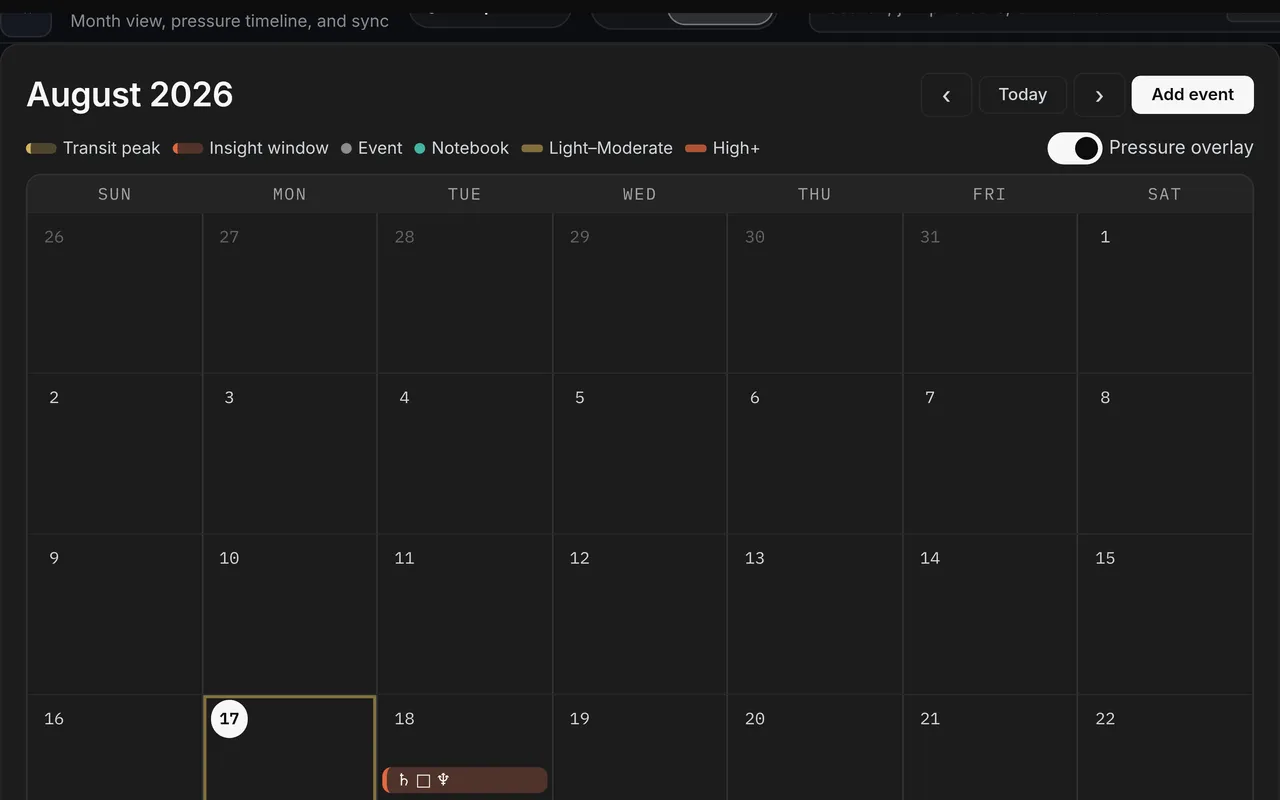
The calendar marks every lunation and eclipse of the year with its degree, and opening a day shows which of your natal points that lunation aspects — with the orb and the exact time in your own timezone.
Put these on your calendar with your own pressure overlay
Common questions
- How many full moons are there in 2026?
- 13, from 3 Jan 2026, 10:02 UTC at 13.0° Cancer to 24 Dec 2026, 01:28 UTC at 2.2° Cancer — May has two. There are 12 new moons.
- When is the blue moon in 2026?
- 31 May 2026, 08:45 UTC, at 9.9° Sagittarius — the second full moon of May, after the one on 1 May 2026. "Blue moon" here is the calendar-month definition; the older seasonal definition can name a different one.
- Which moons in 2026 are eclipses?
- New Moon 17 Feb 2026, 12:01 UTC, annular solar eclipse, 28.8° Aquarius; Full Moon 3 Mar 2026, 11:37 UTC, total lunar eclipse, 12.8° Virgo; New Moon 12 Aug 2026, 17:36 UTC, total solar eclipse, 20.0° Leo; Full Moon 28 Aug 2026, 04:18 UTC, partial lunar eclipse, 4.9° Pisces. The flags come from an eclipse search, not from the lunation's distance to the node.
- When is the next full moon and new moon?
- Full moon: 26 Oct 2026, 04:11 UTC at 2.7° Taurus. New moon: 10 Oct 2026, 15:50 UTC at 17.3° Libra. Counted from the snapshot; the live line above recounts at load.
- Why does another calendar give a different date for the same moon?
- Usually the time zone: these are UTC instants, and a lunation in the small hours UTC is the previous calendar day in the Americas. Occasionally the zodiac: a sidereal table names the degree about 24° earlier, which can change the sign, though never the instant.
- Which house does a lunation fall in for me?
- The house changes with the birth time and place. Given full birth details, the app puts every new and full moon of the year into your chart and dates its contacts to your points.
The words on this page
Every term this layer uses has a definition in the research library — what it means, and what it means for a chart.
Related
See where every 2026 lunation lands in your chart
Cosmic KPI computes each of these events as a transit to your own natal points — the house, the exact aspects, the time in your zone. No account needed to start.
Put these on your calendar with your own pressure overlay →