
New Moon, January 2027
7 Jan 2027, 20:24 UTC · Sun and Moon at 17.3° Capricorn · Mars turns retrograde 2.7 days later
The New Moon of January 2027 — the year's first — is exact 7 Jan 2027, 20:24 UTC, Sun and Moon at 17.3° Capricorn, not an eclipse. Venus entered Sagittarius 12 hours before it (7 Jan 2027, 08:53 UTC), and Mars stations retrograde 2.7 days after it, 10 Jan 2027, 12:58 UTC at 10.4° Virgo — the start of 81 days retrograde. The instant is 7 Jan, 15:24 EST for a reader in New York, 7 Jan, 20:24 GMT in London, 8 Jan, 07:24 AEDT in Sydney.
See what this lunation lands on in your chart
101 days — to exact, counted from 2026-09-28 10:53 UTC; the Moon is full at 96.2% illumination now.
With JavaScript on, this line becomes a live countdown with the Moon's current phase and illumination (POST /api/objects). Without it, the figure is correct as of the snapshot.
Computed 2026-09-28 10:53 UTC · Skyfield 1.55 + JPL DE440 via POST /api/scan (Sun + Moon, hourly) and POST /api/eclipses · tropical zodiac, geocentric, times in UTC. The static figures are recomputed on every deploy; the live block refreshes when the page loads. Times are shown in UTC.
The cycle around it
| Phase | Exact (UTC) | Moon at | Sun at | Note |
|---|---|---|---|---|
| New Moon | 16.9° Sagittarius | 16.9° Sagittarius | ||
| First Quarter | 25.2° Pisces | 25.2° Sagittarius | ||
| Full Moon | 2.2° Cancer | 2.2° Capricorn | ||
| Last Quarter | 9.0° Libra | 9.0° Capricorn | ||
| New Moon | 17.3° Capricorn | 17.3° Capricorn | this page | |
| First Quarter | 25.4° Aries | 25.4° Capricorn | ||
| Full Moon | 2.2° Leo | 2.2° Aquarius | ||
| Last Quarter | 9.2° Scorpio | 9.2° Aquarius |
Sun into Aquarius, 20 Jan 2027, 07:29 UTC — 12 days after this new moon.
What this means for everyone
The year opens on a Capricorn new moon
Exact at 20:24 UTC on 7 Jan 2027, at 17.3° Capricorn, from an hourly Skyfield/JPL DE440 lattice interpolated to the minute; not an eclipse, the conjunction being 35.2° from the nodes. A new moon in the second decan of a cardinal earth sign is the tradition's seed of a month spent building rather than beginning — structure before motion — and the first lunation of a calendar year tends to be read as the year's own seed. Both readings are collective. The degree is the same in every chart.
Three days before Mars turns
What this new moon has that the other twelve of the year do not is its timing against the Mars table. Mars stations retrograde 10 Jan 2027, 12:58 UTC at 10.4° Virgo, 2.7 days after the conjunction, and stays retrograde 81 days, retracing 19.5° back to 20.9° Leo by 1 Apr 2027. Mars retrogrades once every twenty-six months, so most new moons fall nowhere near one; this one opens the lunar month in which the year's only long retrograde begins. The tradition reads a Mars station as momentum stalling before it reverses, and a month seeded in that week carries the reading throughout.
Twelve hours earlier, Venus
Venus crossed into Sagittarius at 7 Jan 2027, 08:53 UTC, 12 hours before the new moon. An ingress and a lunation in the same half-day is a coincidence of two independent cycles, but it means the month opens with Venus freshly in a new sign — a detail a table of new-moon dates cannot carry and this page can, because the ingress table is refined to the minute alongside the lunation table. Jupiter and Uranus are retrograde at the instant.
Placed, or not
For a chart with a natal point near 17.3° of Aries, Cancer, Libra or Capricorn the new moon is an exact aspect; for one with a planet in Mars's coming arc (20.9° Leo to 10.4° Virgo) the bigger event is the three passes Mars makes over it in the months ahead. Neither can be read from the sky alone, and the house the new moon seeds needs birth time and place. A year's first new moon is often read as a personal seed as well as a collective one; the chart is what decides in which department of life it is planted, and this page cannot see the chart. That is where it hands off.
What the instrument claims
The instant, the degree, an ingress and a station, each computed. It does not say what the year holds.
For your chart specifically
The new moon is at 17.3° Capricorn; Mars is about to retrace 20.9° Leo–10.4° Virgo. A natal point at either is the chart's business, not the sky's.
How this appears in Cosmic KPI
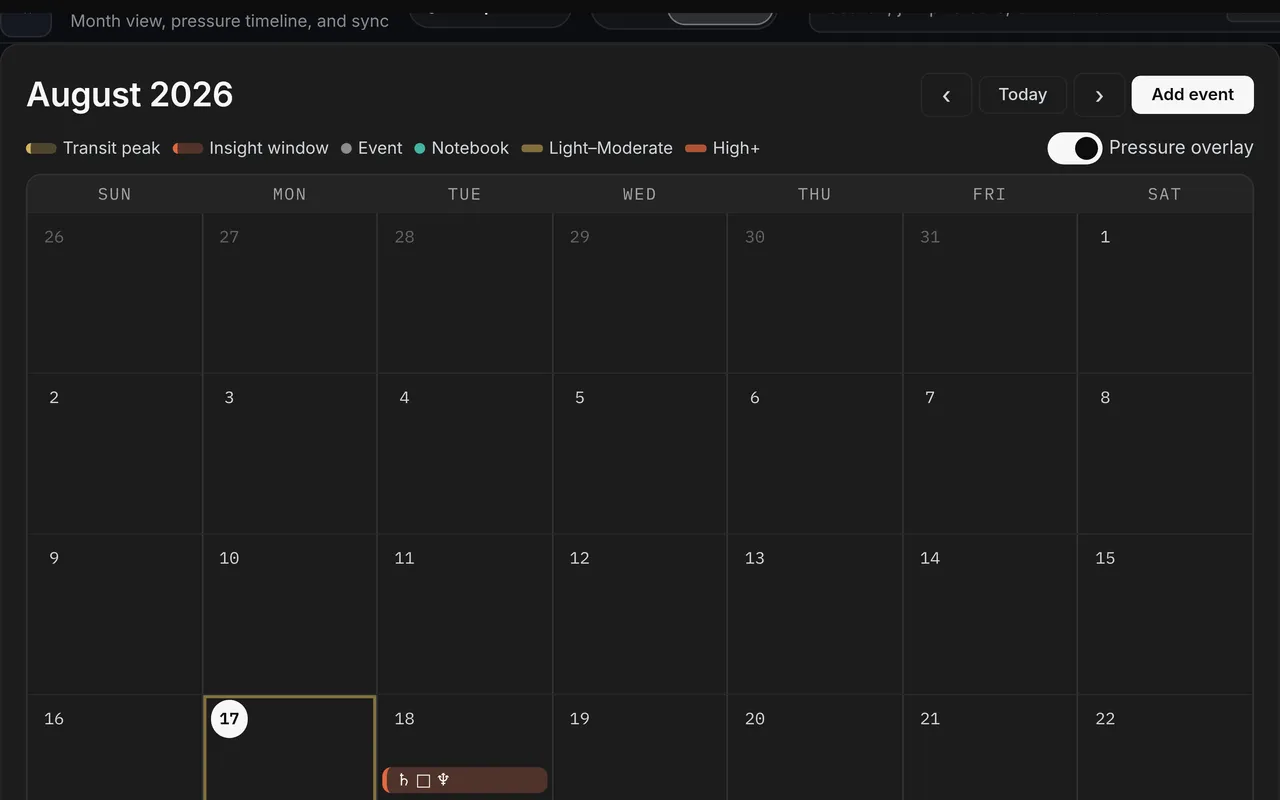
The calendar marks the new moon on its day; Life Cycles shades the whole Mars retrograde across your timeline with its shadow periods, and flags any natal point inside the arc.
See what this lunation lands on in your chart
Common questions
- When is the new moon in January 2027?
- 7 Jan 2027, 20:24 UTC — 7 Jan, 15:24 EST for a reader in New York, 7 Jan, 20:24 GMT in London, 8 Jan, 07:24 AEDT in Sydney.
- What sign is the January 2027 new moon in?
- Capricorn, 17.3° Capricorn. That is the tropical degree; sidereally the same conjunction falls in Sagittarius.
- Is the January 2027 new moon an eclipse?
- No: 35.2° from the nodes. The first eclipse of 2027 is 6 Feb 2027, 15:59 UTC, an annular solar eclipse at 17.6° Aquarius.
- When does Mars go retrograde in 2027?
- 10 Jan 2027, 12:58 UTC at 10.4° Virgo, 2.7 days after this new moon; it stations direct 1 Apr 2027, 14:16 UTC at 20.9° Leo.
- When is the full moon after the January 2027 new moon?
- 22 Jan 2027, 12:17 UTC at 2.2° Leo. The full moon before it was 24 Dec 2026, 01:28 UTC at 2.2° Cancer; the next new moon is 6 Feb 2027, 15:56 UTC at 17.6° Aquarius.
- What house does this new moon fall in for me?
- Not from the sky alone: the houses are set by the birth time and place. Enter them and the app answers with the house and every dated aspect.
The words on this page
Every term this layer uses has a definition in the research library — what it means, and what it means for a chart.
Related
See where this New Moon lands in your chart
Cosmic KPI computes every contact this lunation makes to your natal points — the house, the exact aspects, the time in your zone. No account needed to start.
See what this lunation lands on in your chart →