Full Moon, August 2026
28 Aug 2026, 04:18 UTC · Moon 4.9° Pisces opposite Sun 4.9° Virgo · partial lunar eclipse
The Full Moon of August 2026 is exact 28 Aug 2026, 04:18 UTC, the Moon at 4.9° Pisces opposite the Sun at 4.9° Virgo, and it is a partial lunar eclipse whose maximum comes 6 minutes earlier, at 04:12 UTC. It is the second eclipse of the season, after the total solar eclipse of 12 Aug 2026. For New York that is 28 Aug, 00:18 EDT; for London 28 Aug, 05:18 BST; for Sydney 28 Aug, 14:18 AEST.
See what this lunation lands on in your chart
31 days ago — it was exact on 28 Aug 2026, counted from 2026-09-28 10:53 UTC; the Moon is full at 96.2% illumination now.
With JavaScript on, this line becomes a live countdown with the Moon's current phase and illumination (POST /api/objects). Without it, the figure is correct as of the snapshot.
Computed 2026-09-28 10:53 UTC · Skyfield 1.55 + JPL DE440 via POST /api/scan (Sun + Moon, hourly) and POST /api/eclipses · tropical zodiac, geocentric, times in UTC. The static figures are recomputed on every deploy; the live block refreshes when the page loads. Times are shown in UTC.
The cycle around it
| Phase | Exact (UTC) | Moon at | Sun at | Note |
|---|---|---|---|---|
| Full Moon | 6.5° Aquarius | 6.5° Leo | ||
| Last Quarter | 13.6° Taurus | 13.6° Leo | ||
| New Moon | 20.0° Leo | 20.0° Leo | total solar eclipse | |
| First Quarter | 27.1° Scorpio | 27.1° Leo | ||
| Full Moon | 4.9° Pisces | 4.9° Virgo | partial lunar eclipse | |
| Last Quarter | 11.8° Gemini | 11.8° Virgo | ||
| New Moon | 18.4° Virgo | 18.4° Virgo | ||
| First Quarter | 25.9° Sagittarius | 25.9° Virgo |
Sun into Virgo, 23 Aug 2026, 02:18 UTC — 5 days before this full moon.
What this means for everyone
Two instants for one event
A full moon is the instant the Moon's longitude is 180° from the Sun's. A lunar eclipse is the Moon passing through the Earth's shadow, which happens when that opposition falls near a lunar node. The two are the same event but not the same instant: the opposition in longitude is at 04:18 UTC and the eclipse maximum at 04:12 UTC, 6 minutes earlier, because the Moon's latitude carries it through the shadow's centre-line a little before its longitude reaches the opposition. Both are real. Almanacs print the maximum; ephemerides print the opposition; this page prints both and says which is which.
An early mutable degree
The Moon stands at 4.9° Pisces, 5 degrees into a mutable sign, with the Sun at 4.9° Virgo. The Pisces–Virgo axis is the one the tradition reads as dissolution against discrimination — what is felt whole against what is sorted into parts — and a full moon holds both ends up at once. As an eclipse, the reading stretches from a fortnight to a season. This is the collective layer: the same axis, the same degree, for every chart.
The same instant, a different chart
Placement is what changes. A natal planet or angle in the first degrees of Gemini, Virgo, Sagittarius or Pisces — the mutable cross — receives an exact hard contact from this eclipse; a chart with nothing there gets the month's weather. The house the Moon falls in needs a birth time and place, which is why the handoff below asks for full birth details. With them, an eclipse on a natal point is a dated event; without them it is a degree.
The slow arcs it fell inside
Mercury had crossed into Virgo 65 hours earlier (25 Aug 2026, 11:04 UTC), so the Sun's end of the axis carried two bodies by the time the Earth's shadow reached the Moon. Three of the bodies that retrograde had already turned back, and the eclipse ended none of them: Pluto stationed 6 May 2026 at 5.5° Aquarius, Saturn stationed 26 Jul 2026 at 14.7° Aries, Neptune stationed 7 Jul 2026 at 4.4° Aries. The soonest of the three did not turn direct for another 49 days. That is a lunation against its background — an instant fixed to the minute, falling inside arcs measured in months, none of which it moved.
What the instrument claims
The opposition, the eclipse maximum, the degrees, the node distance and the eclipse type — each computed with Skyfield from JPL DE440 and printed to the minute. Not the visibility (a lunar eclipse is visible from wherever the Moon is above the horizon at the time, which this page does not map), and not an outcome.
For your chart specifically
The Moon is at 4.9° Pisces. A natal point within a degree or two of 4.9° of any mutable sign takes an exact aspect from this eclipse; which house it lights needs your birth time.
How this appears in Cosmic KPI
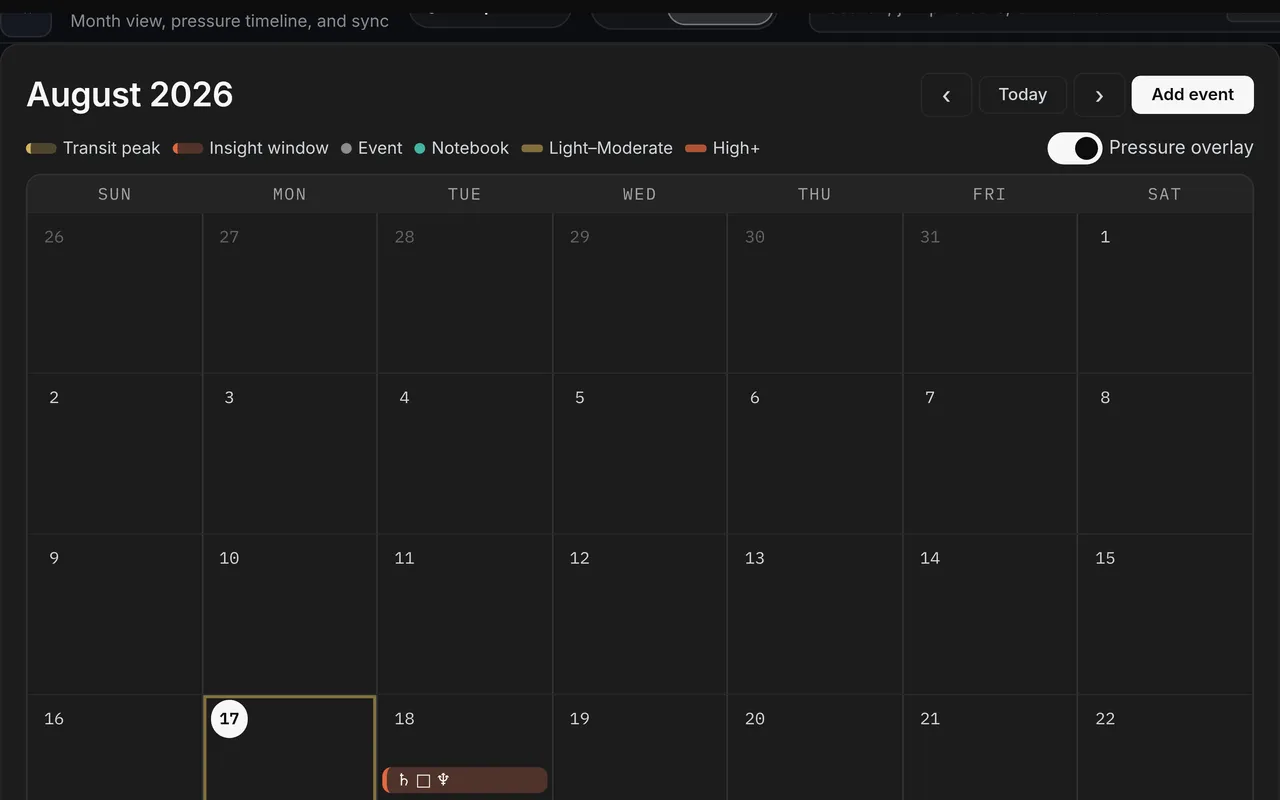
The Eclipse Pack in Life Cycles lists this eclipse with its degree and flags whether it lands within a few degrees of a natal planet or angle of yours; the calendar marks it on its day with the time in your zone.
See what this lunation lands on in your chart
Common questions
- When is the full moon in August 2026?
- 28 Aug 2026, 04:18 UTC for the opposition; the eclipse maximum is 6 minutes earlier, 28 Aug 2026, 04:12 UTC. For New York that is 28 Aug, 00:18 EDT; for London 28 Aug, 05:18 BST; for Sydney 28 Aug, 14:18 AEST.
- What sign is the August 2026 full moon in?
- Pisces, at 4.9° Pisces, opposite the Sun at 4.9° Virgo. Tropical zodiac — a sidereal table names it in Aquarius.
- Is the August 2026 full moon a lunar eclipse?
- Yes, a partial one: the Moon is 5.4° from the node. Maximum eclipse 28 Aug 2026, 04:12 UTC; the Moon is in the Earth's shadow for some hours either side.
- Why are two times given for the eclipse?
- Because the opposition in longitude (04:18 UTC) and the eclipse maximum (04:12 UTC) are different measurements of the same event. The Moon has latitude as well as longitude, and the deepest point of the shadow crossing does not coincide exactly with the 180° separation.
- When are the new moons before and after it?
- Before: 12 Aug 2026, 17:36 UTC at 20.0° Leo, a total solar eclipse. After: 11 Sep 2026, 03:27 UTC at 18.4° Virgo, not an eclipse.
- When is the next full moon?
- 26 Sep 2026, 16:49 UTC at 3.6° Aries, not an eclipse.
- Which house does this eclipse fall in for me?
- Houses come from the birth time and place, so the page cannot say. Given both, the app puts 5° Pisces where it belongs in your chart and dates the eclipse's contacts to your points.
The words on this page
Every term this layer uses has a definition in the research library — what it means, and what it means for a chart.
Related
See where this Full Moon lands in your chart
Cosmic KPI computes every contact this lunation makes to your natal points — the house, the exact aspects, the time in your zone. No account needed to start.
See what this lunation lands on in your chart →