Current planetary aspects
Every pair of the ten classical bodies within orb, applying or separating from the speed channel — and the next sixty days of exact aspects, to the minute.
11 planet-to-planet aspects are within 3° of exact as of 2026-09-28 10:53 UTC: Neptune sextile Pluto (0.21°, separating); Sun trine Uranus (0.23°, applying); Moon opposition Mercury (0.55°, separating); Sun trine Pluto (2.20°, separating); Sun opposition Neptune (2.41°, separating); Moon square Mars (2.41°, applying); Uranus trine Pluto (2.42°, applying); Uranus sextile Neptune (2.63°, separating); Mars trine Neptune (2.73°, applying); Mars opposition Pluto (2.94°, applying); Mercury square Mars (2.96°, applying). The next exact aspect between planets is Sun trine Uranus, 28 Sep 2026, 16:21 UTC, at 5.5° Libra and 5.5° Gemini; 24 exact aspects fall in the next 60 days. An aspect is an angle between two geocentric longitudes, so the grid reads the same in any zodiac; the instants are UTC.
See which of these aspects touch your chart
11 — planet-to-planet aspects within 3° at 2026-09-28 10:53 UTC, 6 applying and 5 separating.
TIGHTEST PAIR · NEPTUNE SEXTILE PLUTO
no exact crossing in the forward list
Geometric closeness — not significance
| Pair | Aspect | Separation | Orb | Phase |
|---|---|---|---|---|
| Neptune – Pluto | ⚹ sextile | 59.79° | 0.21° | separating |
| Sun – Uranus | △ trine | 119.77° | 0.23° | applying |
| Moon – Mercury | ☍ opposition | 179.45° | 0.55° | separating |
| Sun – Pluto | △ trine | 117.80° | 2.20° | separating |
| Sun – Neptune | ☍ opposition | 177.59° | 2.41° | separating |
| Moon – Mars | □ square | 92.41° | 2.41° | applying |
| Uranus – Pluto | △ trine | 122.42° | 2.42° | applying |
| Uranus – Neptune | ⚹ sextile | 62.63° | 2.63° | separating |
| Mars – Neptune | △ trine | 117.27° | 2.73° | applying |
| Mars – Pluto | ☍ opposition | 177.06° | 2.94° | applying |
| Mercury – Mars | □ square | 87.04° | 2.96° | applying |
Snapshot at 2026-09-28 10:53 UTC. With JavaScript on, the grid is recomputed for the current instant from POST /api/objects (one request, about 2 KB); applying or separating is read from each body's speed.
Computed 2026-09-28 10:53 UTC · Skyfield 1.55 + JPL DE440 via POST /api/objects and POST /api/scan · tropical zodiac, geocentric, times in UTC. The static figures are recomputed on every deploy; the live block refreshes when the page loads. Times are shown in UTC.
Exact aspects ahead, 60 days
Each instant is the root of the two longitudes' separation against the aspect's angle, bracketed on a daily lattice and re-solved on a fifteen-minute window. For the slowest pairs the separation changes by less than the ephemeris resolution in an hour, so an outer-planet instant is good to the hour rather than the minute. The Moon is left out of this list — it perfects an aspect every few hours — but it is in the grid above.
| Exact (UTC) | Pair | Aspect | Degrees |
|---|---|---|---|
| Sun – Uranus | trine | 5.5° Libra – 5.5° Gemini | |
| Mercury – Mars | square | 2.4° Scorpio – 2.4° Leo | |
| Mercury – Pluto | square | 3.1° Scorpio – 3.1° Aquarius | |
| Mars – Neptune | trine | 2.8° Leo – 2.8° Aries | |
| Mars – Pluto | opposition | 3.1° Leo – 3.1° Aquarius | |
| Sun – Saturn | opposition | 11.3° Libra – 11.3° Aries | |
| Mercury – Venus | conjunction | 8.2° Scorpio – 8.2° Scorpio | |
| Mars – Uranus | sextile | 5.4° Leo – 5.4° Gemini | |
| Venus – Mars | square | 7.3° Scorpio – 7.3° Leo | |
| Sun – Jupiter | sextile | 22.0° Libra – 22.0° Leo | |
| Mars – Saturn | trine | 10.3° Leo – 10.3° Aries | |
| Venus – Pluto | square | 3.0° Scorpio – 3.0° Aquarius | |
| Sun – Venus | conjunction | 0.7° Scorpio – 0.7° Scorpio | |
| Sun – Pluto | square | 3.0° Scorpio – 3.0° Aquarius | |
| Mercury – Mars | square | 17.9° Scorpio – 17.9° Leo | |
| Venus – Jupiter | sextile | 24.7° Libra – 24.7° Leo | |
| Sun – Mercury | conjunction | 12.1° Scorpio – 12.1° Scorpio | |
| Venus – Mars | sextile | 23.1° Libra – 23.1° Leo | |
| Mars – Jupiter | conjunction | 25.8° Leo – 25.8° Leo | |
| Sun – Jupiter | square | 26.0° Scorpio – 26.0° Leo | |
| Sun – Mars | square | 27.4° Scorpio – 27.4° Leo | |
| Sun – Neptune | trine | 1.7° Sagittarius – 1.7° Aries | |
| Sun – Pluto | sextile | 3.4° Sagittarius – 3.4° Aquarius | |
| Sun – Uranus | opposition | 3.6° Sagittarius – 3.6° Gemini |
What this means for everyone
What an aspect between two planets is
Take two geocentric longitudes and subtract them. If the difference is within a few degrees of 0°, 60°, 90°, 120° or 180°, the pair is in aspect — conjunction, sextile, square, trine or opposition, the five Ptolemaic angles the transit terminal uses — and the distance from the exact angle is the orb. That is all the grid is: forty-five pairs, five angles, and a 3° envelope, the same envelope the product applies to a transit against a chart. Nothing about a birth is involved, which is what makes it the sky's own weather.
Applying, separating, and the rate
Every row has a direction. An applying aspect is one whose orb is closing — the page projects each body one hour ahead on its current speed and asks whether the angle got nearer to exact — and a separating one has already perfected. The direction matters less than the rate. Moon and Mars close their separation at about 13.41° a day, so a 2.41° orb is a matter of days; Uranus and Pluto move 0.007° a day relative to each other, so their 2.42° orb is a configuration that stays within orb for a season and comes back the following year. The exact-instants table below turns each applying row into a time.
Slow pairs and fast pairs
The grid is really two grids laid over each other. 3 of the 11 rows are between outer planets — Neptune sextile Pluto, Uranus trine Pluto, Uranus sextile Neptune — and those are the aspects that colour years: they perfect, drift apart in retrograde, perfect again, and hold within orb across whole seasons. The rest involve the Sun, Mercury, Venus or Mars, and they pass in days. The tradition reads the slow configuration as the character of a period shared by everyone alive in it, and the fast contacts as the events of a week; both are collective. Neither says where they land for any one person.
Planet-to-planet is not planet-to-chart
A sky aspect is between two moving bodies. A transit is between one moving body and a fixed point in a birth chart, and that is a different geometry with a different answer for every chart: the Sun at 5.3° Libra is square something in one chart and nothing in the next. The terminal is where this grid becomes personal — the same five angles and the same 3° orb, applied to your natal points instead of to the planets — and the handoff below opens it.
What the instrument claims
It computes the angles, sorts them by orb, reads the direction from the speed channel and dates the exact instants ahead. It does not say what a Jupiter–Saturn trine brings, and it does not add the aspects up into a score for the day.
For your chart specifically
The same angles measured against your natal points instead of against each other — that is the terminal. The slow planets in this grid are each mid-transit to some part of every chart.
How this appears in Cosmic KPI
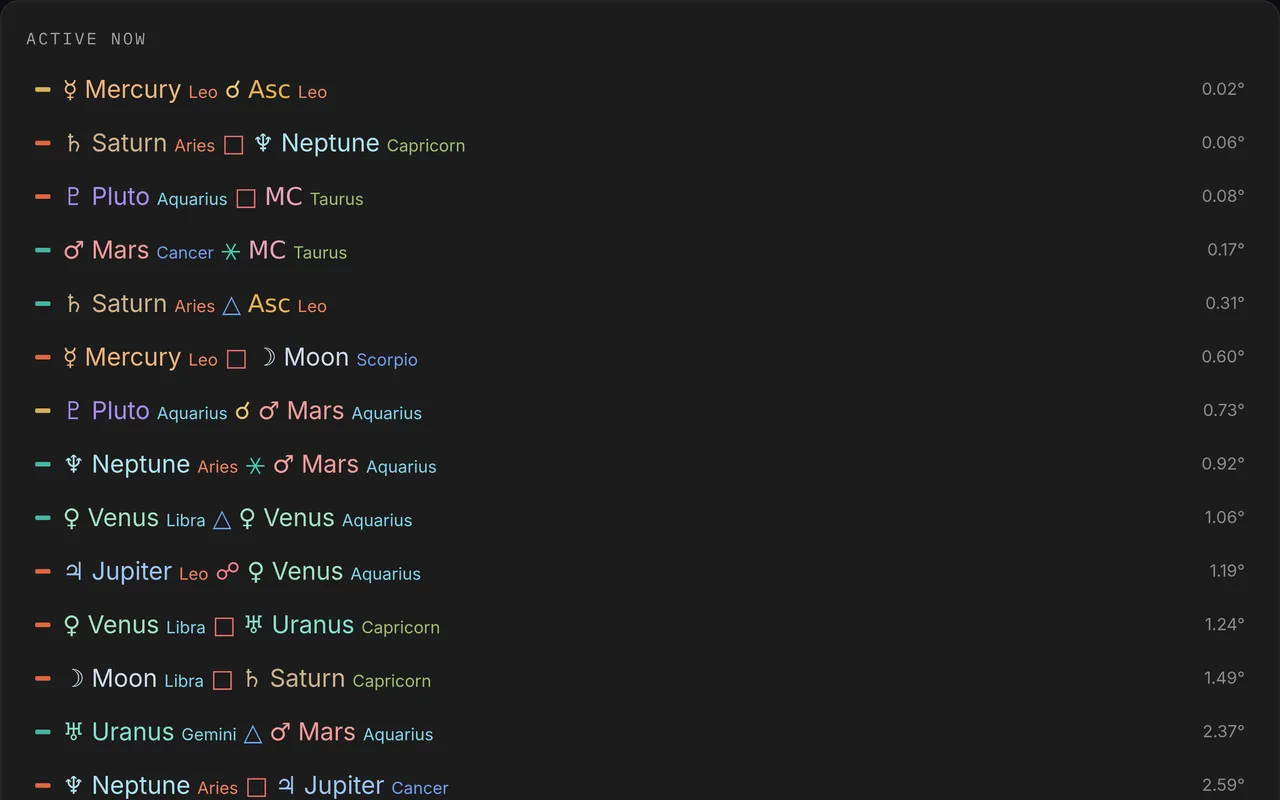
The transit terminal lists every contact currently in orb against your chart with its exact orb reading, applying or separating, and the time it perfects; the sky map draws the live wheel with your natal chart inside it.
See which of these aspects touch your chart
Common questions
- What planetary aspects are happening right now?
- As of 2026-09-28 10:53 UTC, 11 within 3°: Neptune sextile Pluto (0.21°, separating); Sun trine Uranus (0.23°, applying); Moon opposition Mercury (0.55°, separating); Sun trine Pluto (2.20°, separating); Sun opposition Neptune (2.41°, separating); Moon square Mars (2.41°, applying); Uranus trine Pluto (2.42°, applying); Uranus sextile Neptune (2.63°, separating); Mars trine Neptune (2.73°, applying); Mars opposition Pluto (2.94°, applying); Mercury square Mars (2.96°, applying). The grid recomputes when the page loads.
- What does "applying" mean in an aspect?
- That the orb is closing — the two bodies are moving toward the exact angle. Separating means it has already perfected and the orb is widening. The page reads this from each body's current speed, projected one hour ahead.
- When is the next exact planetary aspect?
- Sun trine Uranus, exact 28 Sep 2026, 16:21 UTC at 5.5° Libra and 5.5° Gemini. Every exact aspect between the planets for the next 60 days is in the table above.
- Are these aspects in my chart?
- No — they are between the planets themselves and are the same for everyone. An aspect to your chart is between a planet and one of your natal points; enter birth details and the terminal lists those with their orbs.
- Do aspects differ between the tropical and sidereal zodiac?
- No. An aspect is the angle between two longitudes, and changing the zero point of the zodiac shifts both longitudes by the same amount, so the angle — and the instant it is exact — is identical in either frame. Only the signs the two bodies are named in change.
- Which aspects and orbs does this page use?
- The five Ptolemaic aspects — conjunction, sextile, square, trine, opposition — within a 3° orb, for every pair of the ten classical bodies. The forward list of exact instants leaves the Moon out, because it perfects an aspect every few hours.
The words on this page
Every term this layer uses has a definition in the research library — what it means, and what it means for a chart.
Related
See the aspects the sky is making to your chart
Cosmic KPI computes every contact between the current sky and your natal points — exact orbs, exact times, your own chart. No account needed to start.
See which of these aspects touch your chart →