Full Moon, September 2026
26 Sep 2026, 16:49 UTC · Moon 3.6° Aries opposite Sun 3.6° Libra · not an eclipse
The Full Moon of September 2026 is exact on 26 Sep 2026, 16:49 UTC, with the Moon at 3.6° Aries directly opposite the Sun at 3.6° Libra. It is the first full moon after the September equinox and it is not an eclipse — the eclipse of this season was the partial lunar eclipse of 28 Aug 2026 at 4.9° Pisces. The instant is the same everywhere on Earth; in New York it is 12:49 EDT, in London 17:49 BST, in Sydney 02:49 AEST on the 27th.
See what this lunation lands on in your chart
2 days ago — it was exact on 26 Sep 2026, counted from 2026-09-28 10:53 UTC; the Moon is full at 96.2% illumination now.
With JavaScript on, this line becomes a live countdown with the Moon's current phase and illumination (POST /api/objects). Without it, the figure is correct as of the snapshot.
Computed 2026-09-28 10:53 UTC · Skyfield 1.55 + JPL DE440 via POST /api/scan (Sun + Moon, hourly) and POST /api/eclipses · tropical zodiac, geocentric, times in UTC. The static figures are recomputed on every deploy; the live block refreshes when the page loads. Times are shown in UTC.
The cycle around it
| Phase | Exact (UTC) | Moon at | Sun at | Note |
|---|---|---|---|---|
| Full Moon | 4.9° Pisces | 4.9° Virgo | partial lunar eclipse | |
| Last Quarter | 11.8° Gemini | 11.8° Virgo | ||
| New Moon | 18.4° Virgo | 18.4° Virgo | ||
| First Quarter | 25.9° Sagittarius | 25.9° Virgo | ||
| Full Moon | 3.6° Aries | 3.6° Libra | this page | |
| Last Quarter | 10.3° Cancer | 10.3° Libra | ||
| New Moon | 17.3° Libra | 17.3° Libra | ||
| First Quarter | 25.3° Capricorn | 25.3° Libra |
Sun into Libra, 23 Sep 2026, 00:05 UTC (the equinox) — 4 days before this full moon.
What this means for everyone
What a full moon is, measured
A full moon is an opposition: the instant the Moon's ecliptic longitude is exactly 180° from the Sun's. Illumination peaks at that moment and the Moon rises at sunset everywhere. The instant is found here as the root of the Sun–Moon elongation on an hourly lattice of Skyfield/JPL DE440 positions, then interpolated — good to within a minute or two of the value a full search would give, and the same value astronomical almanacs publish.
The degree matters more than the date. This Full Moon falls at 3.6° Aries, the Moon barely into the first sign of the zodiac while the Sun sits at 3.6° Libra, days after the equinox. Aries–Libra is the axis the tradition reads as self and other — initiative on one side, accommodation on the other — and a full moon is the point in the cycle where the two ends of an axis are held in view at once. That reading belongs to the month as a whole. It is the same axis for every chart.
The same instant, a different chart
What differs is where 3.6° Aries lands. In a chart with a planet or angle in the first degrees of a cardinal sign — Aries, Cancer, Libra, Capricorn — this Full Moon makes an exact hard contact, and a lunation on a natal point is a dated event worth writing down. In a chart with nothing near those degrees it is background, part of the month's weather rather than a marked day. The house it falls in depends on the birth time and place, which is why the handoff below asks for the full birth details and not just a date.
Not an eclipse
Full moons near the lunar nodes are eclipses; this one is not. The nodes sit about 36° from the Sun–Moon axis, well outside the eclipse limit. The lunar eclipse of this season was the partial one of 28 Aug 2026 at 4.9° Pisces, and the next eclipse of any kind is the annular solar eclipse of 6 Feb 2027 at 17.6° Aquarius.
What the instrument claims
It dates the instant, names the degrees, and says whether the lunation is an eclipse. It does not claim the Full Moon brings anything in particular, and it does not read the twelve signs one by one — that is a horoscope format, and the position of a single lunation in a single chart is a better question than the sign of the Sun.
For your chart specifically
The Full Moon is at 3.6° Aries. Its contacts to your chart are a matter of degrees — a natal planet within a few degrees of 3.6° of any cardinal sign receives an exact aspect; the house it lights up needs your birth time.
How this appears in Cosmic KPI
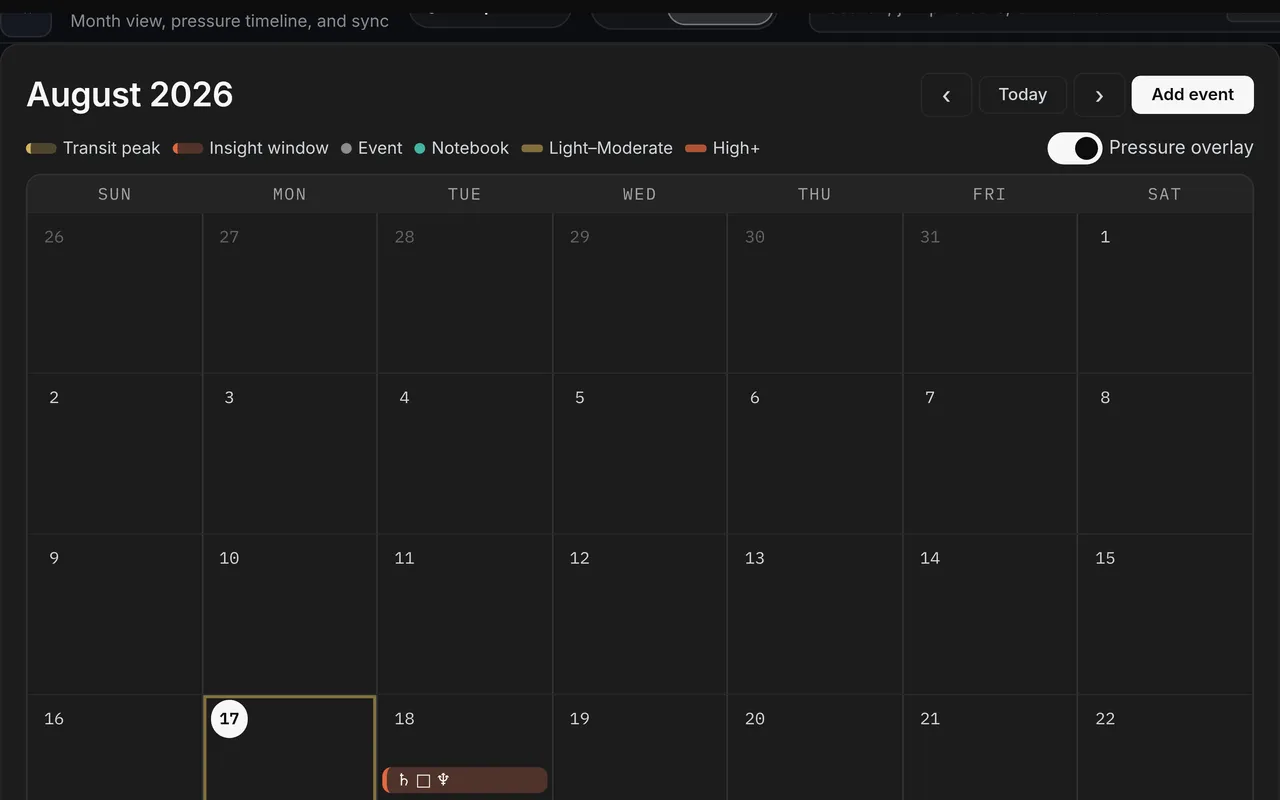
Lunations appear on the calendar as dated markers with the Moon's degree, and the day view shows which of your natal points the Full Moon aspects — with the orb and the exact time in your own timezone.
See what this lunation lands on in your chart
Common questions
- When is the full moon in September 2026?
- 26 Sep 2026, 16:49 UTC — 12:49 EDT in New York, 17:49 BST in London, and 02:49 AEST in Sydney on the 27th. The instant is global; only the clock reading changes.
- What sign is the September 2026 full moon in?
- Aries, at 3.6° Aries, opposite the Sun at 3.6° Libra. It is sometimes called the Harvest Moon, being the full moon closest to the September equinox.
- Is the September 2026 full moon an eclipse?
- No. The Sun–Moon axis is about 36° from the lunar nodes. The season's lunar eclipse was the partial one on 28 Aug 2026 at 4.9° Pisces.
- When is the new moon before and after it?
- Before: 11 Sep 2026, 03:27 UTC at 18.4° Virgo. After: 10 Oct 2026, 15:50 UTC at 17.3° Libra.
- What house does this full moon fall in for me?
- That depends on your birth time and place — a house cannot be found from a birth date alone. Enter full birth details and the app places the Full Moon in your chart and dates its contacts to your natal points.
The words on this page
Every term this layer uses has a definition in the research library — what it means, and what it means for a chart.
Related
See where this Full Moon lands in your chart
Cosmic KPI computes every contact this lunation makes to your natal points — the house, the exact aspects, the time in your zone. No account needed to start.
See what this lunation lands on in your chart →