The Moon right now
Sign, degree, phase and void-of-course status computed at load — and every Moon sign change for the next four months, to the minute.
Aries — the Moon is at 27.7° Aries, full at 96.2% illumination, +14.003° a day at 2026-09-28 10:53 UTC; in Aries since 26 Sep 2026, 10:23 UTC.
Enters Taurus 28 Sep 2026, 14:40 UTC — in about 4 hours.
Yes — the Moon is void of course since its trine to Jupiter at 27 Sep 2026, 19:46 UTC — no further aspect before it enters Taurus.
LAST ASPECT IN ARIES · MOON TRINE JUPITER
peaked 27 Sep 2026, 19:46 UTC
Geometric closeness — not significance
Snapshot at 2026-09-28 10:53 UTC. With JavaScript on, the sign, degree, phase and illumination are recomputed at load (POST /api/objects) and the void-of-course reading against the next committed sign change from one POST /api/scan/windows call.
The Moon is in Aries, at 27.7° Aries, as of 2026-09-28 10:53 UTC — full and 96.2% illuminated, moving +14.003° a day. It entered Aries 26 Sep 2026, 10:23 UTC and enters Taurus 28 Sep 2026, 14:40 UTC, about 4 hours from the snapshot. It is void of course: its last aspect before the sign change, a trine to Jupiter, was exact 27 Sep 2026, 19:46 UTC, and no further Ptolemaic aspect perfects before it leaves Aries. The next last quarter is 3 Oct 2026, 13:25 UTC at 10.3° Cancer. Tropical zodiac, geocentric, UTC; with JavaScript on, every figure here is recomputed when the page loads.
See which of your houses this Moon is crossing
Computed 2026-09-28 10:53 UTC · Skyfield 1.55 + JPL DE440 via POST /api/objects, POST /api/scan and POST /api/scan/windows · tropical zodiac, geocentric, times in UTC. The static figures are recomputed on every deploy; the live block refreshes when the page loads. Times are shown in UTC.
The next four phases
| Phase | Exact (UTC) | Moon at | Note |
|---|---|---|---|
| Last Quarter | 10.3° Cancer | ||
| New Moon | 17.3° Libra | the new moon page → | |
| First Quarter | 25.3° Capricorn | ||
| Full Moon | 2.7° Taurus | the full moon page → |
Moon sign calendar, next 120 days
Each row is the refined instant the Moon crosses a sign boundary; the daily lattice only finds the candidate day. Stays in a sign run from 2.0 to 2.5 days across this table, because the Moon's speed varies with its distance from Earth.
| Enters | When (UTC) |
|---|---|
| Taurus | |
| Gemini | |
| Cancer | |
| Leo | |
| Virgo | |
| Libra | |
| Scorpio | |
| Sagittarius | |
| Capricorn | |
| Aquarius | |
| Pisces | |
| Aries | |
| Taurus | |
| Gemini | |
| Cancer | |
| Leo | |
| Virgo | |
| Libra | |
| Scorpio | |
| Sagittarius | |
| Capricorn | |
| Aquarius | |
| Pisces | |
| Aries | |
| Taurus | |
| Gemini | |
| Cancer | |
| Leo | |
| Virgo | |
| Libra | |
| Scorpio | |
| Sagittarius | |
| Capricorn | |
| Aquarius | |
| Pisces | |
| Aries | |
| Taurus | |
| Gemini | |
| Cancer | |
| Leo | |
| Virgo | |
| Libra | |
| Scorpio | |
| Sagittarius | |
| Capricorn | |
| Aquarius | |
| Pisces | |
| Aries | |
| Taurus | |
| Gemini | |
| Cancer | |
| Leo | |
| Virgo |
What this means for everyone
What the Moon's sign is, measured
The Moon is the fastest body in the sky, covering twelve to fifteen degrees of longitude a day and a whole sign every two to three days. That is why "what sign is the Moon in" is a today question in a way "what sign is Saturn in" is not — and why a printed monthly calendar answers it badly: on any day with a sign change, the day has two answers, and the boundary falls at a particular minute in UTC. The Moon entered Aries at 10:23 UTC on 26 Sep 2026 and leaves for Taurus at 14:40 UTC on 28 Sep 2026; the table below gives every such boundary for the next 120 days.
Phase is an angle
The phase is not a look, it is a number: the elongation, the Moon's longitude minus the Sun's. At 202.45° the Moon is full, and the illuminated fraction follows from the angle alone — half of one minus the cosine — which gives the 96.2% the page prints. A new moon is 0°, the first quarter 90°, a full moon 180°; the names in between are bands of the angle. The next four phases are computed as the instants the elongation reaches those targets, not read off a calendar.
Void of course, as an instant
The Moon is void of course from the moment it makes its last exact Ptolemaic aspect — conjunction, sextile, square, trine or opposition — to one of the nine classical bodies until it enters the next sign. The tradition reads it as a pause in which matters begun tend not to develop as planned, and that is a reading of the interval, not a verdict on anyone's day. Definitions vary between publishers (some count the outer planets, some do not; some add minor aspects), so this page states its own: five aspects, nine bodies, computed against the refined sign change and never against the daily sample, which once put the last aspect eleven hours after the true ingress.
The Moon for everyone
The Moon's sign is the same for everyone on Earth at a given instant, and the tradition reads it as the texture of the day — the mood a sign filters the month's business through, two and a half days at a time. Where the Moon is *in your chart* is a different question with a different answer for every birth: the house it is lighting needs a birth time and place, and its aspects to your natal points need your degrees. That is the line this page hands off at.
What the instrument claims
It computes the sign, the degree, the elongation, the illumination, the next sign change and the void-of-course interval from Skyfield/JPL DE440 positions, and refreshes them when the page loads. It does not forecast the day, and it does not read the twelve signs in turn.
For your chart specifically
The Moon at 27.7° Aries is in the same sign for every chart. Which house that is, and which of your natal points it is aspecting right now, are the chart's questions.
How this appears in Cosmic KPI
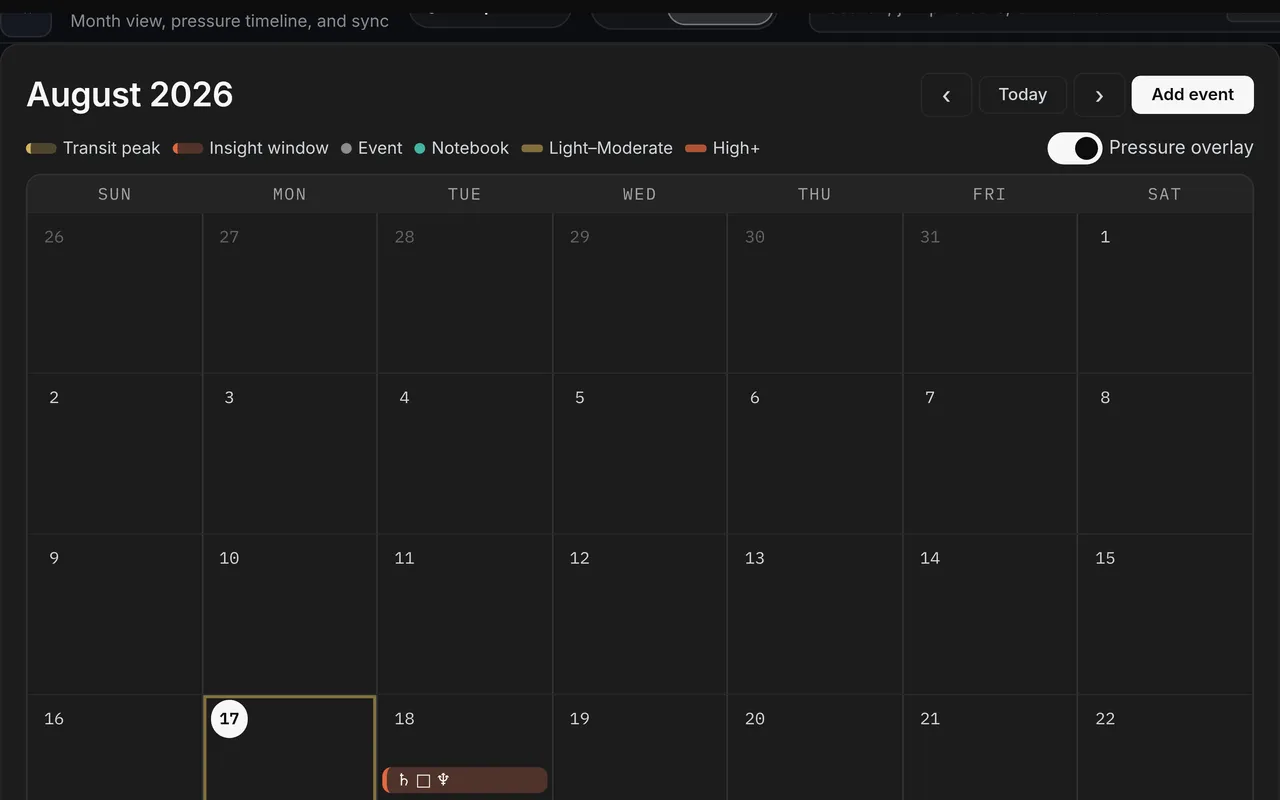
The calendar marks every lunation and eclipse with its degree, and the day view lists the Moon's exact aspects to your natal points with their orbs and times in your own timezone.
See which of your houses this Moon is crossing
Common questions
- What sign is the Moon in today?
- Aries, at 27.7° Aries as of 2026-09-28 10:53 UTC, since 26 Sep 2026, 10:23 UTC. It enters Taurus 28 Sep 2026, 14:40 UTC. The live block recomputes the sign when the page loads.
- What phase is the Moon in today?
- Full, 96.2% illuminated, 202.45° ahead of the Sun. The next last quarter is 3 Oct 2026, 13:25 UTC; the next full moon 26 Oct 2026, 04:11 UTC; the next new moon 10 Oct 2026, 15:50 UTC.
- Is the Moon void of course right now?
- Yes. It is void of course: its last aspect before the sign change, a trine to Jupiter, was exact 27 Sep 2026, 19:46 UTC, and no further Ptolemaic aspect perfects before it leaves Aries.
- When does the Moon change sign next?
- 28 Sep 2026, 14:40 UTC, into Taurus. After that, Gemini on 30 Sep 2026, 17:26 UTC; the full four-month table is above.
- Is this the tropical Moon sign or the sidereal one?
- Tropical, measured from the March equinox. A sidereal or Vedic moon sign (rashi) sits roughly 24° earlier, which for a Moon at 27.7° Aries usually means the previous sign — so two sites can name different signs for the same instant and both be consistent with their own frame.
- What house is the Moon in for me right now?
- That needs your birth time and place, because the houses turn with the Earth. Enter full birth details and the app places the Moon in your chart now and dates its aspects to your natal points.
The words on this page
Every term this layer uses has a definition in the research library — what it means, and what it means for a chart.
Related
See which house the Moon is lighting up in your chart
Cosmic KPI places the Moon in your chart now and dates every lunar aspect to your natal points — visible math, your own chart. No account needed to start.
See which of your houses this Moon is crossing →