
New Moon, March 2027
8 Mar 2027, 09:29 UTC · Sun and Moon at 17.5° Pisces · not an eclipse
The New Moon of March 2027 is exact 8 Mar 2027, 09:29 UTC, Sun and Moon at 17.5° Pisces, not an eclipse. Mercury stationed direct 4.9 days earlier, 3 Mar 2027, 12:35 UTC at 20.9° Aquarius, and clears its post-retrograde shadow 23 Mar 2027. The eclipse season is behind it: the last was the penumbral lunar eclipse of 20 Feb 2027. 8 Mar, 04:29 EST New York, 8 Mar, 09:29 GMT London, 8 Mar, 20:29 AEDT Sydney, one instant.
See what this lunation lands on in your chart
161 days — to exact, counted from 2026-09-28 10:53 UTC; the Moon is full at 96.2% illumination now.
With JavaScript on, this line becomes a live countdown with the Moon's current phase and illumination (POST /api/objects). Without it, the figure is correct as of the snapshot.
Computed 2026-09-28 10:53 UTC · Skyfield 1.55 + JPL DE440 via POST /api/scan (Sun + Moon, hourly) and POST /api/eclipses · tropical zodiac, geocentric, times in UTC. The static figures are recomputed on every deploy; the live block refreshes when the page loads. Times are shown in UTC.
The cycle around it
| Phase | Exact (UTC) | Moon at | Sun at | Note |
|---|---|---|---|---|
| New Moon | 17.6° Aquarius | 17.6° Aquarius | annular solar eclipse | |
| First Quarter | 25.3° Taurus | 25.3° Aquarius | ||
| Full Moon | 2.0° Virgo | 2.0° Pisces | penumbral lunar eclipse | |
| Last Quarter | 9.3° Sagittarius | 9.3° Pisces | ||
| New Moon | 17.5° Pisces | 17.5° Pisces | this page | |
| First Quarter | 24.8° Gemini | 24.8° Pisces | ||
| Full Moon | 1.5° Libra | 1.5° Aries | ||
| Last Quarter | 9.1° Capricorn | 9.1° Aries |
Sun into Aries, 20 Mar 2027, 20:24 UTC (the equinox) — 12 days after this new moon.
What this means for everyone
A quiet lunation, measured
Most month pages on this site earn their argument from what happens around the instant — a station, an ingress, an eclipse. This one earns it from what does not. The Moon catches the Sun at 17.5° Pisces at 09:29 UTC on 8 Mar 2027, 28.3° from the nodes, and the tables around it are empty: 0 ingress and 1 station in range. That is checkable against the ingress and station calendars, and it is a statement about the sky, not about anyone's month. For scale: the year's calendar holds 52 sign changes by the Sun and planets and 16 retrograde stations, one event every 5 days on average — so a stretch of eleven days without either, centred on a lunation, is the exception the tables make visible.
After the eclipses, after the turn
The eclipse season closed with the penumbral lunar eclipse of 20 Feb 2027 at 2.0° Virgo; this is the first new moon since, and it is an ordinary one. Mercury stationed direct 3 Mar 2027, 12:35 UTC at 20.9° Aquarius, 4.9 days before the new moon, and is still re-crossing the degrees it retraced until 23 Mar 2027, 14:50 UTC. The tradition reads a new moon after an eclipse pair and a Mercury station as the month in which the previous six weeks' reversals settle — a seed sown in cleared ground — and it reads that for everyone at once.
Pisces, second decan
Seventeen degrees of mutable water, the last sign, the tradition's register of what dissolves boundaries — a new moon there as the seed of a month spent absorbing rather than deciding. The Sun reaches Aries and the equinox 20 Mar 2027, 20:24 UTC, 13 days later, so this is the last lunation of the astrological year. Mars and Jupiter are still retrograde at the instant.
Where the quiet ends
A quiet sky is still a specific degree. For a chart holding a planet or angle around 17.5° of Gemini, Virgo, Sagittarius or Pisces, this new moon is an exact aspect; a chart with nothing there gets a month whose opening carries no marker at all. Its house is set by the hour and place of birth — which is what the handoff collects.
What the instrument claims
An instant, a degree, and a measured absence — counted from the same tables that fill the other pages. Not a promise that the month is calm.
For your chart specifically
The new moon is at 17.5° Pisces, in a week with nothing else in the tables. Whether that degree meets a natal point of yours is the only thing that makes it more than weather.
How this appears in Cosmic KPI
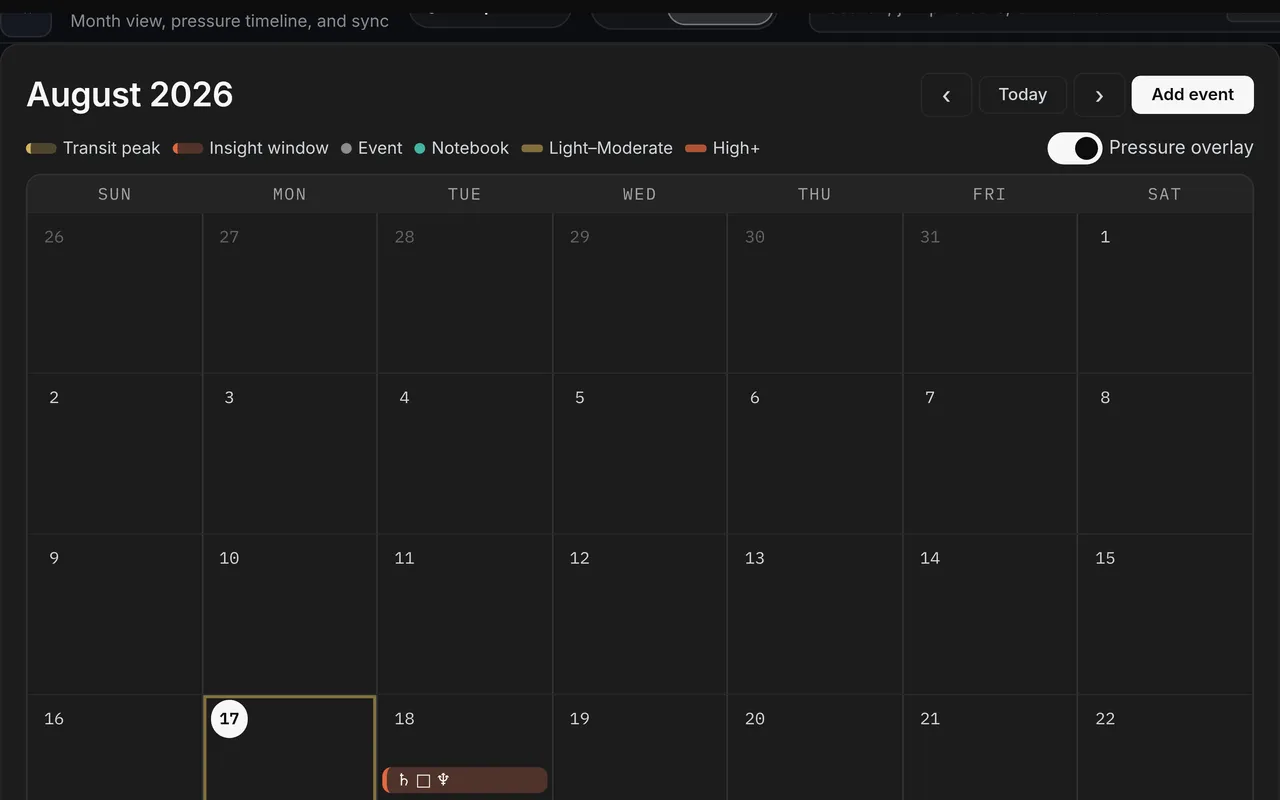
The calendar marks the new moon on its day and shows an otherwise empty week; the day view lists its exact aspects to your points, with the orb and the time in your zone.
See what this lunation lands on in your chart
Common questions
- When is the new moon in March 2027?
- 8 Mar 2027, 09:29 UTC: 8 Mar, 04:29 EST New York, 8 Mar, 09:29 GMT London, 8 Mar, 20:29 AEDT Sydney, one instant.
- What sign is the March 2027 new moon in?
- Pisces — 17.5° Pisces. Tropical; sidereally the conjunction is in Aquarius.
- Is the March 2027 new moon an eclipse?
- No, and the season is over: 28.3° from the nodes, the last eclipse having been 20 Feb 2027. The next is 18 Jul 2027, a penumbral lunar eclipse.
- Is Mercury retrograde at the March 2027 new moon?
- No — it stationed direct 3 Mar 2027, 12:35 UTC at 20.9° Aquarius, though it remains in the post-retrograde shadow until 23 Mar 2027.
- What are the full moons either side of it?
- Before: 20 Feb 2027, 23:23 UTC at 2.0° Virgo (penumbral lunar eclipse). After: 22 Mar 2027, 10:43 UTC at 1.5° Libra. The next new moon is 6 Apr 2027, 23:51 UTC at 16.9° Aries.
- What house does this new moon fall in for me?
- The hour of birth decides it, so the sky-only page has no answer; enter time and place and the app supplies the house and the contacts.
The words on this page
Every term this layer uses has a definition in the research library — what it means, and what it means for a chart.
Related
See where this New Moon lands in your chart
Cosmic KPI computes every contact this lunation makes to your natal points — the house, the exact aspects, the time in your zone. No account needed to start.
See what this lunation lands on in your chart →