Saturn square natal Sun
♄ □ ☉ — transiting Saturn at 90° to the Sun in your birth chart.
Saturn square natal Sun is the period when transiting Saturn sits within 3° of a 90° angle to the Sun's position in your birth chart. It happens twice in each of Saturn's 29.5-year orbits — a median 14.6 years apart — and the in-orb window runs a median 60 days.
Measured shape of this transit
Computed 2026-09-14 · Skyfield 1.55 + JPL DE440 via POST /api/scan · 3° canonical envelope (CANONICAL_PRESSURE_ORB). Recomputed on every deploy.
Is it active for you?
Without JavaScript, or before the calculator loads, the table below is the answer at Sun-sign resolution. Your own window is a slice of your sign's band: the band is when the contact reaches some degree of your sign, your window is when it reaches yours.
| Your Sun sign | Status | Window (3° orb) | Branch | Then |
|---|---|---|---|---|
| Aries | upcoming | 21 Jun 2032 → 13 Jun 2035 (split by a retrograde) | waxing | — |
| Taurus | upcoming | 3 Aug 2034 → 2 Aug 2037 | waxing | — |
| Gemini | upcoming | 19 Sep 2036 → 30 Sep 2039 (split by a retrograde) | waxing | — |
| Cancer | in orb now | 23 Apr 2025 → 6 May 2028 (split by a retrograde) | waning | 18 Nov 2038 |
| Leo | upcoming | 9 Jul 2027 → 7 Mar 2031 (split by a retrograde) | waning | — |
| Virgo | upcoming | 9 May 2030 → 27 Apr 2033 (split by a retrograde) | waning | — |
| Libra | upcoming | 21 Jun 2032 → 13 Jun 2035 (split by a retrograde) | waning | — |
| Scorpio | upcoming | 3 Aug 2034 → 2 Aug 2037 | waning | — |
| Sagittarius | upcoming | 19 Sep 2036 → 30 Sep 2039 (split by a retrograde) | waning | — |
| Capricorn | in orb now | 23 Apr 2025 → 6 May 2028 (split by a retrograde) | waxing | 18 Nov 2038 |
| Aquarius | upcoming | 9 Jul 2027 → 7 Mar 2031 (split by a retrograde) | waxing | — |
| Pisces | upcoming | 9 May 2030 → 27 Apr 2033 (split by a retrograde) | waxing | — |
Each window is the contiguous period in which transiting Saturn is within 3° of square to any degree of that sign. Waxing = Saturn ahead of the Sun's degree; waning = behind.
What the contact means
The geometry, before the meaning
A square is a 90° separation. Because the zodiac's twelve signs run in a fixed order of modality — cardinal, fixed, mutable, repeating — two points 90° apart almost always sit in signs of the same modality and different elements. That is the structural fact underneath everything the tradition says about squares: the two points want the same kind of motion and disagree about the direction of it. Neither is passive, so the tension does not resolve by waiting.
Saturn takes 29.5 years to travel the zodiac once, which means it reaches each of the two square points to your Sun once per orbit. Measured across 1801-01-01–2398-01-01, weekly lattice at 72 sampled natal degrees, consecutive squares land a median 14.6 years apart, and never closer than 13.5 or further than 16.3. That spread is Saturn's orbital eccentricity — it moves faster near perihelion than near aphelion — not measurement noise, and it is why a single "every fifteen years" figure is an average rather than a schedule.
What Saturn contributes
Saturn is the tradition's principle of time, limit and consequence: the planet of what has to be built, maintained, or given up. It is slow, and the slowness is the point. A Saturn contact is not a moment; it is a stretch of months in which the same question keeps being asked, and the answers that survive are the ones that hold up under repetition. Read as a measurement, a Saturn transit is the longest-duration, lowest-frequency signal in the chart — it stays in orb long enough to be compared against a season of a life rather than matched to a single day.
What the Sun contributes
The natal Sun is identity, vitality and conscious will — the thing a chart is organised around and the part of it a person is most likely to defend. It is not a life area; it is the centre from which the life areas are viewed. So a square from Saturn is a contact between the principle of structure and the point of the chart that carries "who I am". The tradition reads that as a demand for the identity to be evidenced rather than asserted, which is a different claim from the identity being under threat.
The two squares are not interchangeable
In the waxing square Saturn is 90° ahead of your Sun: it is the first hard contact after a Saturn–Sun conjunction, and the tradition reads it as a test of something already begun. In the waning square Saturn is 90° behind, on the way back to the conjunction, and the reading is a review of what the previous cycle built. Which of the two is coming for your Sun sign is a geometric fact, so the table above states it rather than leaving you to work it out from an ephemeris.
One hit or three
Whether Saturn perfects this square once or three times depends on where the contact falls relative to Saturn's annual retrograde loop. Over 2854 decidable contacts on the 2020-01-01–2065-01-01, daily lattice, 54% perfect three times — direct, retrograde, direct — and 46% perfect once. Never twice, and that is a property of the orbit rather than a convention: a body that comes in on one side of the contact point goes out on the other, leaving a middle crossing with nothing to pair with. A three-pass square stretches the in-orb window to as much as 193 days against a median of 60. The traditional reading of a three-pass series is that the first crossing raises the matter, the retrograde crossing reworks it, and the third settles it — and the useful part of that reading is that it tells you which three dates to compare, not what will occupy them.
What this page does not claim
The instrument's job here is to bound the window and quantify how busy the sky is inside it. It issues no forecast, and there is no Saturn–Sun angle that entails a particular outcome. What you get is an exactly dated period with its arithmetic on show; the reading of that period stays yours.
How this transit appears in Cosmic KPI
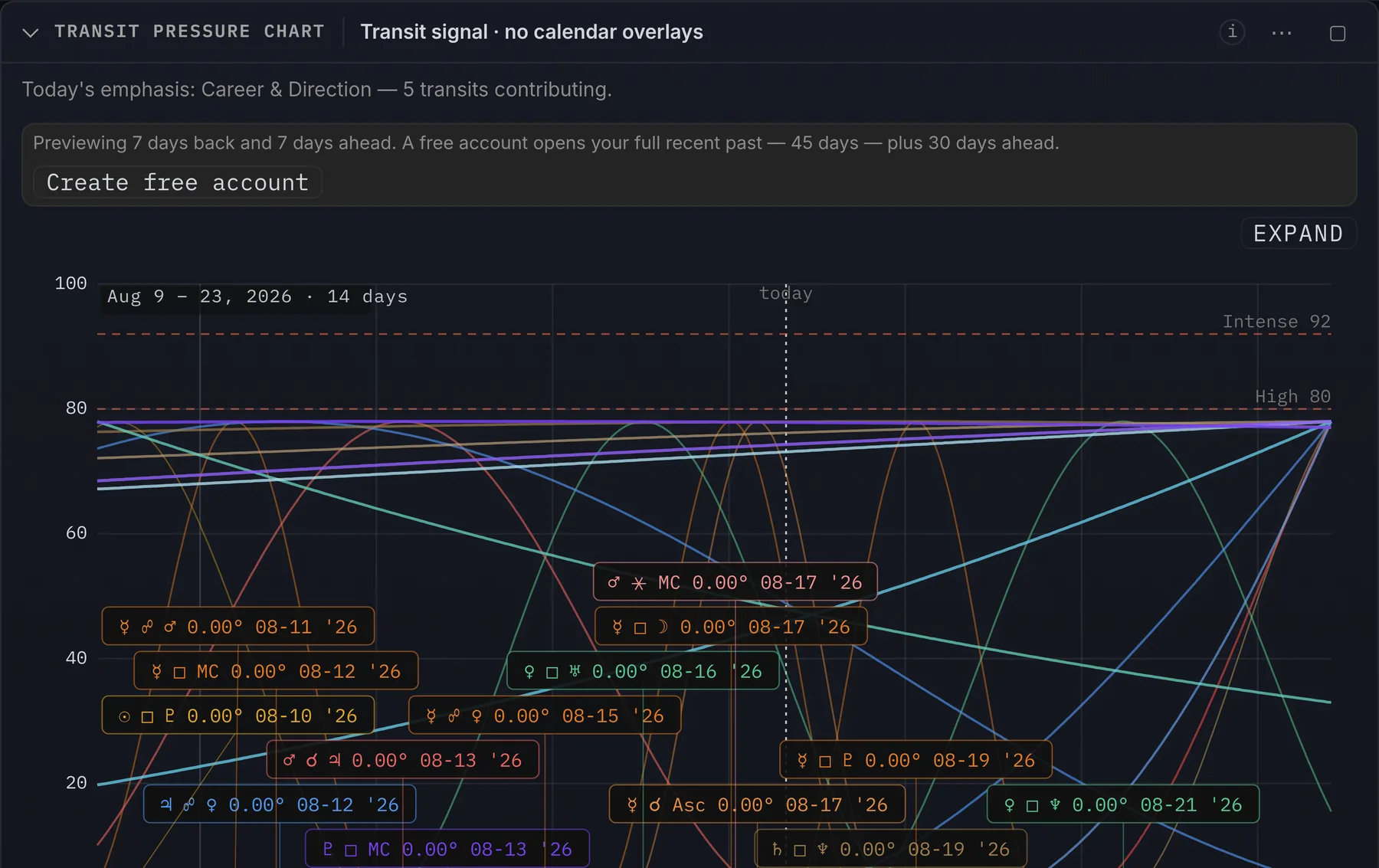
Every window on this page is one contact inside the pressure timeline: Cosmic KPI scores the whole sky against your chart hour by hour, so a Saturn square shows up as a broad raised band with one or three sharp peaks on the exact dates. The transit terminal lists it while it is in orb with the live orb reading; the calendar feed publishes its start, peak and end to your calendar.
The words on this page
Every term this layer uses has a definition in the research library — what it means, and what it means for a chart.
Common questions
- How long does Saturn square Sun last?
- At the 3° envelope Cosmic KPI uses, a median 60 days, with 80% of windows falling between 46 and 167 days. When the square catches Saturn's retrograde loop the same window runs up to 193 days across three exact crossings. Measured over 466 windows on the 2020-01-01–2065-01-01, daily lattice.
- How often does Saturn square my Sun?
- Twice in each 29.5-year Saturn orbit — once waxing, once waning. Consecutive squares are a median 14.6 years apart, ranging 13.5–16.3 years depending on your Sun's degree, because Saturn moves faster near perihelion than near aphelion. Measured over 2852 intervals on the 1801-01-01–2398-01-01, weekly lattice.
- How many times is Saturn square Sun exact?
- Once or three times — 54% of the sampled contacts perfect three times and 46% perfect once. It is never exactly twice: the number of crossings in one visit is always odd — the planet arrives on one side of the contact point and leaves on the other, so the crossings cannot pair off evenly.
- Is Saturn square Sun the same as a Saturn return?
- No. A Saturn return is transiting Saturn returning to its own birth position, near ages 29½, 59 and 88. Saturn square Sun is transiting Saturn at 90° to the Sun's birth position, which can happen at any age and repeats about every fifteen years. Different geometry, different timing, different reading.
- Is Saturn square Sun active for me right now?
- It depends on your Sun's exact degree. As of 2026-09-14 Saturn is at 12.8° Aries, so the square is in orb for the Sun signs marked on the table above; the calculator on this page turns your birth date into your own dates.
See exactly when Saturn is square to your own Sun
Cosmic KPI computes it from your birth details — exact dates, visible math, your own chart. No account needed to start.
Enter your birth details →