Saturn conjunct natal Sun
♄ ☌ ☉ — transiting Saturn on the exact degree of your natal Sun.
Saturn conjunct natal Sun is the period when transiting Saturn sits within 3° of the Sun's exact degree in your birth chart. It happens once per Saturn orbit — a median 29.1 years apart — and the in-orb window runs a median 60 days.
Measured shape of this transit
Computed 2026-09-14 · Skyfield 1.55 + JPL DE440 via POST /api/scan · 3° canonical envelope (CANONICAL_PRESSURE_ORB). Recomputed on every deploy.
Is it active for you?
Without JavaScript, or before the calculator loads, the table below is the answer at Sun-sign resolution. Your own window is a slice of your sign's band: the band is when the contact reaches some degree of your sign, your window is when it reaches yours.
| Your Sun sign | Status | Window (3° orb) | Branch | Then |
|---|---|---|---|---|
| Aries | in orb now | 23 Apr 2025 → 6 May 2028 (split by a retrograde) | waning | 27 Feb 2055 |
| Taurus | upcoming | 9 Jul 2027 → 7 Mar 2031 (split by a retrograde) | waning | — |
| Gemini | upcoming | 9 May 2030 → 27 Apr 2033 (split by a retrograde) | waxing | — |
| Cancer | upcoming | 21 Jun 2032 → 13 Jun 2035 (split by a retrograde) | waxing | — |
| Leo | upcoming | 3 Aug 2034 → 2 Aug 2037 | waxing | — |
| Virgo | upcoming | 19 Sep 2036 → 30 Sep 2039 (split by a retrograde) | waning | — |
| Libra | upcoming | 18 Nov 2038 → 4 Sep 2042 (split by a retrograde) | waxing | — |
| Scorpio | upcoming | 18 Oct 2041 → 26 Nov 2044 | waning | — |
| Sagittarius | upcoming | 6 Jan 2044 → 23 Nov 2047 (split by a retrograde) | waxing | — |
| Capricorn | upcoming | 29 Dec 2046 → 5 Nov 2050 (split by a retrograde) | waning | — |
| Aquarius | upcoming | 15 Apr 2049 → 6 Feb 2053 (split by a retrograde) | waxing | — |
| Pisces | upcoming | 17 Mar 2052 → 18 Dec 2055 (split by a retrograde) | waning | — |
Each window is the contiguous period in which transiting Saturn is within 3° of conjunction to any degree of that sign. Waxing = Saturn ahead of the Sun's degree; waning = behind.
What the contact means
Once per orbit, not twice
This is the arithmetic that separates a conjunction from a square, and it is easy to miss. A body is 90° from a natal point at two places in its orbit, so squares arrive twice per circuit; it occupies the point itself at only one. Saturn therefore conjoins your Sun a median 29.1 years apart — measured over 1390 intervals on 1801-01-01–2398-01-01, weekly lattice — where its squares to the same degree come round twice as often. Most people get two or three of these in a life, which is few enough that each one is remembered and few enough that comparing them is worth doing.
What a conjunction is
Zero degrees of separation. Every other aspect describes two points regarding each other from a distance; at 0° the distance is gone and the tradition reads the pair as fused. That is the reason conjunctions are classically read as the START of a cycle rather than as an episode inside one — Saturn arriving on the Sun's degree begins the twenty-nine-year relationship whose squares and opposition are the later chapters. If you want to know what the next Saturn square to your Sun is testing, this contact is where the tradition says the thing being tested was set up.
What Saturn is
Time, limit, and consequence: the principle of what must be built to last, maintained, or given up. Saturn's slowness is not incidental to that reading, it is the mechanism of it. A median of 60 days in orb — with a p90 of 167 and a longest observed passage of 193 — means the same question is present long enough to be answered badly once and then answered again. Fast transits do not have that property, which is why the tradition assigns Saturn the work of consolidation rather than of incident.
What the Sun is
Identity, vitality, conscious will — the centre a chart is organised around rather than one of the areas it organises. Because a conjunction has no distance in it, the classical reading of Saturn on the Sun is not that something external is pressing on the self, but that the principle of structure is temporarily operating from the self's own position. The tradition takes that as a demand for the identity to be evidenced rather than asserted — a claim about what is being asked, not a claim about what will happen.
One crossing or three
Whether Saturn perfects this once or three times depends on where the contact falls against its yearly retrograde loop. Over 1427 decidable contacts, 767 ran direct–retrograde–direct and 660 crossed once. Never twice: the count in a single visit is always odd — an approach that goes in one side has to come out the other, so the crossings arrange themselves around a middle one with no partner. A three-crossing conjunction stretches the window from 60 days towards 193, and the useful part of knowing which you are getting is that it tells you how many dates there are to compare.
Where the page stops
Cosmic KPI dates the window and measures how concentrated the rest of the sky is inside it. It does not forecast, and no Saturn–Sun configuration corresponds to a specific outcome. The dating and the visible arithmetic are the product; the reading is yours.
How this transit appears in Cosmic KPI
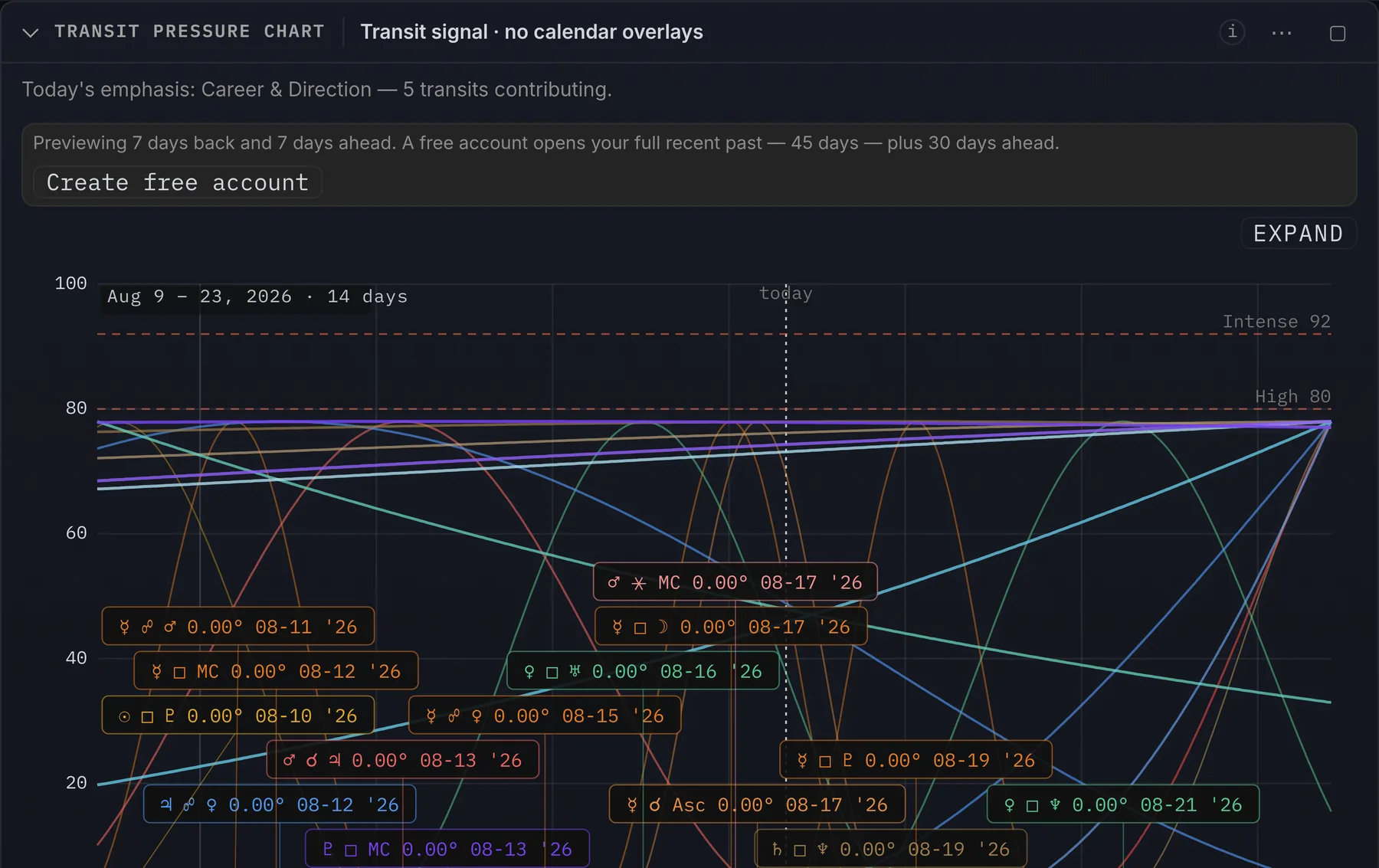
On the pressure timeline a Saturn conjunction is a broad raised band with one or three sharp peaks inside it, and because the same geometry recurs every twenty-nine years, the journal makes the previous one available as evidence rather than memory. That comparison is the closest thing this instrument offers to a check on a reading.
The words on this page
Every term this layer uses has a definition in the research library — what it means, and what it means for a chart.
Common questions
- How often is Saturn conjunct my Sun?
- Once per Saturn orbit — a median 29.1 years, ranging 29.1 to 29.9 across 1390 measured intervals. That is half as often as its squares to the same degree, because a body passes a point once per circuit but squares it twice.
- How long does Saturn conjunct Sun last?
- A median 60 days inside the 3° envelope, 80% of windows between 46 and 167 days, and up to 193 when a retrograde loop stretches it across three crossings. Measured over 233 windows.
- Is Saturn conjunct Sun the same as a Saturn return?
- No, and they are easy to confuse because both come round every 29.5 years or so. A Saturn return is Saturn back on its OWN birth position, which lands near ages 29½, 59 and 88 for everyone. Saturn conjunct Sun is Saturn on the SUN's birth position, which can land at any age depending on how far apart those two degrees are in your chart.
- Which Sun signs is Saturn conjunct now?
- Saturn is at 12.8° Aries as of 2026-09-14, so only Suns within three degrees of that are in orb. The table on this page gives the current or next window for every Sun sign.
Saturn to other natal points
See exactly when Saturn is conjunction to your own Sun
Cosmic KPI computes it from your birth details — exact dates, visible math, your own chart. No account needed to start.
Enter your birth details →