Saturn conjunct natal Moon
♄ ☌ ☽ — transiting Saturn on the exact degree of your natal Moon.
Saturn conjunct natal Moon is the period when transiting Saturn sits within 3° of the Moon's degree in your birth chart. It arrives once per Saturn orbit, a median 29.1 years apart, and holds the 3° envelope a median 60 days.
Measured shape of this transit
Computed 2026-09-14 · Skyfield 1.55 + JPL DE440 via POST /api/scan · 3° canonical envelope (CANONICAL_PRESSURE_ORB). Recomputed on every deploy.
Is it active for you?
Without JavaScript, or before the calculator loads, the table below is the answer at Moon-sign resolution. Your own window is a slice of your sign's band: the band is when the contact reaches some degree of your sign, your window is when it reaches yours.
| Your Moon sign | Status | Window (3° orb) | Branch | Then |
|---|---|---|---|---|
| Aries | in orb now | 23 Apr 2025 → 6 May 2028 (split by a retrograde) | waning | 27 Feb 2055 |
| Taurus | upcoming | 9 Jul 2027 → 7 Mar 2031 (split by a retrograde) | waning | — |
| Gemini | upcoming | 9 May 2030 → 27 Apr 2033 (split by a retrograde) | waxing | — |
| Cancer | upcoming | 21 Jun 2032 → 13 Jun 2035 (split by a retrograde) | waxing | — |
| Leo | upcoming | 3 Aug 2034 → 2 Aug 2037 | waxing | — |
| Virgo | upcoming | 19 Sep 2036 → 30 Sep 2039 (split by a retrograde) | waning | — |
| Libra | upcoming | 18 Nov 2038 → 4 Sep 2042 (split by a retrograde) | waxing | — |
| Scorpio | upcoming | 18 Oct 2041 → 26 Nov 2044 | waning | — |
| Sagittarius | upcoming | 6 Jan 2044 → 23 Nov 2047 (split by a retrograde) | waxing | — |
| Capricorn | upcoming | 29 Dec 2046 → 5 Nov 2050 (split by a retrograde) | waning | — |
| Aquarius | upcoming | 15 Apr 2049 → 6 Feb 2053 (split by a retrograde) | waxing | — |
| Pisces | upcoming | 17 Mar 2052 → 18 Dec 2055 (split by a retrograde) | waning | — |
Each window is the contiguous period in which transiting Saturn is within 3° of conjunction to any degree of that sign. Waxing = Saturn ahead of the Moon's degree; waning = behind.
What the contact means
Two or three times in a life
Saturn returns to a given degree a median 29.1 years apart — 1390 intervals measured on 1801-01-01–2398-01-01, weekly lattice, ranging 29.1 to 29.9. A conjunction happens once per circuit rather than twice, so a normal lifespan holds two or three of these and no more. That is a rare property among transits: frequent enough that a previous one is usually available to look back at, rare enough that each stands apart. Most of what a chart does is either too fast to remember or too slow to repeat; this sits in between, which is the range where a record earns its keep.
Fusion at a point, not a relationship across one
A conjunction has no angular separation. The tradition does not read the two bodies as interacting at 0° — it reads them as merged, with the transiting principle operating from the natal point's own position for as long as the orb holds. That is also why conjunctions mark the opening of a cycle rather than a stage within one: the squares and opposition that follow over the next twenty-nine years are, in the classical reading, chapters of whatever this contact began.
Structure meeting instinct
The natal Moon is the reflexive layer: needs, memory, the felt sense of safety, everything the body settles before the conscious will is consulted. Saturn is time, limit and consequence — the demand that something be built to last or be let go. The tradition reads their conjunction as those two meeting without a buffer, and it is careful to describe it as a demand rather than a verdict. What the geometry marks is that the instinctive layer is where the question of structure is being put; it does not say what the answer is.
A birth time changes this one materially
The Moon covers roughly 13° a day. Without a birth time it can only be placed to within half a sign, and against Saturn's twelve degrees a year that uncertainty is worth more than a year of window. The cohort table on this page is reliable at sign resolution, and the calculator computes from a birth date at noon UTC — accurate for the slow bodies, approximate for the Moon, and it says so rather than presenting a placeholder as a fact. Full birth details in the app give the degree-exact answer.
The shape of the passage
Of 1427 decidable contacts, 660 perfected once and 767 perfected three times — direct, retrograde, direct — depending on where the contact fell relative to Saturn's yearly loop. Two crossings is impossible; the count in a visit is always odd. A three-crossing passage stretches the in-orb window from 60 days towards 193, so which of the two you are getting is the difference between a couple of months and most of a year.
The claim this page makes, and the one it does not
It computes when the contact is in orb, when it perfects, and how busy the surrounding sky is. It does not forecast events, and no Saturn–Moon configuration entails one.
How this transit appears in Cosmic KPI
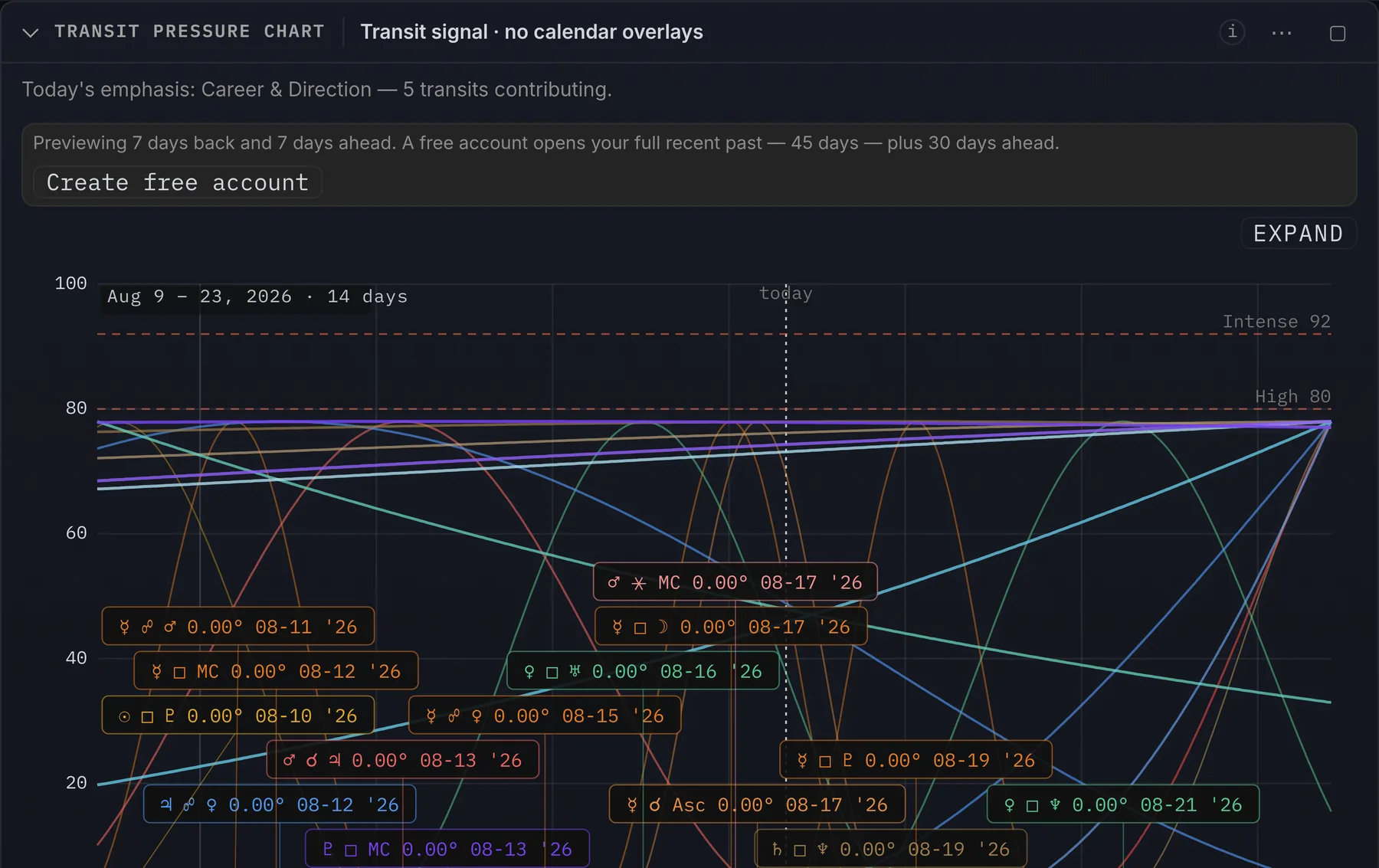
The Moon is the point the daily briefing reads most closely, so this contact appears at two scales at once: a months-long raised band on the pressure timeline, and the ordinary lunar weather running across it. Logging through the window is what turns the next one, twenty-nine years out, into something checkable.
The words on this page
Every term this layer uses has a definition in the research library — what it means, and what it means for a chart.
Common questions
- How long does Saturn conjunct Moon last?
- A median 60 days in the 3° envelope, with 80% of windows between 46 and 167 days and a longest observed passage of 193. Measured over 233 windows on 2020-01-01–2065-01-01, daily lattice.
- How often does Saturn conjunct the Moon?
- Once per Saturn orbit — median 29.1 years, range 29.1–29.9 across 1390 intervals. Two or three times in a normal lifespan.
- Do I need a birth time for this?
- For an exact window, yes. The Moon moves about 13° a day, so a date alone places it to within half a sign — enough to move a Saturn contact by more than a year. The sign-level table here is sound; the degree-level answer needs a time.
- How many times is it exact?
- Once or three times — 660 and 767 of 1427 decidable contacts respectively. Never twice. As of 2026-09-14 Saturn is at 12.8° Aries.
See exactly when Saturn is conjunction to your own Moon
Cosmic KPI computes it from your birth details — exact dates, visible math, your own chart. No account needed to start.
Enter your birth details →