Pluto conjunct natal Moon
♇ ☌ ☽ — transiting Pluto on the exact degree of your natal Moon.
Pluto conjunct natal Moon is the period when transiting Pluto sits within 3° of the Moon's degree in your birth chart. For a fixed degree it arrives about once in 245 years, and the window runs a median 192 days — the slowest body in the chart parked on its fastest point.
Measured shape of this transit
Computed 2026-09-14 · Skyfield 1.55 + JPL DE440 via POST /api/scan · 3° canonical envelope (CANONICAL_PRESSURE_ORB). Recomputed on every deploy.
Is it active for you?
Without JavaScript, or before the calculator loads, the table below is the answer at Moon-sign resolution. Your own window is a slice of your sign's band: the band is when the contact reaches some degree of your sign, your window is when it reaches yours.
| Your Moon sign | Status | Window (3° orb) | Branch | Then |
|---|---|---|---|---|
| Aries | upcoming | 24 Apr 2064 → 1 Sep 2064 | waning | — |
| Taurus | beyond 2065 | 2092–2132 (year resolution) | waxing | — |
| Gemini | beyond 2065 | 2123–2162 (year resolution) | waning | — |
| Cancer | beyond 2065 | 2154–2187 (year resolution) | waning | — |
| Leo | beyond 2065 | 2181–2205 (year resolution) | waning | — |
| Virgo | beyond 2065 | 2201–2220 (year resolution) | waxing | — |
| Libra | beyond 2065 | 2216–2232 (year resolution) | waning | — |
| Scorpio | beyond 2065 | 2228–2243 (year resolution) | waning | — |
| Sagittarius | beyond 2065 | 2240–2256 (year resolution) | waxing | — |
| Capricorn | beyond 2065 | 2253–2272 (year resolution) | waxing | — |
| Aquarius | in orb now | 3 Feb 2022 → 31 Jan 2046 (split by a retrograde) | waxing | — |
| Pisces | upcoming | 4 May 2040 → 1 Jan 2065 (split by a retrograde) | waning | — |
Each window is the contiguous period in which transiting Pluto is within 3° of conjunction to any degree of that sign. Waxing = Pluto ahead of the Moon's degree; waning = behind.
What the contact means
The widest speed gap in the chart
The Moon crosses a degree of zodiac in under two hours. Pluto can take a year over the same degree. Nothing else in a chart puts those two extremes on the same point, and it is worth stating plainly because it explains the character of the contact better than any keyword: the part of you that changes fastest is receiving the part of the sky that changes slowest. The numbers make it concrete — a median 192 days in orb, a p90 of 1152 and a longest observed passage of 1411 days, against a natal point whose own transits are measured in hours.
What the natal Moon is
Not moods in the casual sense. The Moon is the tradition's instinctive layer: needs, memory, the reflexive sense of what is safe, and the body's response before the conscious will has weighed in. It is the part of a chart that operates without being consulted. Where the Sun is what a person means to be, the Moon is what they already are when nothing is being decided.
What a conjunction does to it
At 0° there is no separation and nothing mediating. The tradition reads a conjunction as fusion rather than relationship — the transiting body operates from inside the natal point's own position for the duration. Applied to the Moon, that is why the classical reading of this contact is about the instinctive layer rather than about circumstances: Pluto's principle of depth and non-negotiability is not arriving from elsewhere in the chart, it is occupying the place the reflexes come from.
Once, if at all
Measured across 95 intervals on 1801-01-01–2398-01-01, weekly lattice, consecutive Pluto conjunctions to a fixed degree are a median 245 years apart. A lifetime covers thirty to fifty degrees of Pluto's travel, so this is a contact most charts never receive and none receives twice. The cohort table is the whole answer to whether yours is in range — and unlike the Sun, a Moon sign is not something a birthday tells you, so the calculator is doing real work here.
A caveat about birth time, stated rather than buried
The Moon moves about 13° a day. Without a birth time its degree is uncertain by up to half a sign, which for a contact this slow shifts the window by years rather than days. The calculator on this page computes from a birth date at noon UTC and says so; if you know your birth time, entering full details at the start of the app is the difference between a sign-level answer and a degree-level one. That distinction matters more on this page than on any other in the set.
The shape, and what the page will not say
Across 144 decidable contacts the split was 51 at three crossings and 93 at five, with nothing at one. Cosmic KPI puts dates on those crossings and measures the sky around them; it issues no prediction, and nothing in this geometry answers to a particular event.
How this transit appears in Cosmic KPI
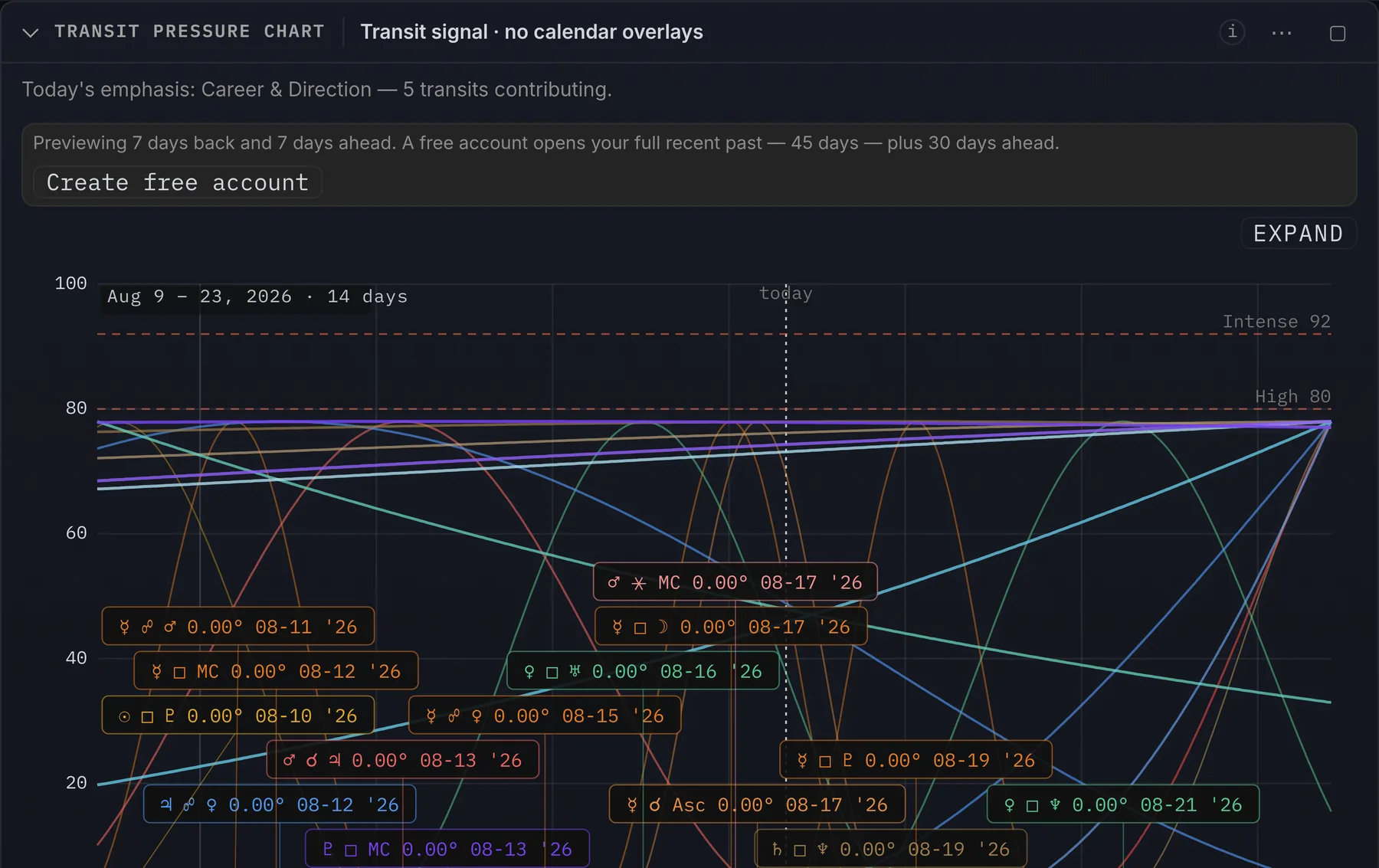
The Moon is also the point the daily briefing tracks most closely, so a slow contact to it shows up twice in the product: as a multi-year raised floor on the pressure timeline, and in the day-level readings the Moon drives. Seeing both at once is the argument for an instrument over a date.
The words on this page
Every term this layer uses has a definition in the research library — what it means, and what it means for a chart.
Common questions
- How long does Pluto conjunct Moon last?
- A median 192 days at the 3° envelope, with the slowest tenth past 1152 days and a longest observed passage of 1411. Measured over 54 windows on 2020-01-01–2065-01-01, daily lattice.
- How often does Pluto conjunct the Moon?
- About once in 245 years for a fixed degree — median 245 across 95 intervals. Since a lifetime covers only a fraction of Pluto's circuit, most charts never receive it.
- Do I need my birth time for this transit?
- For a degree-exact answer, yes. The Moon covers about 13° a day, so a birth date alone places it to within half a sign, and against a body as slow as Pluto that uncertainty translates into years. The sign-level table on this page is reliable; the exact window needs a time.
- Which Moon signs is Pluto conjunct now?
- As of 2026-09-14 Pluto is at 3.3° Aquarius, so only Moons within three degrees of that are in orb. The table flags which sign that is and gives the next window for every other.
See exactly when Pluto is conjunction to your own Moon
Cosmic KPI computes it from your birth details — exact dates, visible math, your own chart. No account needed to start.
Enter your birth details →