Neptune square natal Mercury
♆ □ ☿ — transiting Neptune at 90° to Mercury in your birth chart.
Neptune square natal Mercury is the period when transiting Neptune sits within 3° of a 90° angle to the degree Mercury held at your birth. It comes twice per Neptune circuit — a median 81.6 years apart — and holds the envelope a median 186 days, with the slowest tenth running past 775.
Measured shape of this transit
Computed 2026-09-14 · Skyfield 1.55 + JPL DE440 via POST /api/scan · 3° canonical envelope (CANONICAL_PRESSURE_ORB). Recomputed on every deploy.
Is it active for you?
Without JavaScript, or before the calculator loads, the table below is the answer at Mercury-sign resolution. Your own window is a slice of your sign's band: the band is when the contact reaches some degree of your sign, your window is when it reaches yours.
| Your Mercury sign | Status | Window (3° orb) | Branch | Then |
|---|---|---|---|---|
| Aries | upcoming | 16 Aug 2063 → 1 Jan 2065 (split by a retrograde) | waxing | — |
| Taurus | beyond 2065 | 2077–2094 (year resolution) | waxing | — |
| Gemini | in orb now | 1 Jan 2020 → 23 Feb 2027 (split by a retrograde) | waning | — |
| Cancer | in orb now | 11 May 2023 → 15 Apr 2040 (split by a retrograde) | waning | — |
| Leo | upcoming | 29 Apr 2037 → 2 Apr 2054 (split by a retrograde) | waning | — |
| Virgo | upcoming | 19 Jun 2050 → 1 Jan 2065 (split by a retrograde) | waning | — |
| Libra | upcoming | 16 Aug 2063 → 1 Jan 2065 (split by a retrograde) | waning | — |
| Scorpio | beyond 2065 | 2077–2094 (year resolution) | waning | — |
| Sagittarius | in orb now | 1 Jan 2020 → 23 Feb 2027 (split by a retrograde) | waxing | — |
| Capricorn | in orb now | 11 May 2023 → 15 Apr 2040 (split by a retrograde) | waxing | — |
| Aquarius | upcoming | 29 Apr 2037 → 2 Apr 2054 (split by a retrograde) | waxing | — |
| Pisces | upcoming | 19 Jun 2050 → 1 Jan 2065 (split by a retrograde) | waxing | — |
Each window is the contiguous period in which transiting Neptune is within 3° of square to any degree of that sign. Waxing = Neptune ahead of the Mercury's degree; waning = behind.
What the contact means
A contact that has no single date
Neptune covers about two degrees of zodiac a year. Six degrees of orb passage therefore takes years rather than weeks: a median 186 days, a p90 of 775, and a longest observed passage of 776 days across 140 windows on 2020-01-01–2065-01-01, daily lattice. There is no day on which this happens. There is a stretch of a year or two during which it is true, and the exact crossings inside it are landmarks rather than the event. That is worth stating up front because the genre convention of giving a transit "a date" is more misleading here than almost anywhere else.
Three crossings or five, never one
Of 490 decidable contacts, 370 perfected three times and 120 perfected five. A single-crossing Neptune square did not occur in the sample. The reason is a ratio rather than a coincidence: Neptune's annual retrograde retraces nearly three degrees while the planet only advances about two in a year, so anything it has just crossed gets crossed again. The count is always odd — the body enters and leaves the contact point from opposite sides — so an even number would be a detection fault, not a result.
What Mercury marks
Mercury in a birth chart is the faculty of articulation: perception, language, the way a person sorts what they take in and hands it on. It is the most instrumental point in a chart — not what someone is, but what they think with. That distinction is why a contact here reads differently from one to the Sun or the Moon: the pressure is not on the identity or the instincts, it is on the apparatus both of those use to describe themselves.
What Neptune contributes
Neptune is the tradition's principle of dissolution: the softening of edges, the loss of a boundary that had been doing work. Where Saturn defines and Pluto removes, Neptune blurs. Read against Mercury, the classical account is of the articulating faculty operating without its usual outlines — described in the older literature as confusion and in the newer as imagination, and the honest position is that the geometry does not choose between those. It marks a period in which the boundary is less firm. What that is worth depends on what the boundary was doing.
Why a square rather than the softer angles
Ninety degrees puts two points in the same modality and different elements — the same kind of push, aimed differently, with neither one passive. The tradition reads that as tension requiring discharge through action rather than tension that resolves on its own. Applied to a dissolving principle, the specific difficulty the literature names is that there is nothing concrete to push against: the square's demand for action meets a contact whose character is the absence of firm edges. Which is a description of a shape, not a forecast.
Twice per circuit, a lifetime apart
A median 81.6 years between successive squares, measured over 454 intervals on 1801-01-01–2398-01-01, weekly lattice with a narrow 80.6–83.4 spread — Neptune's orbit is the most circular of the outer planets, so unlike Pluto it keeps close to its average. Longer than a lifetime, which means you get one of these or none.
How this transit appears in Cosmic KPI
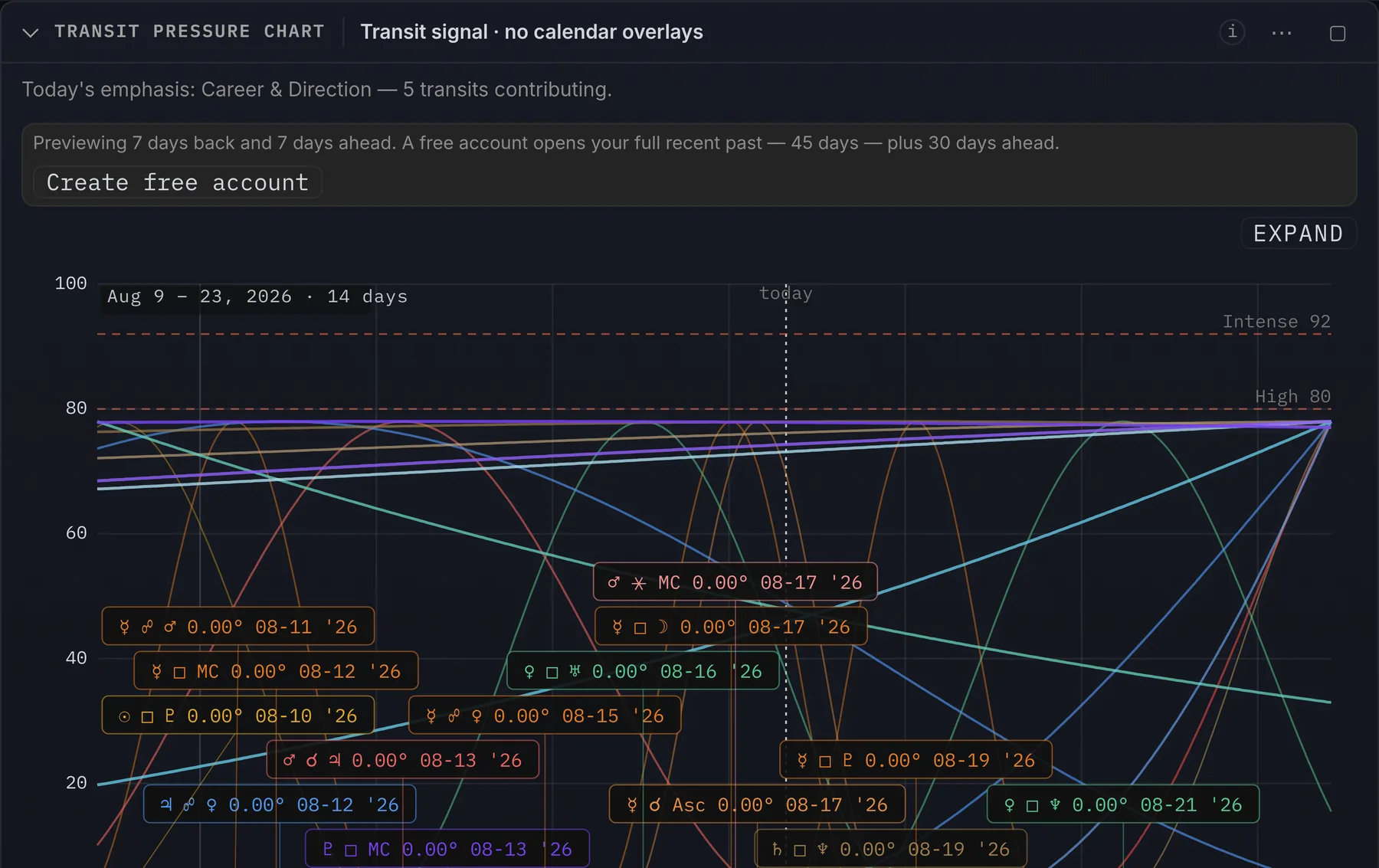
A two-year contact is invisible as an event and obvious as a curve. On the pressure timeline Neptune shows as a raised floor rather than a peak, with the crossings marked on top of it; the terminal reports the live orb so the approach is visible long before any exact date. This is the case the instrument exists for.
The words on this page
Every term this layer uses has a definition in the research library — what it means, and what it means for a chart.
Common questions
- How long does Neptune square Mercury last?
- A median 186 days inside the 3° envelope, 74–775 for 80% of windows, and a longest observed passage of 776 days — over two years. Measured over 140 windows.
- How many times is Neptune square Mercury exact?
- Three or five, never once — 370 and 120 of 490 decidable contacts. Neptune retraces more ground in a retrograde loop than it covers in a year of forward motion, so it always re-crosses what it has just passed.
- How often does Neptune square my Mercury?
- Twice per Neptune circuit, a median 81.6 years apart across 454 measured intervals. That is longer than a lifetime, so a chart receives one of the two or neither.
- Which Mercury signs is Neptune squaring now?
- Neptune is at 3.3° Aries as of 2026-09-14, and squares land on a pair of opposite signs at once. Mercury is never more than 28° from the Sun, so its sign is usually your Sun sign or one adjacent — the calculator computes the exact degree.
Neptune to other natal points
More contacts for this planet are being added tranche by tranche.
See exactly when Neptune is square to your own Mercury
Cosmic KPI computes it from your birth details — exact dates, visible math, your own chart. No account needed to start.
Enter your birth details →