Mars conjunct natal Ascendant
♂ ☌ Asc — transiting Mars on the degree that was rising when you were born.
Mars conjunct natal Ascendant is the period when transiting Mars sits within 3° of the degree rising at your birth. It is the fastest and most frequent contact in this set — a median 1.9 years apart, and only 8 days in orb.
Measured shape of this transit
Computed 2026-09-14 · Skyfield 1.55 + JPL DE440 via POST /api/scan · 3° canonical envelope (CANONICAL_PRESSURE_ORB). Recomputed on every deploy.
Is it active for you?
Your Ascendant depends on your birth time and place, not just the date, so there is no shortcut here: pick your Ascendant sign in the table below for the band, and enter full birth details to get the degree-exact window.
Without JavaScript, or before the calculator loads, the table below is the answer at Ascendant-sign resolution. Your own window is a slice of your sign's band: the band is when the contact reaches some degree of your sign, your window is when it reaches yours.
| Your Ascendant sign | Status | Window (3° orb) | Branch | Then |
|---|---|---|---|---|
| Aries | upcoming | 16 Mar 2028 → 1 May 2028 | waning | — |
| Taurus | upcoming | 24 Apr 2028 → 11 Jun 2028 | waning | — |
| Gemini | upcoming | 4 Jun 2028 → 25 Jul 2028 | waxing | — |
| Cancer | in orb now | 7 Aug 2026 → 3 Oct 2026 | waxing | 17 Jul 2028 |
| Leo | upcoming | 24 Sep 2026 → 22 May 2027 (split by a retrograde) | waxing | — |
| Virgo | upcoming | 19 Nov 2026 → 20 Jul 2027 (split by a retrograde) | waning | — |
| Libra | upcoming | 10 Jul 2027 → 6 Sep 2027 | waning | — |
| Scorpio | upcoming | 29 Aug 2027 → 20 Oct 2027 | waning | — |
| Sagittarius | upcoming | 12 Oct 2027 → 29 Nov 2027 | waning | — |
| Capricorn | upcoming | 22 Nov 2027 → 7 Jan 2028 | waning | — |
| Aquarius | upcoming | 31 Dec 2027 → 14 Feb 2028 | waxing | — |
| Pisces | upcoming | 7 Feb 2028 → 23 Mar 2028 | waxing | — |
Each window is the contiguous period in which transiting Mars is within 3° of conjunction to any degree of that sign. Waxing = Mars ahead of the Ascendant's degree; waning = behind.
What the contact means
A different order of magnitude
Every other page in this set describes something measured in months or years. This one is measured in days: a median 8 in orb, with 80% of windows between 7 and 12 days, across 1862 windows on 2020-01-01–2065-01-01, daily lattice. And where a Pluto contact arrives once in a lifetime, this one arrives a median 1.9 years apart — 1672 intervals measured — which is forty or more times in a life. The reading tradition treats fast contacts as colouring a period rather than defining one, and the arithmetic is the reason: a week-long window recurring every two years cannot be doing the same job as a three-year window that never repeats.
Nearly always one crossing
1645 of 1717 decidable contacts perfected exactly once; only 72 perfected three times. That is the mirror image of the outer planets, and the mechanism is speed — Mars covers around 180 degrees a year going forward and retrogrades only once every two years, so it is almost always long gone before a loop could catch it. When Mars does station near your Ascendant the window stretches from 8 days towards 64, which is the rare version of this contact and worth noticing when it happens.
The Ascendant is not a planet
It is the degree of the zodiac rising on the eastern horizon at the moment and place of birth. That makes it a property of the chart's frame rather than a body in the sky: it does not travel, it cannot transit anything, and it exists only because a specific time and place were specified. The tradition reads it as the interface — manner, bearing, the immediate way a person meets what is in front of them — which is a different register from the Sun's identity or the Moon's instinct.
Why there is no calculator on this page
Because the Ascendant moves about one degree every four minutes. A birth time that is an hour out puts it fifteen degrees away; a birth date with no time at all does not locate it even to the sign. Every other page in this set offers a birth-date box because the bodies it deals with move slowly enough for a date to be sufficient. Here it is not, and offering the box anyway would return a number that looked authoritative and was arbitrary. The table above works from your rising sign, which you either know or can get from a chart with a real birth time — and the full birth details the app asks for are exactly what this calculation needs.
Mars at the interface
Mars is the tradition's principle of assertion: initiative, friction, the willingness to push. Conjunct the Ascendant it is read as arriving at the point of contact between a person and everything outside them — assertion at the interface rather than in some interior department. Because the contact is brief and frequent, this is one of the few transits where a reader can honestly test a reading against their own record: forty occurrences in a life is enough to notice a pattern or to notice that there isn't one.
How this transit appears in Cosmic KPI
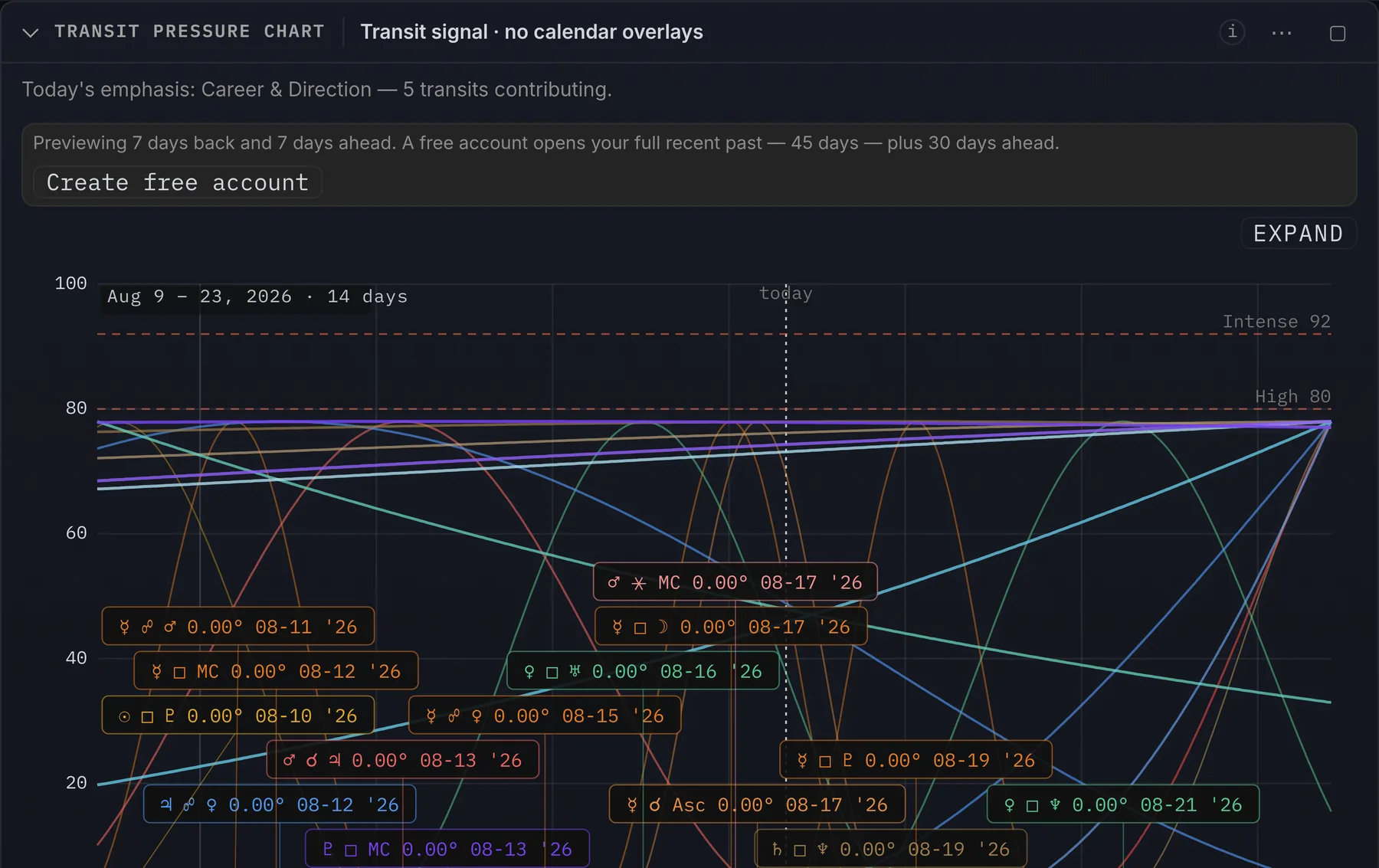
A week-long contact is the kind the daily briefing surfaces rather than the timeline: it shows as a narrow spike on the pressure curve, and the terminal lists it while it is in orb with the live reading. Its real value in the product is comparative — because it recurs every couple of years, the journal accumulates enough occurrences to say something about your own chart rather than about the tradition.
The words on this page
Every term this layer uses has a definition in the research library — what it means, and what it means for a chart.
Common questions
- How often is Mars conjunct my Ascendant?
- A median 1.9 years — 1672 intervals measured on 2020-01-01–2065-01-01, daily lattice. The short-end values in that range come from retrograde loops producing a second passage soon after the first.
- How long does Mars conjunct Ascendant last?
- A median 8 days at the 3° envelope, with 80% of windows between 7 and 12 days. When Mars stations near the degree it can stretch to 64 days, but that is the exception.
- Why does this page not have a birth-date calculator?
- Because the Ascendant depends on birth time and place, not just the date — it moves a degree every four minutes, so a date alone cannot place it even to the nearest sign. The other pages in this set compute from a date because the bodies they cover move slowly enough for that to be honest. Here it would not be.
- How many times is Mars conjunct Ascendant exact?
- Once, 96% of the time — 1645 of 1717 decidable contacts. The remaining 72 perfect three times, when a Mars retrograde happens to fall on the degree. Two crossings is impossible; the count is always odd.
Mars to other natal points
More contacts for this planet are being added tranche by tranche.
See exactly when Mars is conjunction to your own Ascendant
Cosmic KPI computes it from your birth details — exact dates, visible math, your own chart. No account needed to start.
Enter your birth details →