Uranus Opposition Calculator
The one Uranus opposition of your life, dated from your birth date. No account, and no birth time needed.
The Uranus opposition is the period when transiting Uranus reaches the degree opposite the one it held at your birth — the halfway mark of an orbit that takes 84.0 years, which is why it happens once in a life and why no second one is coming. Across the birth years in the table below it lands between ages 39.7 and 44.1, median 43.1. This calculator computes your own dates from your birth date using Swiss Ephemeris positions.
See your Uranus opposition beside every other cycle in your chart
Computed 2026-09-02 · Swiss Ephemeris 2.10.03 (pyswisseph) via POST /api/scan · 3° canonical envelope (CANONICAL_PRESSURE_ORB). The calculator above runs live against the same engine. Recomputed on every deploy.
What the result means structurally
One opposition, and usually three dates. Uranus crosses the opposite degree, stations retrograde and backs over it, then turns direct and crosses a third time, so the contact is a span of about a year rather than an instant — and for 91% of the birth years below that is exactly what happens. The calculator labels each pass and gives the in-orb window around all of them.
What the dates mean
Why the age is a range and not a number
Almost everything published about this contact puts it at 42, and 42 is simply half of 84.0. The arithmetic is right and the answer is not, because Uranus does not travel the zodiac at a constant rate. Its orbit is an ellipse, so it covers ground faster near perihelion than near aphelion, and the time to cross the half of the zodiac that starts at your natal degree depends on which half that is. Measured across the birth years in the table below, the opposition arrives anywhere from 39.7 to 44.1 — a spread of 4.4 years around a median of 43.1, and someone told "42" could be four years early or two years late.
That spread is not noise in the measurement. Two people born a decade apart genuinely have their oppositions at different ages, and the difference is large enough to matter to anyone trying to place the window in their own life. It is the same reason the Saturn return is not exactly 29 for everybody, one order of magnitude larger.
Three dates, and why this contact almost always has them
Uranus advances about 4.3° in an average year, and during its annual retrograde loop it retraces very nearly the same distance. Those two numbers being so close is the whole story: a degree Uranus passed in the months before it stationed is usually still inside the arc it is about to back over. So the opposition perfects three times for 91% of the birth years computed here — a direct crossing, a retrograde crossing, and a second direct one — typically spread across about a year.
Saturn behaves differently for the same structural reason. Its retrograde arc is a little over half its annual travel, so its loop catches a given degree far less often, and 33% of Saturn returns have three crossings against this page's 91%. The pattern is not a quirk of one planet: it is the ratio between how far a body backs up and how far it gets in a year, and it is computable for any of them.
An even count is impossible, and that is worth saying plainly because it is what makes the number trustworthy. To cross a degree a second time a planet has to have turned around, and having turned around it has to turn back before it can leave — so the crossings come in ones and threes. Where the searched range was too narrow to watch Uranus depart on both sides, the row below reports the crossings it found and says the total is unproven, rather than presenting a partial count as a complete one.
What the window is, as against the exact dates
The exact crossing is an instant, and three of them are three instants. What people usually mean by "my Uranus opposition" is the period around them, and that is what the in-orb column dates: the contiguous stretch in which transiting Uranus is within 3° of the opposite point, from the approach before the first crossing to the departure after the last. Measured across the rows below, a three-pass opposition holds that window for a median of 402 days and a one-pass opposition for 106 — the difference is the retrograde loop keeping the planet in the neighbourhood for most of a year.
3° is the envelope this whole site computes with, not a number chosen for this page: it is the same one behind the transit readings and the pressure model, so a window quoted here and a window quoted there mean the same thing. A tighter orb would give a shorter window and the same three crossing dates, because an exact crossing is exact at any orb.
What this page does not tell you
It dates the contact. It does not read it. The Life Cycles guide covers what the traditional reading of a Uranus opposition is, and Cosmic KPI itself measures the sky inside the window rather than describing it in advance — which contacts are exact when, how concentrated the rest of the chart is around them, and what was actually happening the last time the same geometry came round. A date is the beginning of that, not the end.
Uranus opposition by birth year (computed)
Birth date 1 July of each year, 12:00 UTC. Your own dates will differ by up to a few months depending on your birth date within the year — the calculator above computes them exactly.
| Born | Natal Uranus | Exact crossings | Passes | In orb (3°) | Age |
|---|---|---|---|---|---|
| 1960 | 18.8° Leo | 14 Mar 2000 · 11 Aug 2000 · 5 Jan 2001 | 3 | 21 Jan 2000 → 27 Feb 2001 | 39.7 |
| 1961 | 23.3° Leo | 28 Mar 2001 · 3 Aug 2001 · 18 Jan 2002 | 3 | 1 Feb 2001 → 12 Mar 2002 | 39.7 |
| 1962 | 27.8° Leo | 13 Apr 2002 · 25 Jul 2002 · 31 Jan 2003 | 3 | 14 Feb 2002 → 26 Mar 2003 | 39.8 |
| 1963 | 2.3° Virgo | 4 May 2003 · 12 Jul 2003 · 14 Feb 2004 | 3 | 28 Feb 2003 → 10 Apr 2004 | 39.8 |
| 1964 | 6.9° Virgo | 28 Feb 2005 · 31 Oct 2005 · 1 Dec 2005 | 3 | 2 Jan 2005 → 15 Feb 2006 | 40.7 |
| 1965 | 11.5° Virgo | 15 Mar 2006 · 8 Oct 2006 · 31 Dec 2006 | 3 | 21 Jan 2006 → 3 Mar 2007 | 40.7 |
| 1966 | 16.1° Virgo | 31 Mar 2007 · 24 Sep 2007 · 21 Jan 2008 | 3 | 7 Feb 2007 → 17 Mar 2008 | 40.7 |
| 1967 | 20.7° Virgo | 17 Apr 2008 · 10 Sep 2008 · 7 Feb 2009 | 3 | 23 Feb 2008 → 2 Apr 2009 | 40.8 |
| 1968 | 25.4° Virgo | 7 May 2009 · 27 Aug 2009 · 25 Feb 2010 | 3 | 11 Mar 2009 → 20 Apr 2010 | 40.8 |
| 1969 | 0.1° Libra | 1 Jun 2010 · 9 Aug 2010 · 14 Mar 2011 | 3 | 28 Mar 2010 → 9 May 2011 | 40.9 |
| 1970 | 4.8° Libra | 30 Mar 2012 · 21 Nov 2012 · 4 Jan 2013 | 3 | 2 Feb 2012 → 17 Mar 2013 | 41.7 |
| 1971 | 9.5° Libra | 16 Apr 2013 · 29 Oct 2013 · 2 Feb 2014 | 3 | 21 Feb 2013 → 3 Apr 2014 | 41.8 |
| 1972 | 14.2° Libra | 4 May 2014 · 14 Oct 2014 · 24 Feb 2015 | 3 | 12 Mar 2014 → 20 Apr 2015 | 41.8 |
| 1973 | 18.9° Libra | 23 May 2015 · 1 Oct 2015 · 13 Mar 2016 | 3 | 29 Mar 2015 → 6 May 2016 | 41.9 |
| 1974 | 23.6° Libra | 13 Jun 2016 · 15 Sep 2016 · 31 Mar 2017 | 3 | 14 Apr 2016 → 24 May 2017 | 42 |
| 1975 | 28.3° Libra | 14 Jul 2017 · 22 Aug 2017 · 16 Apr 2018 | 3 | 1 May 2017 → 13 Jun 2018 | 42 |
| 1976 | 3.0° Scorpio | 2 May 2019 · 10 Dec 2019 · 11 Feb 2020 | 3 | 9 Mar 2019 → 17 Apr 2020 | 42.8 |
| 1977 | 7.7° Scorpio | 17 May 2020 · 23 Nov 2020 · 5 Mar 2021 | 3 | 25 Mar 2020 → 2 May 2021 | 42.9 |
| 1978 | 12.4° Scorpio | 2 Jun 2021 · 12 Nov 2021 · 23 Mar 2022 | 3 | 10 Apr 2021 → 17 May 2022 | 42.9 |
| 1979 | 17.1° Scorpio | 18 Jun 2022 · 2 Nov 2022 · 8 Apr 2023 | 3 | 25 Apr 2022 → 31 May 2023 | 43 |
| 1980 | 21.8° Scorpio | 4 Jul 2023 · 25 Oct 2023 · 21 Apr 2024 | 3 | 9 May 2023 → 13 Jun 2024 | 43 |
| 1981 | 26.5° Scorpio | 21 Jul 2024 · 14 Oct 2024 · 4 May 2025 | 3 | 21 May 2024 → 27 Jun 2025 | 43.1 |
| 1982 | 1.1° Sagittarius | 11 Aug 2025 · 2 Oct 2025 · 16 May 2026 | 3 | 3 Jun 2025 → 10 Jul 2026 | 43.1 |
| 1983 | 5.8° Sagittarius | 28 May 2027 | 1 | 2 Apr 2027 → 24 Jul 2027 | 43.9 |
| 1984 | 10.4° Sagittarius | 6 Jun 2028 · 25 Jan 2029 · 10 Mar 2029 | 3 | 13 Apr 2028 → 20 May 2029 | 43.9 |
| 1985 | 15.0° Sagittarius | 16 Jun 2029 · 17 Jan 2030 · 27 Mar 2030 | 3 | 25 Apr 2029 → 29 May 2030 | 44 |
| 1986 | 19.5° Sagittarius | 25 Jun 2030 · 14 Jan 2031 · 8 Apr 2031 | 3 | 4 May 2030 → 7 Jun 2031 | 44 |
| 1987 | 24.1° Sagittarius | 3 Jul 2031 · 13 Jan 2032 · 16 Apr 2032 | 3 | 13 May 2031 → 13 Jun 2032 | 44 |
| 1988 | 28.5° Sagittarius | 8 Jul 2032 · 15 Jan 2033 · 23 Apr 2033 | 3 | 18 May 2032 → 19 Jun 2033 | 44 |
| 1989 | 3.0° Capricorn | 14 Jul 2033 · 18 Jan 2034 · 28 Apr 2034 | 3 | 24 May 2033 → 24 Jun 2034 | 44 |
| 1990 | 7.5° Capricorn | 18 Jul 2034 · 23 Jan 2035 · 3 May 2035 | 3 | 29 May 2034 → 28 Jun 2035 | 44 |
| 1991 | 11.9° Capricorn | 22 Jul 2035 · 30 Jan 2036 · 4 May 2036 | 3 | 2 Jun 2035 → 1 Jul 2036 | 44.1 |
| 1992 | 16.2° Capricorn | 23 Jul 2036 · 8 Feb 2037 · 4 May 2037 | 3 | 3 Jun 2036 → 2 Jul 2037 | 44.1 |
| 1993 | 20.6° Capricorn | 25 Jul 2037 · 19 Feb 2038 · 3 May 2038 | 3 | 4 Jun 2037 → 3 Jul 2038 | 44.1 |
| 1994 | 24.9° Capricorn | 25 Jul 2038 · 6 Mar 2039 · 28 Apr 2039 | 3 | 5 Jun 2038 → 4 Jul 2039 | 44.1 |
| 1995 | 29.2° Capricorn | 25 Jul 2039 | 1 found, total unproven | 4 Jun 2039 → 18 Sep 2039 | 44.1 |
| 1996 | 3.5° Aquarius | 23 Jul 2040 | 1 | 30 May 2040 → 13 Sep 2040 | 44.1 |
| 1997 | 7.7° Aquarius | 17 Oct 2040 · 8 Dec 2040 · 21 Jul 2041 | 3 | 13 Aug 2040 → 10 Sep 2041 | 43.3 |
| 1998 | 11.9° Aquarius | 7 Oct 2041 · 29 Dec 2041 · 18 Jul 2042 | 3 | 11 Aug 2041 → 6 Sep 2042 | 43.3 |
| 1999 | 16.1° Aquarius | 29 Sep 2042 · 17 Jan 2043 · 15 Jul 2043 | 3 | 8 Aug 2042 → 2 Sep 2043 | 43.2 |
| 2000 | 20.2° Aquarius | 22 Sep 2043 · 5 Feb 2044 · 8 Jul 2044 | 3 | 3 Aug 2043 → 27 Aug 2044 | 43.2 |
| 2001 | 24.4° Aquarius | 15 Sep 2044 · 22 Feb 2045 · 2 Jul 2045 | 3 | 29 Jul 2044 → 22 Aug 2045 | 43.2 |
| 2002 | 28.5° Aquarius | 9 Sep 2045 · 15 Mar 2046 · 22 Jun 2046 | 3 | 23 Jul 2045 → 17 Aug 2046 | 43.2 |
| 2003 | 2.5° Pisces | 3 Sep 2046 · 11 Apr 2047 · 6 Jun 2047 | 3 | 16 Jul 2046 → 11 Aug 2047 | 43.2 |
| 2004 | 6.6° Pisces | 27 Aug 2047 | 1 | 6 Jul 2047 → 18 Oct 2047 | 43.2 |
| 2005 | 10.6° Pisces | 13 Nov 2047 · 19 Jan 2048 · 20 Aug 2048 | 3 | 14 Sep 2047 → 8 Oct 2048 | 42.4 |
How this appears in Cosmic KPI
Cosmic KPI plots the Uranus opposition alongside every other cycle in the chart — Saturn and Jupiter returns, the opening and closing squares, nodal and Chiron eras — on one timeline, with the exact crossings dated and the surrounding pressure measured rather than described. This calculator is one row of that page, unlocked.
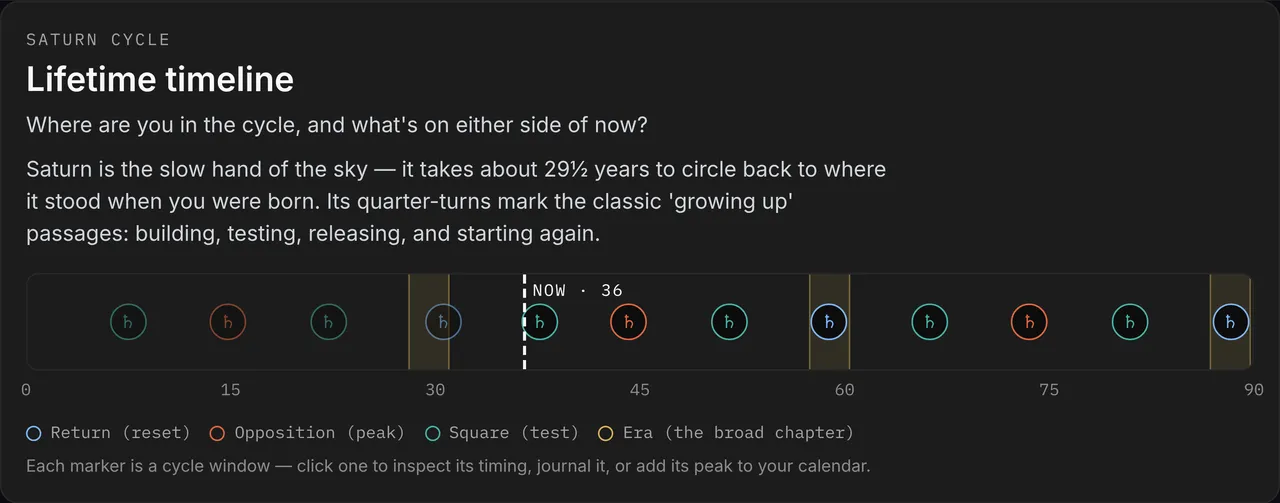
See your Uranus opposition beside every other cycle in your chart
Common questions
- When is my Uranus opposition?
- Enter your birth date above and the calculator returns the exact crossing dates and the in-orb span. Across birth years 1960–2005 it lands between ages 39.7 and 44.1, median 43.1. The spread is real: Uranus's orbit is eccentric, so half a circuit takes longer from some starting degrees than others.
- What age is the Uranus opposition?
- The commonly quoted answer is 42, which is half of Uranus's 84.0-year orbit. Measured rather than divided, it lands between 39.7 and 44.1 with a median of 43.1 across the birth years in the table below. Your own age depends on where in the zodiac your natal Uranus sits.
- Do I need my birth time for the Uranus opposition?
- No. Uranus moves at most 3.8 arcminutes a day, so an unknown birth time shifts the crossing dates by minutes. Birth time matters for the Ascendant, the Midheaven and the Moon — not for Uranus. Positions here are computed for 12:00 UTC on your birth date.
- Why does my Uranus opposition have three dates?
- Because Uranus stationed retrograde after the first crossing, backed over the opposite degree, then turned direct and crossed a third time. That happens for 91% of the birth years computed here, because Uranus retraces almost a full year's travel while retrograde. A contact perfects an odd number of times, so three is the alternative to one and there is no version with two.
- Is the Uranus opposition the same as a midlife crisis?
- They are not the same kind of claim. The opposition is a dated geometric fact: transiting Uranus reaching the point opposite its birth position, once, in a measurable window. What the tradition reads into that window is covered in the Life Cycles guide. Cosmic KPI dates the window and measures the sky inside it; it does not tell you what the period is for.
This is one cycle. See all of yours.
Cosmic KPI computes every cycle in your chart from your birth details — exact dates, visible math, your own chart. No account needed to start.
Enter your birth details →